

Chinese Ambassador: "U.S.-triggered Tariff War Rather an Opportunity for China's Self-Reliant Development"
Summary
- Dai Bing, Chinese Ambassador to South Korea, said the tariff, trade, and technology wars triggered by the United States served as an opportunity for China's self-reliant development and expanded openness.
- The United States and China agreed to a one-year suspension of retaliatory tariffs and mutual measures including suspension of export controls, withdrawal of retaliatory actions, and tariff reductions, aiming to stabilize U.S.-China relations.
- Ambassador Dai said Korea and China are a community of shared interests, and urged strengthening strategic communication and cooperation in emerging industries to promote long-term development.
"Xi Jinping visited Korea to hold a U.S.-China meeting and contribute to the security of bilateral relations"
"Korea and China are a community of shared interests…should pursue stable, long-term development"
Dai Bing, Chinese Ambassador to South Korea, claimed on the 11th that "the tariff, trade, and technology wars triggered by the United States have not weakened China but rather provided an opportunity for China's self-reliant development and expanded openness."
Ambassador Dai said at a forum hosted jointly by the Global Strategy Cooperation Research Institute and the China Global Governance Research Institute at the President Hotel in Jung-gu that "President Xi Jinping visited South Korea to attend the APEC summit in Gyeongju and contributed to the security of U.S.-China relations."
"Stability in U.S.-China relations is good for Korea"
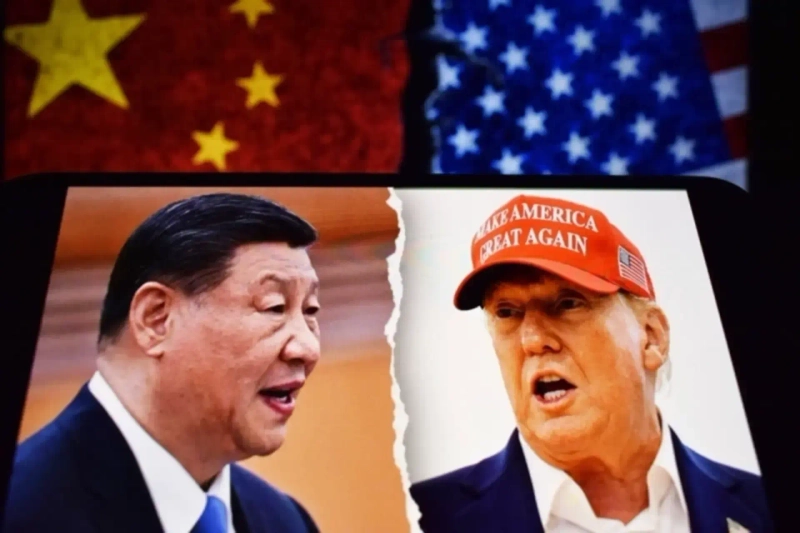
The United States and China agreed to suspend the imposition of mutual retaliatory tariffs for one year starting at 00:01 on the 10th (local time). This measure follows the agreement reached at the summit between U.S. President Donald Trump and Chinese President Xi Jinping in Busan on the 30th of last month.
China promised measures including a suspension of export controls on rare earths and other minerals in full, withdrawal of retaliatory actions against U.S. semiconductor companies, expanded imports of U.S. agricultural products such as soybeans, and suspension of tariffs on U.S. agricultural products. In response, the United States agreed to reduce the 20% fentanyl tariff it had imposed on China to 10%.
Ambassador Dai emphasized that "the Busan meeting between President Xi and U.S. President Donald Trump attracted global attention," adding, "I hope the United States will act as a responsible major power together with China, align words with actions, and faithfully implement the agreements between the two leaders so that U.S.-China relations can develop in a healthy, stable, and sustainable direction."
He also stressed that "the more stable U.S.-China relations are, the better it will be for Korea." Earlier, in line with the U.S.-China summit agreement the previous day, China's Ministry of Commerce announced it would suspend sanctions for one year on five Hanwha Group shipbuilding and shipping subsidiaries symbolic of the 'MASGA (MASGA·Make American Shipbuilding Great Again)' project (Hanwha Philippine Shipyard·Hanwha Shipping·Hanwha Ocean USA International·Hanwha Shipping Holdings·HS USA Holdings).
"Korea and China should pursue a 'great power–great power alliance'"
Regarding Korea-China relations, Ambassador Dai assessed that "under the strategic leadership of President Lee Jae-myung and President Xi, a 'new phase' has been reached." He added, "Going forward, the two countries should thoroughly implement agreements between the leaders, uphold what is just, and strive to ensure that Korea-China relations develop in a stable and long-term manner."
Ambassador Dai said, "Korea and China are important neighbors that cannot be separated and inseparable cooperative partners," and urged that "they should strengthen strategic communication, recognize each other objectively, and deepen mutual trust." He also argued that "Korea and China are already a de facto community of shared interests" and "should strengthen cooperation in traditional fields and pursue a 'great power–great power alliance' in emerging industries."
Noh Jae-heon, South Korea's ambassador to China, said in an online congratulatory speech that "since establishing diplomatic relations in 1992, the two countries have achieved remarkable development in all fields over 33 years," and that "the achievements the two countries have made together will go beyond simple cooperation and serve as a basis for jointly responding to global changes and for sustainable development."
Reporter Bae Seong-su baebae@hankyung.com

Korea Economic Daily
hankyung@bloomingbit.ioThe Korea Economic Daily Global is a digital media where latest news on Korean companies, industries, and financial markets.