

"Can't trust the domestic market" Storm buying of U.S. stocks worth 150 trillion won… 'Seohak Gaemi' that shook the exchange rate
Summary
- This year individual investors' exchange and investment in overseas stocks and dollars reached KRW 157 trillion, a record high.
- Despite the high exchange rate, domestic investors' avoidance of won assets and investment in the U.S. market continue to increase.
- Experts warn that this expansion of overseas investment could raise upward pressure on the exchange rate and lead to structural capital outflows.
Entrenched high exchange rate
Retail investors shaking the foreign exchange market
150 trillion won moved to the U.S. market… 'Seohak Gaemi' that shook the exchange rate
Increasing overseas investment despite a KOSPI boom
This year's dollar exchange amount 'record high'
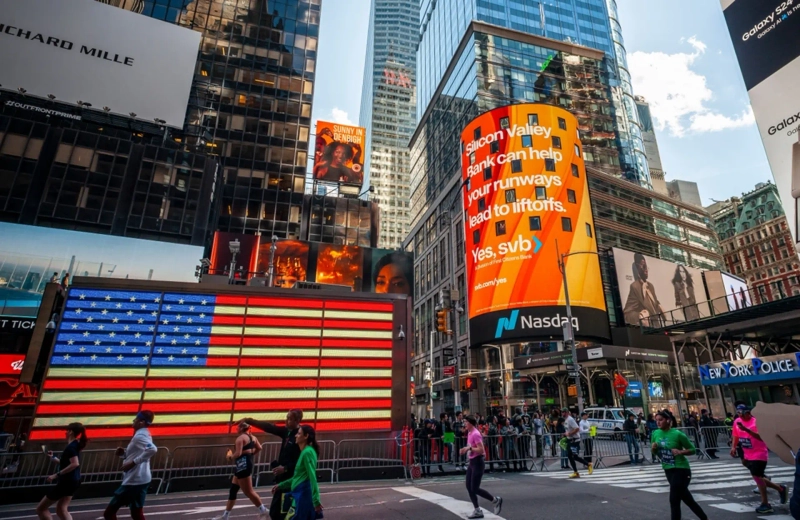
This year the won-dollar exchange rate has been on a high run, but retail investors have exchanged the largest amount ever to buy overseas stocks and bonds. Experts say that unless capital markets are revitalized to raise the expected returns of the domestic stock market, it will be difficult to stop the outflow of dollars.
According to data received by The Korea Economic Daily on the 18th from the Financial Supervisory Service through Rep. Park Sang-hyuk of the Democratic Party, the amount exchanged at the counters of nine major securities firms — Mirae Asset, Korea Investment, NH, KB, Samsung, Kiwoom, Shinhan, Toss, KakaoPay — for the purpose of buying overseas stocks by individual investors totaled KRW 157.6123 trillion through the 15th of last month. This is the largest ever, surpassing last year's exchange amount (KRW 136 trillion). Compared with 2023 (KRW 97 trillion), it increased by 61%.
Through August this year, this exceeds the increase in the National Pension Service's overseas equity and bond investment (KRW 61.4270 trillion) and the domestic foreign exchange products market's average daily trading volume in September (KRW 125.7255 trillion). According to the Korea Securities Depository, the balance of domestic investors' overseas investments is KRW 333.6557 trillion, up 43% from the end of last year. Of this, 81% is investment in U.S. stocks and bonds.
Demand for currency trading aiming for foreign exchange gains has also surged. The daily average outstanding balance of dollar repurchase agreements (RP), a representative foreign exchange trading and standby cash investment vehicle, this month was USD 21.15714 billion (about KRW 31.0079 trillion), up 14.5% from last year (USD 18.47276 billion).
Experts analyze that individual investors' 'investment emigration' is accelerating and a high exchange rate is becoming the new normal. They point out that avoidance of won-denominated assets is fueling exchange rate anxiety. Even though the KOSPI showed the highest rise among major countries this year, individual investors have sold more than KRW 13 trillion of domestic stocks in the second half alone. Bank of America recently noted in a report that "won weakness is not a simple cycle but a structural capital outflow phenomenon."
Avoidance of the 'weakest' won assets… Seohak Gaemi say, despite higher exchange rates, "Let's buy more U.S. stocks"
Distrust in the domestic market behind the fall in the won's value… capital outflow caused by 'investment emigration'
Hong (31), an office worker who has been buying KRW 500,000 worth of Nvidia and Tesla every month since early last year, recently increased his purchase amount by KRW 200,000 despite the high exchange rate. He said, "Seeing the won's value melt away convinced me to buy U.S. stocks for the long term," and added, "Even though domestic stocks are on the rise, because they are based on the won, doesn't their long-term investment appeal decline?"
Retail investors investing in overseas stocks are shaking the foreign exchange market. While buying typically slows under a high exchange rate environment like this, recently net buying strength for overseas stocks has actually increased. Analysts say this is due to a combination of avoidance of won assets, distrust of the domestic market, and the steep rise in real estate prices.
High exchange rates spur overseas investment
On the 18th, the Korea Securities Depository reported that domestic investors' net purchases of overseas stocks last month amounted to USD 6.813 billion (about KRW 10.0082 trillion), the largest monthly amount on record. Last month the KOSPI surged past 4,000 for the first time, but Seohak Gaemi increased their overseas investment while selling domestic stocks. They have sold more than KRW 13 trillion since the domestic market began its full-scale rise in the second half.
As avoidance of won assets that have become the 'weakest' grows, investors are expanding investments in overseas stocks. The won-dollar exchange rate rose so sharply this month that it threatened the 1,500-won level. In a global dollar-weak phase, the won's value has fallen further. According to the Hyundai Research Institute, from September 16 to October 11 the dollar index rose 3.1% while the won-dollar exchange rate surged 6.1%. Compared with the changes in the yen-dollar (4.6%), dollar-euro (-1.7%), and yuan-dollar (0.1%) during the same period, the decline in the won's value stood out.
Choi Kwang-hyuk, head of LS Securities' Research Center, said, "The mentality to hedge won assets by buying U.S. stocks, gold, etc., continues," adding, "Investors strongly believe that U.S. stocks will be more solid in the long term amid the AI boom."
Experts warn that if the Seohak Gaemi craze continues, a high exchange rate could become everyday. They say that if Seohak Gaemi, who pushed up the exchange rate, increase overseas investment to avoid won assets, it could create a vicious cycle that further drives up the exchange rate. Moon Da-un, a researcher at Korea Investment & Securities, pointed out, "The outflow speed of individual investors' dollar assets needs to slow for exchange rate stability to be expected."
Korea bans '3x ETF' by law
In the securities industry, the 'investment emigration' of retail investors favoring dollars and the U.S. market is seen as a structural change. This coincides with a flow in which large-scale liquidity leads to asset price rises such as in real estate and a fall in currency value.
One major industry explanation for the Seohak Gaemi craze is that high-risk products like 3x leveraged ETFs are only listed on overseas exchanges. Domestic investors are buying large amounts of volatile items on foreign markets, such as leveraged/inverse ETFs, meme stocks, and cryptocurrency-related stocks, aiming for high short-term returns. The Direxion Daily Tesla Bull 2x Shares (TSLL), which seeks to deliver twice the daily return of Tesla's stock price listed on the New York Stock Exchange, has a Korean ownership ratio of 47%. Domestically, listings of single-stock 2x and 3x or higher leveraged ETFs are banned by related law.
Hong Kong-based investment bank CLSA pointed out, "Koreans' fever for investing in U.S. stocks is related to high real estate prices and wealth inequality." Rep. Park Sang-hyuk, a member of the National Assembly's Political Affairs Committee from the Democratic Party, said, "Even though the KOSPI 4,000 era has opened, it is insufficient to soothe the long-standing distrust of individual investors," and emphasized, "Incentives such as tax benefits for long-term stock investors are needed."
Reporter Maeng Jingyu maeng@hankyung.com

Korea Economic Daily
hankyung@bloomingbit.ioThe Korea Economic Daily Global is a digital media where latest news on Korean companies, industries, and financial markets.