

Trump in crisis… approval rating 'plummets' over Epstein files and high inflation
Summary
- Reported that Congress's 'Epstein files disclosure bill' passage and internal division have weakened President Trump's control of the Republican Party.
- Said that Trump's approval rating fell to the 30% range due to rising prices from mutual tariff impositions and the like.
- Stated that the approval rating decline and the Republican Party's vulnerability ahead of next year's midterm elections were emphasized.
'Epstein documents disclosure bill' passes U.S. Congress
Approval rating falls to the 30% range
Signs of MAGA internal split emerge
Trump: "Vote in favor of the bill"
House 427 to 1, Senate unanimous
Documents disclosure, only presidential signature remains
Poll: 65% "cannot manage prices"
Approval rating down 9%P within less than a year in office
Weighing response ahead of next year's midterm elections

U.S. President Donald Trump faces the biggest crisis since taking office. This followed Congress passing a bill to make public materials related to the late sex offender Jeffrey Epstein's case. Analysts say Trump's grip on the Republican Party has weakened. Price increases resulting from mutual tariff impositions have further worsened public sentiment, pushing Trump's approval rating to the lowest level of his second term. With next November's midterm elections approaching, an emergency has been triggered.
Midterm elections next year, MAGA split
On the 18th (local time), the U.S. House passed the so-called 'Epstein file transparency bill' by 427 votes to 1. In effect, nearly all members of the governing Republican Party also voted in favor. A few hours after the bill passed the House, the Senate also agreed to process the bill unanimously.
President Trump had repeatedly said he would sign the bill if it passed Congress. If he keeps his promise, the Department of Justice must disclose the Epstein files. These include all confidential records, documents, communications and investigative materials related to Epstein and alleged accomplice Ghislaine Maxwell. The targeted materials will be made available in a searchable or downloadable format within 30 days after the law is enacted. Whether President Trump's name appears on this list is at the heart of the controversy.
During last year's presidential campaign, President Trump said he would release the Epstein files if elected. But after his election he withdrew the disclosure policy. He also dismissed demands to release the Epstein documents as "a Democratic scam." However, when voices within the Republican Party demanding disclosure grew despite Trump's persuasion, he suddenly shifted to supporting disclosure. This is interpreted as a measure to mitigate the blow he would receive when the bill passed Congress. Republican Representative Thomas Massie, who co-sponsored the Epstein bill, said, "President Trump is not able to control his base."
Tensions within Trump's loyal MAGA (Make America Great Again) camp over the disclosure of the Epstein files have also surfaced. A representative example is the falling-out with Rep. Marjorie Taylor Greene (Georgia), who was called a 'Trump follower.' Representative Greene repeatedly called for full disclosure of the files to end Republican infighting and clear up suspicions. She stated, "I support the rape victims." When Representative Greene joined the call to disclose the Epstein files, President Trump criticized her as a "traitor who betrayed the entire Republican Party."
The Hill, a U.S. political news outlet, interpreted that "the process of handling the Epstein materials disclosure bill in the House and Senate showed limits to President Trump's influence over Congress." Politico assessed that unconditional obedience to President Trump is breaking. It also reported, "The unprecedented internal criticism and headwinds facing President Trump show that the Republican Party is considering its future after President Trump."
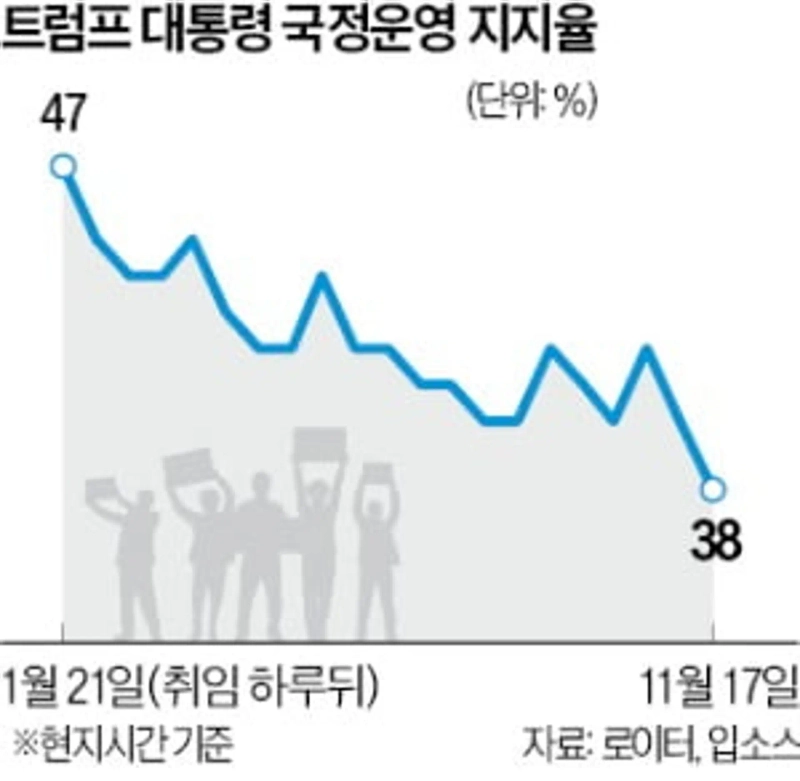
First 30%-range approval rating in the second term
President Trump's approval rating has also plunged. A Reuters poll commissioned to Ipsos released that day (margin of error ±3% points) showed Trump's approval rating at 38%. This is 9% points lower than the 47% recorded on January 21, the day after the start of Trump's second-term administration. It is the lowest in his second term. It is a level similar to Trump's first-term low (33%) and former President Joe Biden's low (35%). The survey polled 1,017 U.S. adults from the 14th to the 17th.
Respondents expressed dissatisfaction with everyday prices. 65% said the government is not managing prices well, while only 26% said it is managing them well. Even among Republicans, one third expressed negative views of price policy. Reuters pointed out, "Trump's signature economic policy was raising tariffs to revive U.S. manufacturing, but many economists view this policy as having caused price increases."
Regarding the handling of the Epstein case, 70% of respondents believed the Trump administration was concealing related information. 87% of Democrats and 60% of Republicans responded this way.
Reuters noted, "Voters judge that the Republican Party has a better approach on economic policy, but the decline in President Trump's popularity could make the Republican Party more vulnerable in next year's midterm elections."
Han Gyeong-je, reporter hankyung@hankyung.com

Korea Economic Daily
hankyung@bloomingbit.ioThe Korea Economic Daily Global is a digital media where latest news on Korean companies, industries, and financial markets.