

KOSPI reels on AI bubble concerns…"Low likelihood of further adjustment" [Weekly Outlook]
Summary
- The KOSPI recently fell due to liquidity concerns and AI bubble fears, but experts say they interpret this as a short-term correction.
- They explained that with the end of the U.S. federal government shutdown, AI earnings outlooks, and reduced valuations, there is potential for medium-term growth and an index rebound.
- While uncertainty over rate cuts and AI overvaluation debates remain, experts say it is necessary to maintain a 'buy on dips' view.
Liquidity worries and AI bubble concerns push the index 'down'
"Liquidity should improve as the U.S. shutdown ends"
"AI overvaluation concerns are excessive…AI capital expenditure to increase through 2026"
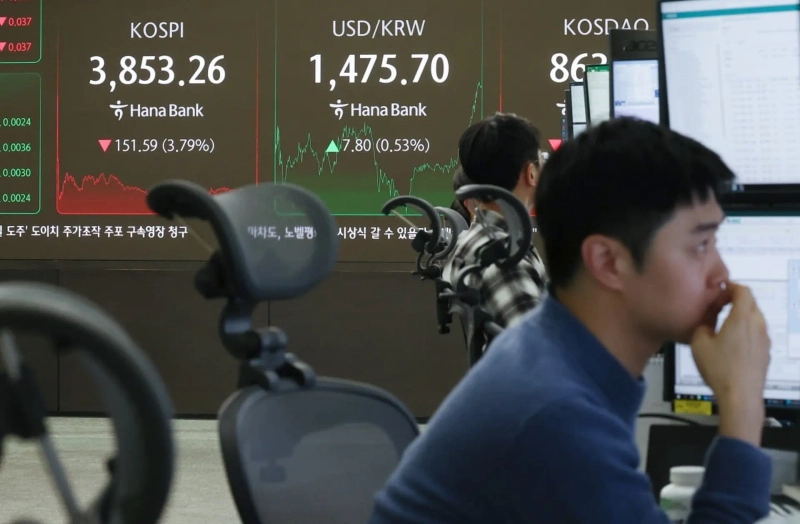
The KOSPI was pushed down to the 3,800 level for the first time in about a month. The fading hopes for a rate cut and growing AI bubble concerns led to a crash in tech stocks. Securities firms say this is only a short-term correction and that the overall trend has not been broken. With the U.S. federal government shutdown over, fiscal funds are being reintroduced, and the implication is that concerns about AI overvaluation are excessive.
According to the Korea Exchange on the 23rd, KOSPI closed at 3853.26, down 3.79% from the previous day. KOSPI was pushed back into the 3,800s for the first time in about a month since September 23 (closing price 3845.56).
Expectations for a rate cut have diminished, freezing investor sentiment. According to the Chicago Mercantile Exchange (CME) FedWatch, the probability of rates being held in December exceeds 60%.
Na Jung-hwan, a researcher at NH Investment & Securities, said, "With continued hawkish comments from senior Federal Reserve officials, the market is effectively assigning a higher probability to a hold rather than a December rate cut," and added, "The October Federal Open Market Committee (FOMC) minutes show that many members expressed the opinion that, given the economic outlook, maintaining the policy rate would be desirable."
He went on to say, "Uncertainty around the U.S. policy rate is likely to persist until the results of the December FOMC are released." The December FOMC meeting will be held on December 9–10.
Debate over AI tech stocks being overvalued also remains. Nvidia's strong earnings briefly weakened bubble concerns. However, attention was drawn to a sharp increase in accounts receivable, which led to a correction in tech stocks. Fed Governor Lisa Cook's remark that "there is a high possibility that overvalued assets such as stocks will fall" also had a negative impact on investor sentiment.
However, experts interpret the KOSPI decline as a "short-term correction." They expect the index to rebound if fiscal spending is reintroduced and dollar liquidity improves with the end of the U.S. federal government shutdown. Samsung Securities' Research Center said, "Because KOSPI surged more than 30% from 3,200 to 4,200 in September–October, we judge this to be a short-term price correction period (now)," and explained, "Short-term dollar liquidity issues are likely to be gradually resolved."
Na said, "The policy rate could be held at the December FOMC," but added, "If the rationale for a hold is 'data absence due to the shutdown,' then there is a possibility of a subsequent cut, which the market would not necessarily view negatively."
There are also voices that AI stock overvaluation concerns are excessive. Na said, "AI bubble concerns are creating a structure in which repeated worries and resolutions suppress the frequency of sharp declines," and added, "We believe AI-related capital expenditure will continue through 2026. We maintain a positive view on the AI infrastructure industry."
He continued, "Uncertainty over rate cuts and AI bubble debates may remain for a while, but this should be seen as a short-term correction within a mid-term growth trend," and stressed, "It is necessary to maintain a 'buy on dips' perspective."
A reduced valuation (price relative to earnings) burden is another factor supporting the downside. Based on KOSPI at 3880 points, the 12-month forward price-earnings ratio (PER) is about 10.2 times. Operating profits of companies listed on the securities market are expected to increase by 38% next year compared to this year, leading to the assessment that the current stock market is not overheated.
On the 25th, U.S. September retail sales, the producer price index (PPI), and the Conference Board consumer confidence index for November will be released. Because the release of the October consumer price index (CPI) was undecided due to the shutdown, these indicators are receiving attention.
On the 27th, the Bank of Korea will hold its final Monetary Policy Board meeting of the year. The market is closely watching Governor Lee Chang-yong's remarks, following his recent suggestion of a possible rate hike in a foreign media interview.
Jin Young-gi, Hankyung.com reporter young71@hankyung.com

Korea Economic Daily
hankyung@bloomingbit.ioThe Korea Economic Daily Global is a digital media where latest news on Korean companies, industries, and financial markets.