

Real value of the won plunges to 'financial crisis level' for first time in 16 years and 2 months
Summary
- The Bank of Korea and the Bank for International Settlements said the real value of the Korean won has fallen to financial crisis levels for the first time in 16 years and 2 months.
- It reported that among 64 countries, the won's real effective exchange rate ranked third from the bottom behind Japan and China.
- It said the increase in domestic residents' overseas stock purchases was cited as the cause of the won's weakness.
Ranked '3rd from the bottom' among 64 countries
Increase in domestic residents' overseas stock purchases 'cause'
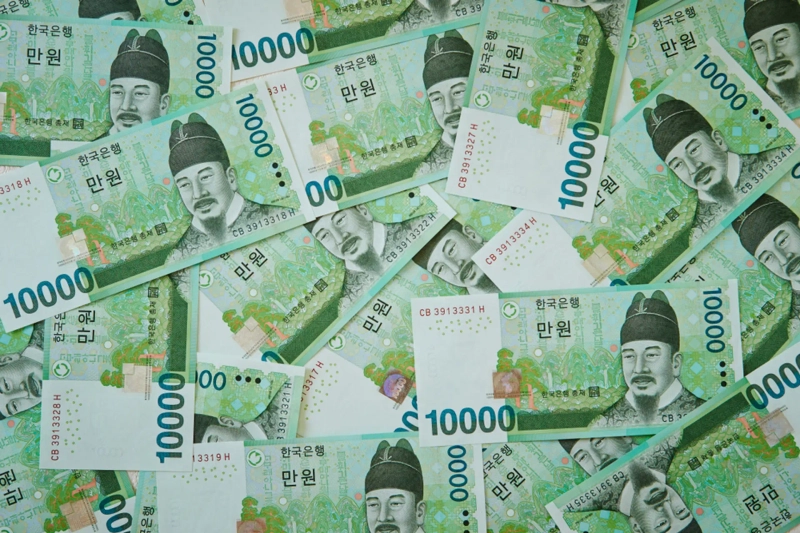
Last month, the real value of the won fell to its lowest level in 16 years since the financial crisis. This month as well, with the won/dollar exchange rate soaring, the won's purchasing power in international trade is expected to decline further.
On the 23rd, according to the Bank of Korea and the Bank for International Settlements (BIS), South Korea's real effective exchange rate index as of the end of October was 89.09 (2020=100). That is 1.44 points lower than at the end of last month. It is the lowest level in 16 years and 2 months since the end of August 2009 (88.88) during the financial crisis.
It is 0.2 points lower even compared to the point in March this year (89.29) when political uncertainty rose due to the emergency martial law situation. The real effective exchange rate is an exchange rate that indicates how much a country's currency has in terms of real purchasing power compared to other countries' currencies. Generally, if it falls below 100, it is interpreted to mean the currency is undervalued compared to the base year.
Among the 64 countries compiled by the BIS, it was the third lowest after Japan (70.41) and China (87.94), ranking '3rd from the bottom.' In particular, the decline during October was the second largest after New Zealand (-1.54), indicating that the won's value weakened rapidly against major currencies.
The reason the won is weak is the large increase in domestic residents' overseas stock purchases. According to the Bank of Korea's international balance of payments table, domestic residents' overseas stock investment (securities investment – equity section) from January to September this year amounted to US$71.8 billion. This surpasses last year's US$42.1 billion and 2023's US$29.8 billion. Compared to US$16.3 billion in 2015, ten years ago, it has increased more than fourfold.
Park Subin, Hankyung.com reporter waterbean@hankyung.com

Korea Economic Daily
hankyung@bloomingbit.ioThe Korea Economic Daily Global is a digital media where latest news on Korean companies, industries, and financial markets.