

"Exchange rate pushed up by supply and demand…Year-end and early-year downward stabilization expected"
Summary
- NH Investment & Securities said it expects the won·dollar exchange rate to stabilize downward toward the end of this year and early next year.
- It stated that current external uncertainty and supply-demand issues led to won weakness, but these negatives are expected to be resolved toward the year-end.
- It reported an analysis that Korea's external soundness indicators are favorable, so concerns about a high exchange rate are excessive.
"External soundness indicators are favorable…Concerns about a high exchange rate are excessive at current levels"
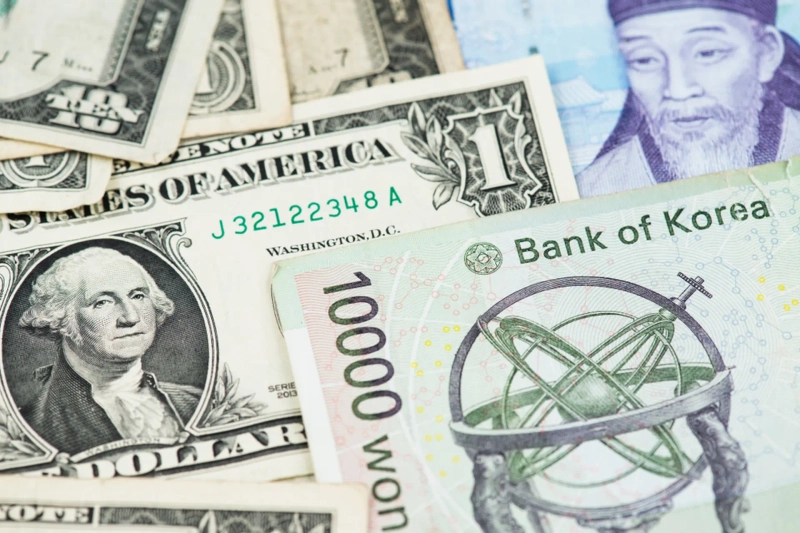
With the won·dollar exchange rate closing in on 1,500 won, NH Investment & Securities said it expects the exchange rate to stabilize downward toward the end of the year. External uncertainty and supply-demand issues have pushed down the won's value, but these negatives are expected to be resolved as the year-end approaches.
Kwon A-min, a researcher at NH Investment & Securities, said in a report on the 24th, "Dovish sentiment on a Fed rate cut in December and yen weakness tied to political developments in Japan are affecting won weakness," and explained, "An increase in actual dollar demand due to domestic investors' overseas investment trend is also affecting the won's value."
The exchange rate surged to 1,476 won during intraday weekly trading on the 21st. It is the highest level since last April.
However, Kwon diagnosed that the situation in April and the current situation are different. He said, "In April, following the fallout from martial law the premium on Korea's credit default swap (CDS) rose, and massive selling of stocks and bonds occurred, representing domestic negatives," and added, "Moreover, external and domestic negatives overlapped, such as the Trump administration's announcement of reciprocal tariffs and a sharp rise in U.S. short- and long-term interest rates."
He continued, "Compared to then, the current external situation appears somewhat stable. The controversy over a December rate cut stems from missing indicators due to a U.S. federal government shutdown (temporary work stoppage)," and said, "After New York Fed President John Williams made dovish remarks, the possibility of a rate cut increased."
In a speech at an event hosted by the Central Bank of Chile in Santiago on the 21st, Williams said of Fed monetary policy, "I believe there is still room to adjust the policy rate further in the near term." He added, "Although recent Fed (rate cut) moves have somewhat reduced it, I consider the current level of monetary policy to be modestly restrictive."
He also assessed that while in the past a high exchange rate equated to a foreign exchange crisis, considering Korea's current external soundness indicators, the concern is excessive. Korea's foreign exchange reserves as a proportion of gross domestic product (GDP) were about 3.3% in 1997, but are currently around 21%.
Kwon said, "Korea became a net creditor in 2014, greatly reducing the possibility of a foreign exchange crisis," and added, "If the exchange rate, which rose to a record level, was close to the 'Sell Korea' mood at the start of the year, now it should be considered in connection with stock market adjustments linked to Fed policy path uncertainty and AI bubble narratives."
He concluded, "I expect stabilization of external uncertainties — such as the Fed's rate cuts and the Bank of Japan's potential rate hikes becoming visible — and downward stabilization of the exchange rate at the end of this year and early next year."
Jin Young-gi Hankyung.com reporter young71@hankyung.com

Korea Economic Daily
hankyung@bloomingbit.ioThe Korea Economic Daily Global is a digital media where latest news on Korean companies, industries, and financial markets.