

Korbit Research Center publishes '2026 Market Outlook' report…stablecoin infrastructure draws attention
Summary
- Korbit Research Center identified the rise of stablecoin infrastructure as a key change in its '2026 Virtual Asset Market Outlook' report.
- The report analyzed major drivers such as the possibility of additional peaks around liquidity re-supply timing and policy changes related to stablecoins, including incorporation into the U.S. financial system.
- It also pointed to various market expansion trends such as RWA tokenization, on-chain derivatives, and superapp competition, emphasizing the importance of structural analysis.
Korbit Research Center, under domestic virtual asset exchange Korbit, announced on the 8th that it published its fourth annual report, "2026 Virtual Asset Market Outlook," which forecasts the virtual asset market for the new year, on the 5th.
This report was prepared with the full participation of four researchers affiliated with the Research Center and analyzed from multiple angles △key trends in the virtual asset market △potential risks △changes in global liquidity and policy environment △the correlations among on-chain, ETF, and derivatives markets.
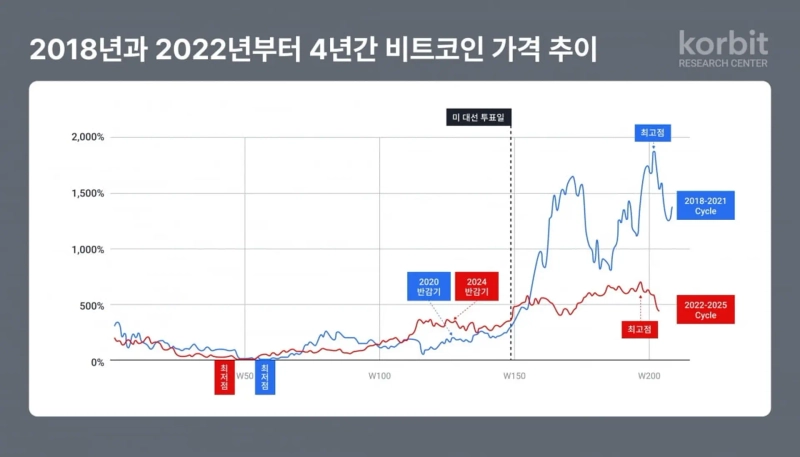
Kim Min-seung, head of the Korbit Research Center, identified cracks in the four-year cycle theory and the rise of stablecoin infrastructure as major changes. He noted that the halving-centered four-year cycle theory has weakened as liquidity cycles were reorganized in a high-interest-rate environment, and suggested the possibility of additional peaks around the time of liquidity re-supply in 2026. He also projected that as stablecoins are incorporated into the U.S. financial system, stablecoin infrastructure that simultaneously meets regulatory compliance and institutional clients' privacy requirements will emerge as a key growth axis.
Center head Choi Yoon-young analyzed that, as asset revaluation occurs based on new economic policies and institutional foundations, the base asset classes for RWA tokenization will expand further. She also forecast that as stablecoins are completed as a payments layer, the on-chain financial ecosystem will expand.
Researcher Kang Dong-hyun predicted that fintech and Web3 companies with strong technological fit and rapid execution will lead RWA market growth. He also analyzed that in prediction markets, trading volume expansion and product diversification will occur centered on Polymarket, Kalshi, and Opinion, and platform competition will intensify.
Researcher Jeong Ji-seong referenced the cases of Robinhood and Coinbase and foreshadowed the arrival of an era of superapp competition offering securities, tokenized securities, and derivatives on a single platform. He further projected that perp DEXs, including Hyperliquid, will grow into on-chain derivatives infrastructure based on token buyback flywheels and a perpetual futures lineup extending to RWAs.
Kim Min-seung, head of the Korbit Research Center, said, "2026 will be a year in which institutionalized asset demand and favorable policy winds combine to propel virtual asset value beyond the existing four-year cycle model into a new dimension," adding, "Structural analysis to understand how liquidity, policy, and technological changes will reshape market structure is essential."

Bloomingbit Newsroom
news@bloomingbit.ioFor news reports, news@bloomingbit.io