

"Global investment flowing to the U.S.…Won likely to remain undervalued for a while" [2026 American Economic Association]
Summary
- "Kim Seong-hyun projected that as global investment concentrates in the U.S., the undervaluation of the won will likely continue for some time."
- Professor Kim stated that Korea's labor policy and financial policy are major factors blocking the inflow of foreign investors.
- Regarding AI, Professor Kim mentioned the possibility of a bubble occurring due to investor psychology if profit realization is delayed.
"Won–dollar exchange rate of 1500 won is excessive…falling below 1400 won is also not easy"
"Korea's labor and financial policies that deter foreign investment"
"Concerns about inflation reignition ease…the Trump variable is a burden"
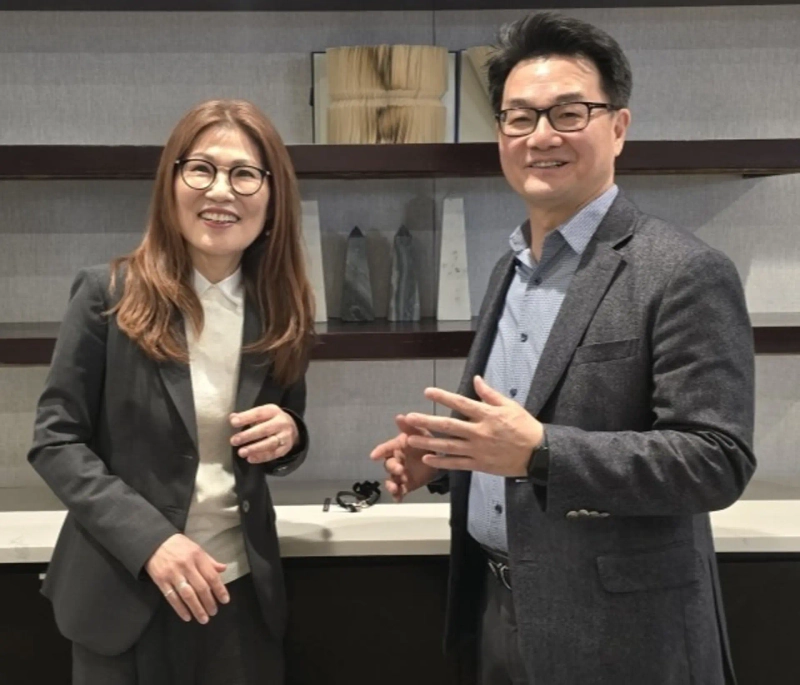
The concerns of Korean economists who attended the American Economic Association (AEA) meeting held this year in Philadelphia were the exchange rate and artificial intelligence (AI). With global investment funds flowing to the United States, there was deep concern about how to defend Korea's exchange rate. In addition, discussions on how economics can contribute in relation to AI were actively held.
On the final day of the American Economic Association meeting, the 5th (local time), Kim Seong-hyun, a member of the Korean-American Economic Association and a professor in the Department of Economics at Sungkyunkwan University (pictured right), said that the won–dollar exchange rate does not seem likely to exceed 1500 won, but that it will also not be easy to fall below 1400 won as in the past. He explained this is because, as the United States continues to attract global investment funds into the artificial intelligence (AI) industry, global investors do not necessarily find investing in Korea attractive.
Korea lacks many factors that attract foreign investment
Professor Kim diagnosed, "Exchange rates are simply determined by supply and demand, and as (due to AI, etc.) demand for dollars continues to arise, the value of the dollar rises, whereas there are not many factors that would lead foreigners to invest in our country."
Some analyze that it is because Seohak ants' investment in the U.S. stock market has surged, but he said that this is not at a level that would sway the exchange rate.
Professor Kim cited the Lee Jae-myung administration's labor policy and financial policy as the biggest reasons for failing to attract foreign investors. He said, "The rigid labor market structure is a factor deterring foreign investors," and added, "I would like to give an F grade on this part."
Professor Kim said, "If there are companies in Korea that foreign investors consider good to invest in, they would bring money in," adding, "But currently confidence in the U.S. stock market is high, so as a result of currency supply and demand effects, (the won being undervalued) can inevitably appear."
Regarding inflation, Professor Kim diagnosed that fears of a renewed surge have abated even among economists. However, he said there are many skeptical views as to whether stable figures can be maintained due to U.S. President Donald Trump's pressure on the U.S. central bank (Fed) to cut interest rates and global geopolitical tensions.
U.S. state governments focus on electricity demand forecasting
Jang Yu-sun, a professor at Indiana State University who attended as a member of the Korean-American Economic Association, described various situations related to AI-related investment in the United States. Professor Jang emphasized, "U.S. state governments are competitively trying to attract data centers," adding, "In particular, when a data center is established, the predictive demand for electricity and the resulting electricity price issues is very large." At this point, he explained that econometricians can build models to predict scenario-based situations.
This is because while expectations for tax revenue increase when a data center is built, at the same time electricity bills that residents with voting rights must bear are likely to rise.
On the other hand, Professor Kim expressed concern about the concentration of AI investment. He said, "AI does help in real life or in improving corporate efficiency, but it is not particularly translating into earnings," and forecasted, "If the timing of profit realization is later than investors' expectations, a bubble could burst due to psychological factors."
Philadelphia=Park Shin-young, correspondent nyusos@hankyung.com

Korea Economic Daily
hankyung@bloomingbit.ioThe Korea Economic Daily Global is a digital media where latest news on Korean companies, industries, and financial markets.