

Jensen Huang "Favorable situation for memory companies… 'HBM major buyer' NVIDIA isn't worried"
Summary
- Jensen Huang, NVIDIA CEO, said that due to AI infrastructure investment, the memory semiconductor market will enjoy a prolonged boom.
- NVIDIA uses HBM4 exclusively, and said it has a relative advantage amid supply shortages through large-scale memory purchases.
- Samsung Electronics, SK Hynix and the three memory companies supply HBM, GDDR, and LPDDR to NVIDIA, and that expanding production capacity and securing stable supply sources are important investment points.
CES on-site briefing
All three memory companies expand production capacity
Demand continues to rise due to AI infrastructure investment
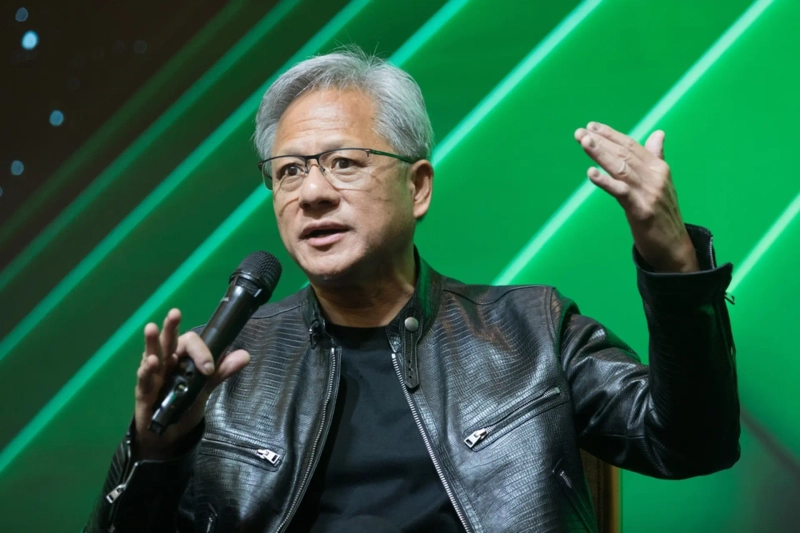
Jensen Huang, NVIDIA Chief Executive Officer (CEO), said of the memory semiconductor boom brought by the artificial intelligence (AI) boom, "As AI factories grow rapidly, more memory semiconductor fabs will be needed," calling it "a very favorable situation for memory companies." He said that the 'AI special' for domestic memory semiconductor companies such as Samsung Electronics and SK Hynix is expected to continue for a considerable period.
Huang said at a press conference held on the 6th (local time) at the Fontainebleau Hotel in Las Vegas, USA, "AI will trigger a 'storage revolution.'" He said, "AI's use of a KV cache (key-value cache) is completely different from the existing information technology (IT) industry," and "Accordingly, demand for high-performance central processing units (CPUs) that manage storage is also exploding." A KV cache is a short-term memory that stores content AI has already read, described as a 'notebook that stores what AI has already read.' The CPU plays the role of placing and moving the KV cache.
Huang said, "CPUs will be used in many places, and it would not be surprising at all if we became the world's No. 1 CPU company." NVIDIA's CPU, 'Grace,' is accompanied by 16 low-power DRAM (LPDDR) chips. LPDDR serves to store the contextual and task information necessary for AI to continue conversations.
Regarding the increasingly deepening shortage of memory semiconductors, Huang said, "I'm not worried. Thanks to being a big buyer in the industry, we will enjoy a (relative) advantage." He explained, "NVIDIA uses the latest high-bandwidth memory (HBM), HBM4 (6th-generation product), exclusively," and "I think other companies will not use HBM4 for a considerable time." He added, "Because NVIDIA's purchase volume is so large, all memory manufacturers are expanding production capacity, and all are delivering results."
Huang emphasized that NVIDIA is one of the largest purchasers of memory semiconductors. He said, "NVIDIA purchases not only HBM but also graphics DRAM (GDDR) and LPDDR directly," and "We are a major buyer of GDDR." NVIDIA receives HBM, GDDR, and LPDDR from the three memory companies such as Samsung Electronics, SK Hynix, and Micron. The latest graphics DRAM, GDDR7, goes into NVIDIA's gaming series GeForce RTX. Samsung Electronics is known as the largest supplier of GDDR7.
Las Vegas=Park Ui-myung reporter uimyung@hankyung.com

Korea Economic Daily
hankyung@bloomingbit.ioThe Korea Economic Daily Global is a digital media where latest news on Korean companies, industries, and financial markets.