"There’s plenty of dollars," says the BOK… so why does the won keep weakening? [Hankyung FX Market Watch]
Summary
- The Bank of Korea said dollars are plentiful in the foreign-currency funding market, pushing the swap rate up to near the policy-rate differential, but it is hard to view this as an FX market crisis.
- In the spot FX market, however, the exchange rate has been fluctuating at elevated levels due to increased overseas equity investment by residents, greater overseas investment by institutional investors, and exporters’ dollar retention.
- Yoon Kyung-soo, director general of the BOK’s International Department, stressed that if currency weakness amplifies expectations of worsening economic fundamentals, it could trigger a vicious cycle of capital outflows and further won depreciation, underscoring the need to ease supply-demand imbalances and maintain consistent FX authority policies.
Forecast Trend Report by Period


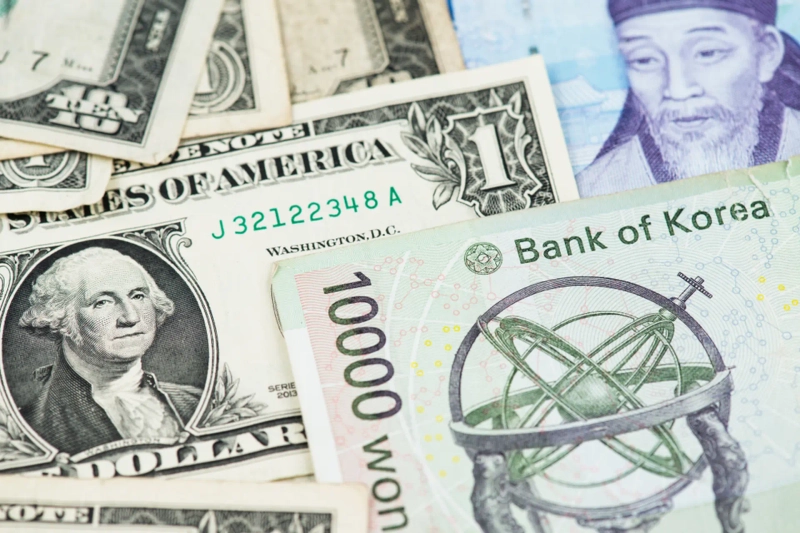
The Bank of Korea (BOK) recently assessed that a “poverty amid plenty” phenomenon is emerging in the foreign-exchange market. While dollars are awash in the foreign-currency funding market where dollars are lent, the spot FX market—where dollars are bought and sold—is seeing the opposite: a shortage of dollars that is pushing the exchange rate higher.
Dollar glut in the funding market
On the 19th, the BOK analyzed the phenomenon in a post on its blog titled “Why is the exchange rate rising when there are plenty of dollars in the foreign-currency funding market?” Yoon Kyung-soo, director general of the BOK’s International Department, said, “It is somewhat contradictory for the exchange rate to rise even though dollars are abundant in the FX market,” adding, “Given that dollar funding is plentiful and borrowing has become easier, it is hard to call the current situation an FX market crisis.”
The foreign-currency funding market is where financial institutions such as banks lend dollars and exchange interest payments. Transactions are mainly conducted through FX swaps, in which won is provided as collateral, dollars are borrowed and used, and after a set period the dollars are returned and the won is received back.
In Korea, the interest rate on borrowing won is currently about 2.4% per annum (based on 3-month tenors), lower than the 3.6% per annum rate on borrowing dollars in the United States. For a swap transaction to be established, interest at least equal to this gap—1.2% per annum—must be paid. Because the U.S. is the issuer of the key reserve currency, a premium above the rate differential is added. The “swap rate” is calculated by adding this premium, i.e., the spread, to the rate differential.
However, this spread declines when more participants want to lend dollars—more supply pushes the price down. Recently, the spread fell to as low as 0.004%p (3-month tenor) as of the 15th. After narrowing from 0.041%p at end-June last year to 0.022%p at end-2024, it has now dropped to a level virtually close to zero. As a result, the swap rate rose to near the policy-rate differential. In other words, as the funding market has become flush with dollars, there is no longer a need to pay additional interest beyond the rate gap.
Dollar funding supply has increased primarily because a large current-account surplus has been flowing in. In addition, companies opting to retain dollars rather than convert them after exports has also boosted dollar supply in the funding market. In particular, in November–December last year, foreign-currency deposits increased, especially among small and midsize companies. Foreigners’ bond inflows last year rose 2.7 times from a year earlier, and about half of that served as a source of foreign-currency funding supply as investors borrowed dollars via FX hedges and invested in won assets. Easing FX soundness regulations implemented by the BOK and the government also supported this trend.
Even with a higher FX rate, "not an FX crisis"
By contrast, the spot FX market has seen the exchange rate fluctuate at elevated levels. The BOK said the trend rise in the exchange rate in recent years has been driven by the interest-rate and growth differential between Korea and the U.S., and the relatively low returns on domestic financial assets.
Still, it judged that last year’s moves were largely driven by FX supply-and-demand factors. It said demand for dollar buying was concentrated as residents increased overseas equity investment and institutional investors—including the National Pension Service—expanded investments abroad.
According to the BOK, last year’s current-account surplus totaled $101.8 billion (January–November), and net investment in direct investment and portfolio investment was similarly large at $99.5 billion. But supply-demand imbalances intensified as exporters did not sell dollars and instead deposited them with financial institutions. In particular, in the fourth quarter of last year, overseas equity investment by individuals and institutions surged, while foreigners’ funds in Korean equities actually flowed out, maximizing the imbalance.
The BOK explains that even with a high exchange rate, the dollar funding market remains stable, so it cannot be viewed as a “crisis.” Director General Yoon said, “An FX crisis occurs when external payment capacity weakens and it becomes difficult to borrow dollar funding,” adding, “Right now, dollars can be borrowed at historically the lowest cost, so this is far from a crisis.” In fact, add-on spreads for foreign-currency funding by financial institutions and the government, as well as CDS premiums, remain stable. The FX authorities’ view is that this is completely different from the crises in 1997 or 2008.
The problem is that the exchange-rate rise is spreading pessimism about the Korean economy. Yoon warned, “If expectations spread that a rise in the exchange rate directly implies deterioration in economic fundamentals, a self-fulfilling vicious cycle could emerge, fueling capital outflows and further currency weakening.” He emphasized, “Over the medium to long term, we need to improve fundamental factors, while in the short term we need to ease supply-demand imbalances to temper one-way expectations.” He added that the FX authorities will pursue consistent policies.
By Kang Jin-kyu josep@hankyung.com

Korea Economic Daily
hankyung@bloomingbit.ioThe Korea Economic Daily Global is a digital media where latest news on Korean companies, industries, and financial markets.