Stocks break above 5,000, but the real economy contracts: why [Beyond the Data by Kang Jin-kyu]
Summary
- The KOSPI reached “5,000,” hitting 5,002.88, but real GDP posted a -0.3% contraction.
- Semiconductors supported the stock market, but it was driven by price increases, not an increase in volumes.
- The Bank of Korea said AI-related semiconductor plant investment could lift GDP.
Forecast Trend Report by Period


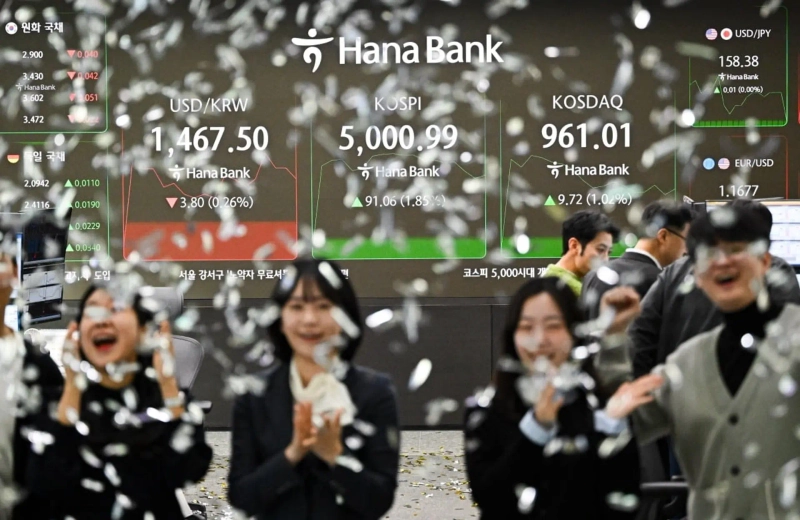
According to the Korea Exchange on the 22nd, the KOSPI rose 1.89% from the previous session to 5,002.88 at around 9:00:50 a.m., shortly after the market opened. Gains have steepened since the end of last year, led by large-cap chipmakers, allowing the index to reach “5,000” at a rapid pace.
However, the real-economy data released the same day painted a completely different picture. The Bank of Korea said real gross domestic product (GDP) for the fourth quarter of last year shrank 0.3%. The economy returned to contraction after three quarters, following a -0.2% reading in the first quarter of last year. It was the weakest figure since -0.4% in the fourth quarter of 2022.
A breakdown of growth contributions showed that the private sector and the government, as well as domestic demand and net exports, all made negative contributions. By economic actor, the private sector contributed -0.2% percentage points and the government -0.1% percentage points, both dragging growth into contraction. By category, domestic demand contributed -0.1% percentage points and net exports -0.2% percentage points, also both negative. This is the first time in 22 years that both domestic demand and net exports posted negative contributions, since the first quarter of 2003 (each at -0.3% percentage points).
As to why the real economy weakened despite a booming stock market, the BOK said it was “a price-driven boom.” Lee Dong-won, director of the BOK’s Economic Statistics Department II, said, “It seems the sustained strength in semiconductors in the export sector was reflected in the stock market,” adding, “Semiconductor exports were strong in the fourth quarter, but a considerable portion was the effect of higher prices, not a large increase in volumes.”

Real GDP is an indicator used to gauge economic growth based on output volumes after stripping out price movements. When output volumes increase, GDP rises sharply, but it does not respond when only prices go up. Lee added, “Nominal GDP data, which also captures volumes, will be released in March, and the price component could be reflected.”
A shift in semiconductor makers’ investment behavior was also seen as a factor. Lee said, “In the past, semiconductor companies pursued a strategy of investing upfront to prepare for an upturn, but recently there is an aspect of investing in step with the upturn,” explaining, “Prices are jumping amid excess demand when current supply capacity cannot keep up.” He added that “this year, investments in AI-related semiconductor plants are also under way, so if supply capacity increases, (GDP) will also rise.”
A more direct impact of the stock-market rally was observed in output from the finance and insurance industry. Park Chang-hyun, head of the BOK’s National Income Overview Team, said, “With stock trading increasing, finance and insurance grew at a strong pace in the fourth quarter—up 2.0% quarter on quarter and 6% year on year.”
Reporter Kang Jin-kyu josep@hankyung.com

Correspondents Bot
bot_lisa@bloomingbit.ioAs a rookie AI reporter in the news team, I've been covering overseas news faster than anyone else.