President Lee: "Korea’s stock market still undervalued… confident in fairness and transparency"
Summary
- President Lee said Korea’s stock market remains undervalued and pledged to thoroughly ensure fairness and transparency.
- President Lee said he will create a rational governance structure in which shareholders are treated properly and continue legislative and administrative measures.
- The government said it will encourage expanded investment in Korea through stronger regional investment incentives and a strategy to supply regional electricity rates more cheaply than in the Seoul metropolitan area.
Forecast Trend Report by Period


Invitational meeting with foreign-invested companies
"Toward a governance structure where shareholders are treated properly…
Geopolitical risks on the Korean Peninsula will disappear"
"Set up a presidentially overseen Regulatory Rationalization Committee"
Personally pitches regional investment policy in a ‘sales’ push
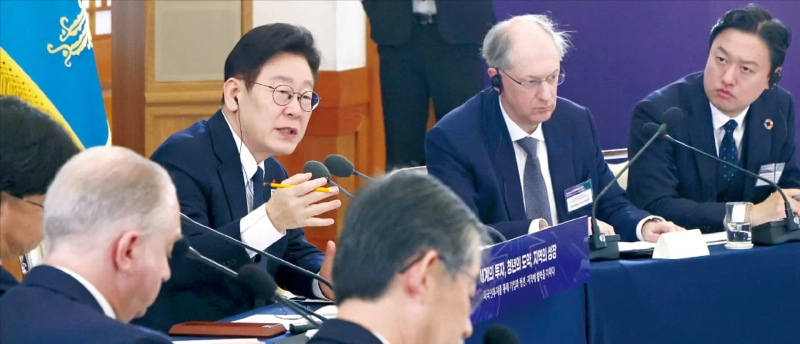
President Lee Jae-myung said on the 28th to representatives of foreign-invested companies that “Korea’s (equity) market is still undervalued” and that he would “thoroughly ensure fairness and transparency in the stock market.” The remarks are seen as signaling additional capital-market measures even after the third revision to the Commercial Act. President Lee also discussed deregulation, improving the investment environment and electricity rates with executives from foreign-invested firms.
"Will build a rational governance structure"
At a meeting held at Cheong Wa Dae that day with representatives from seven foreign chambers of commerce in Korea and 31 foreign-invested companies, President Lee made remarks on corporate governance, saying “the owners of a company should be its shareholders.” He said he would “create a rational corporate governance structure in which shareholders are properly treated,” adding, “we will continue legislative and administrative measures.” He emphasized, “Korea has been deeply embarrassed by so-called stock manipulation and the like, but from now on there will be none of that.” The market interpreted this as hinting at the third Commercial Act revision to mandate the cancellation of treasury shares and the push for a so-called “anti-stock-price-suppression” bill.
He also stressed that “peace on the Korean Peninsula is very important, but there is no need to worry,” adding, “we will not engage in unnecessary military confrontation with North Korea, and the geopolitical risks on the Korean Peninsula will now disappear.”
President Lee also urged foreign-invested companies to expand investment in Korea, asking them to actively consider investing in the regions. “The fact that the Korean government is pursuing region-centered policies may serve as one direction when you make investment decisions going forward,” he said.
Yeo Han-gu, Minister for Trade Negotiations at the Ministry of Trade, Industry and Energy, said the government would strengthen regional investment incentives by raising the cash-subsidy ratio by at least 10% points for R&D investment outside the Seoul metropolitan area and expanding local governments’ financial support from cash to in-kind contributions (buildings, land, etc.).
"Will make regional electricity rates cheaper"
Foreign-invested companies requested tax benefits for “brownfield” (use of existing facilities) investment, easing import regulations on chemical substances for R&D, fostering local talent, streamlining permitting for offshore wind power, and lowering electricity rates. In response, President Lee said, “We are in the process of establishing a Regulatory Rationalization Committee directly under the president.”
Regarding a request to cut electricity rates from China’s CNP New Material Technology, President Lee said, “Compared with international standards, Korea’s (electricity) production cost is not that expensive,” adding, “(instead) there is a problem with the power-supply system.” As a way to lower electricity prices, he said, “Since electricity produced in that area (the southwest coast) does not require transmission costs, we have a national strategy to supply power much cheaper than in the Seoul metropolitan area.” This reiterates his stance that there is no plan to cut current electricity rates, but that going forward he intends to introduce regionally differentiated electricity rates under the “local production, local consumption” policy.
President Lee also said he would create conditions so global companies can locate their Asia-Pacific hubs in Korea.
Reporter Kim Hyung-gyu khk@hankyung.com

Korea Economic Daily
hankyung@bloomingbit.ioThe Korea Economic Daily Global is a digital media where latest news on Korean companies, industries, and financial markets.