Korea Internet Corporations Association: "Opposed to exchange stake caps and bank-led stablecoins"
Summary
- KICOA said the proposed stake caps on controlling shareholders of crypto exchanges and the bank-led push for stablecoin issuance amount to “excessive regulation.”
- The association said forced divestment could curb investment, lower corporate valuations, and increase the risk of hostile M&A by foreign capital.
- It stressed that a bank-centered structure would block participation by private innovators and crypto exchanges, constraining the competitiveness of won-denominated stablecoins and the growth of the digital-asset industry.
Forecast Trend Report by Period


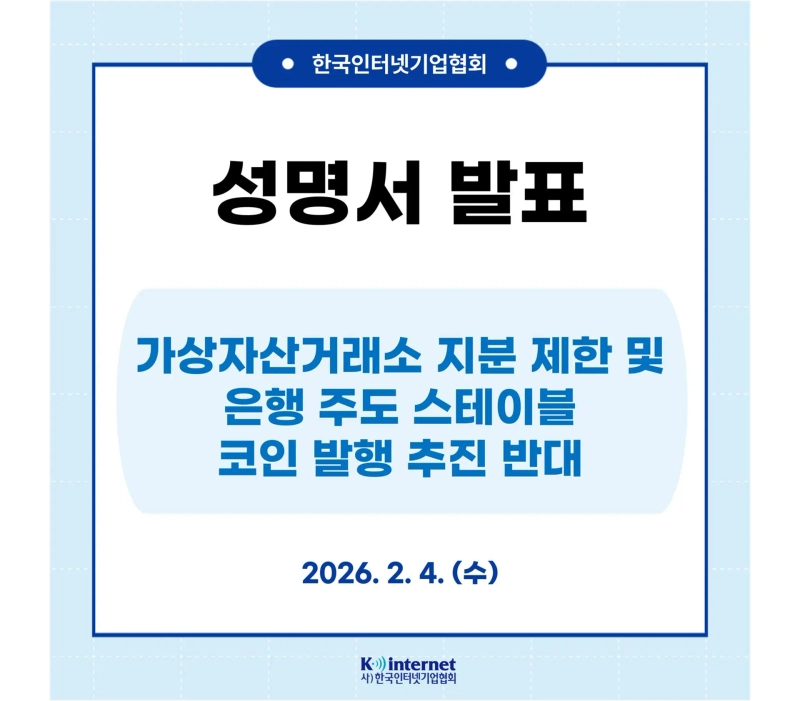
The Korea Internet Corporations Association (KICOA) said it is strongly opposed to moves to cap controlling shareholders’ stakes in crypto-asset exchanges and to promote bank-centered issuance of stablecoins. The association argued the policies could damage a private-sector-led innovation ecosystem and weaken global competitiveness.
In a statement on the 4th, KICOA criticized as “excessive regulation” financial authorities’ moves to define crypto exchanges as public infrastructure and cap controlling shareholders’ ownership at 15–20%, as well as efforts to push a bank-led model for introducing stablecoins. It said this amounts to an attempt to impose ex post control over an industry that grew through private investment and risk-taking.
The association first argued that capping controlling shareholders’ stakes is highly likely to undermine the legal principle of protecting legitimate expectations. It said forcing the sale of shares that were already acquired legally could constitute an infringement of property rights and erode trust in the legal order. It added that choosing compulsory divestment despite the existence of other supervisory and enforcement tools is excessive.
It also warned that stake-cap regulation—rare globally—could turn Korea’s digital finance industry into a “Galapagos” market shaped by idiosyncratic rules. Because founders’ governance stability and decision-making authority are key to investment decisions, it said the measure could significantly dampen domestic and foreign investment. It added that this could accelerate an outflow of talent, technology and capital overseas.
KICOA also raised practical concerns. With large exchanges valued in the trillions of won, it said forcing a rapid sell-down would inevitably depress valuations, harm minority shareholders, and heighten management uncertainty. It also took issue with the risk that if controlling stakes are limited to around 15%, it would be difficult to defend management control, leaving firms more vulnerable to hostile mergers and acquisitions (M&A) by foreign capital.
Criticism also extended to a bank-centered stablecoin issuance structure. The association argued that requiring banks to hold a majority stake in order to participate in the stablecoin market would constrain innovation. It cited the fact that major stablecoins that have succeeded globally have grown under the leadership of non-bank innovators.
The association emphasized that the competitiveness of a won-denominated stablecoin hinges on securing demand and service innovation, and that participation by a wide range of private-sector players—including IT companies and crypto exchanges—is essential. Given that a primary use case for stablecoins is digital-asset trading, it said a structure that excludes exchanges could hinder market formation and adoption.
KICOA urged financial authorities to ▲fully reconsider the policy capping controlling shareholders’ stakes in crypto exchanges ▲halt retroactive regulation and adhere to the principle of protecting legitimate expectations ▲ensure access to the stablecoin market for private innovative firms, not only banks ▲craft balanced policies that do not undermine the startup ecosystem.
“The government needs policy judgment that respects the achievements of private-sector innovation and fosters a globally competitive digital-asset industry ecosystem,” the association said.

YM Lee
20min@bloomingbit.ioCrypto Chatterbox_ tlg@Bloomingbit_YMLEE