[Exclusive] Kim Sung-joo: “The won’s slide isn’t because of the NPS… Our push to expand overseas investment remains unchanged”
Summary
- Kim Sung-joo said the rebalancing deferral for domestic equities is a temporary measure through the first half aimed at improving returns.
- He said the policy direction of expanding the NPS’s overseas investment will be maintained, and that claims it is a major driver of exchange-rate rises do not square with the numbers.
- He said the NPS will halt strategic FX hedging once markets stabilize and maintain its open-FX strategy and long-term asset allocation strategy to continue enhancing long-term returns.
Forecast Trend Report by Period


Hankyung interview – Kim Sung-joo, Chairman of the National Pension Service, first interview since taking office
“Equity rebalancing moratorium to end within the first half”
“A temporary measure to boost returns”
“To be reviewed again by the Fund Management Committee”
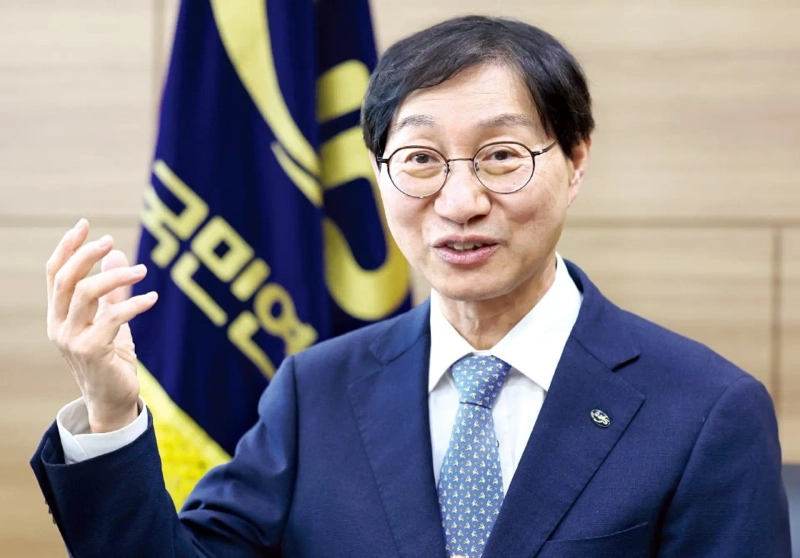
Kim Sung-joo, chairman of the National Pension Service (photo), said in an interview with The Korea Economic Daily on the 4th that “we plan to operate, on a temporary basis through the first half, a measure to defer ‘rebalancing’—the mechanical selling of domestic equities—when holdings exceed the permitted range for asset allocation.” He added, “It is not reasonable to view the NPS’s overseas investment as the cause of the high exchange rate,” and said, “Once the FX market stabilizes, it is appropriate to return to an unhedged, open-FX strategy.”
The NPS Fund Management Committee decided on the 26th of last month not to conduct rebalancing for the time being even if domestic equity holdings exceed the target (14.9%). Kim stressed, “This is a temporary measure to avoid giving up expected returns because of an institutional constraint called rebalancing at a time when the undervaluation of Korea’s stock market is being resolved and AI-related stocks are surging,” adding, “Speculation that it was at the government’s request is not true.”
Responding to claims that the NPS’s expansion of overseas investment is behind the sharp rise in the won–dollar exchange rate, Kim countered that it is “not supported by the data.” He added, “I have a firm conviction that we must maintain the policy direction of expanding overseas investment.”
Kim was reappointed as chairman in December last year, becoming the first in the NPS’s history to serve two terms as chairman. This is his first media interview since taking office.
In 2020, when FX procurement was the largest in the past 10 years, the rate averaged only 1,180 won
Claims that pension overseas investment drove up the FX rate don’t match the data
“Over the past 10 years, the year in which the NPS procured the most foreign currency was 2020, when the average won–dollar exchange rate was 1,180. In 2024, when procurement was the smallest, the exchange rate was 1,364. It is not supported by the data to say the NPS’s overseas investment is a major factor behind the rise in the exchange rate.”
In an interview with The Korea Economic Daily on the 4th, Kim methodically rebutted the FX authorities’ claim that the NPS’s expansion of overseas investment is the main driver behind the recent surge in the won–dollar exchange rate, citing figures. He stressed in particular that the policy direction of expanding overseas investment will continue to enhance long-term returns. He also made clear that the strategically resumed FX hedging would be halted once the FX market stabilizes. On criticism that the NPS deferred rebalancing to support the stock market, he drew a line, calling it “a temporary measure to avoid undermining returns.”
Throughout the nearly two-hour interview, he emphasized that as the fund grows, the NPS must strengthen investment accountability and improve returns in a stable manner.
▷You decided not to ‘rebalance’ even if domestic equity holdings exceed the target ratio.
“Right now the domestic stock market is performing best; if we sell because of a ‘cap’ called rebalancing, we end up taking a loss. And given the market’s excessive volatility, we judged it was better to watch for a few more months. Speculation that this was driven by government demands has absolutely no basis.”
▷The market is confused because you didn’t specify the length of the rebalancing deferral.
“This was a temporary decision through the first half, considering that Korea’s undervaluation is being resolved and a new era of AI is arriving, driving a sharp rise in returns. The NPS is not a short-term investor. The average holding period per stock, which was 13–14 months in 2017, has recently increased to two years. Because our investment horizon is long, there is no reason to rush to sell just because prices have risen.”
▷Lowering the target allocation to overseas equities to stabilize the FX rate is also controversial.
“When I first took office as NPS chairman in 2017, the annual average return was 4–6%. Over the past five years, it has risen to 8–10%. That was because we changed the asset allocation strategy, including shifting the domestic-to-overseas investment mix from about 7:3 to 4:6. The compromise in the Fund Management Committee—slightly reducing the overseas equity share while not raising the domestic share further—means we will not tamper with the broad direction of the mid-term asset allocation strategy. I have a firm conviction that we must maintain the policy direction of expanding overseas investment.”
▷FX authorities cite the NPS’s overseas investment as a major factor behind the rise in the exchange rate.
“In 2020, when the NPS’s FX procurement was the largest over the past 10 years, we procured $25.2 billion (about 36 trillion won) in that year alone. The average won–dollar exchange rate then was 1,180. By contrast, in 2024, when FX procurement was the smallest at $11.2 billion, the year-end exchange rate was 1,364. The rise in the exchange rate is the result of multiple domestic and external factors acting in combination, and it cannot be seen as being caused by increased overseas investment by the NPS fund.”
▷Many also argue that the NPS should expand FX hedging.
“Since 2018, the NPS has used a fully open-FX strategy of not hedging currency exposure on overseas investment assets. Strategic FX hedging is a system put in place on a temporary basis to stabilize the market when it was rocked by the 2022 Legoland incident and the exchange rate spiked. The NPS’s clear principle is ‘natural hedging’—bringing the sum of FX gains and FX losses close to zero (0) through long-term investment. The fund management guidelines’ FX management objectives clearly state: ‘Portfolio volatility must be reduced. The fund must be protected from large-scale FX losses.’ Once conditions stabilize, I believe it is appropriate to return to the open-FX strategy.”
▷Bank of Korea Governor Rhee Chang-yong argues that the NPS needs permanent FX hedging.
“With the recent surge in fund returns, the time over which the fund can be managed stably has expanded from about 10 years to at least 20–30 years. If we had to sell assets to pay pensions within 2–3 years, the exchange rate at the time of sale would be extremely important; now, by contrast, the exchange rate at the time of investing is what matters. The exchange-rate issue at the time we must sell overseas assets decades from now seems a bit remote. If the new framework is discussed and a conclusion is reached through commissioned research, then the NPS may need to reassess as well.”
▷What is the purpose of the new framework?
“In 2017, the fund grew by several tens of trillions of won a year, but now the annual pace of increase far exceeds 200 trillion won. Since we invest 60–70% of the growing funds overseas, we need a lot of foreign currency. But as the fund’s size has become outsized relative to Korea’s FX market, procuring foreign currency in the market becomes an enormous driver of exchange-rate volatility. The new framework began from the judgment that ‘it is time for a new overseas investment strategy.’”
▷In your inauguration speech, you emphasized operating principles.
“With an operating scale befitting a ‘global top 3,’ I want to emphasize the philosophy and principles of being a ‘universal owner,’ that is, a broad-based owner. The NPS is the No. 1 or No. 2 shareholder in most listed Korean companies. As a universal owner responsible for Korea’s economy and companies, we need to play that role. The NPS’s first mission is to enhance returns, but we must also pursue social responsibility.”
▷Some point out that emphasizing social responsibility inevitably sacrifices returns.
“In the US and Europe recently, ESG (environment, social, governance) and responsible investment are recognized as financial factors. Strengthening social responsibility can prevent crises and minimize loss risks because it proactively removes investment risk factors. As seen in investments such as Mitsubishi Heavy Industries—a Japanese wartime perpetrator company—Coupang, which leaked member information, and MBK’s Homeplus incident, the NPS is also being asked to be accountable for its investments.”
▷Concerns are also being raised about independence.
“On the controversy over independence, I can speak with confidence. A firm principle is that the entity that judges and decides investments is the NPS. The principle—‘Political and economic power must not interfere in fund management. The NPS is the retirement money of our people’—is always valid.”
▷You argue that a financial ecosystem should be built in Jeonju, North Jeolla.
“If the Korea Investment Corporation (KIC) and various pension funds and mutual aid associations gather in Jeonju, a financial ecosystem will naturally be created. If Seoul is an international finance hub and Busan is a hub city for marine derivatives finance, then through the second relocation of public institutions, Jeonju should be developed into a pension-fund-centered financial hub.”
■ Profile
△Born in 1964 in Jeonju, North Jeolla
△Graduated from Seoul National University, Department of Korean History
△2006: Member, North Jeolla Provincial Council
△2012–2016: 19th Member of the National Assembly
△2017–2020: 16th Chairman, National Pension Service
△2020–2024: 21st Member of the National Assembly
△2022–2024: Secretary, National Assembly Special Committee on Pension Reform
△From December 2025: 19th Chairman, National Pension Service
Reporters Nam Jung-min / Jung Young-hyo / Min Kyung-jin peux@hankyung.com

Korea Economic Daily
hankyung@bloomingbit.ioThe Korea Economic Daily Global is a digital media where latest news on Korean companies, industries, and financial markets.