Trump’s ‘MEGA’…Top oil producer U.S. moves to control even Venezuela, No. 1 in reserves
Summary
- The report said the United States has become an oil-market “superpower” as the world’s largest producer on the back of shale oil and by securing control over Venezuelan oil.
- It noted the United States is aiming for energy self-sufficiency and to strengthen global energy dominance by using low-cost Venezuelan heavy crude, weakening OPEC’s influence.
- It said the United States is seeking to dominate the global oil and gas markets by deploying even military and diplomatic tools—through sanctions on Iran and Russia, expanded energy exports to Europe and India, and pressure for long-term LNG purchases.
Forecast Trend Report by Period


Trump’s Oil War
(2) U.S. energy dominance solidifies
U.S. becomes an oil-market ‘superpower’
U.S.·Venezuela
Combined output
80% of OPEC
Even global oil prices
swayed at will
The United States has emerged as a ‘superpower’ in the global oil market. It follows the Donald Trump administration’s push to accelerate domestic drilling, coupled with securing control over Venezuelan oil.
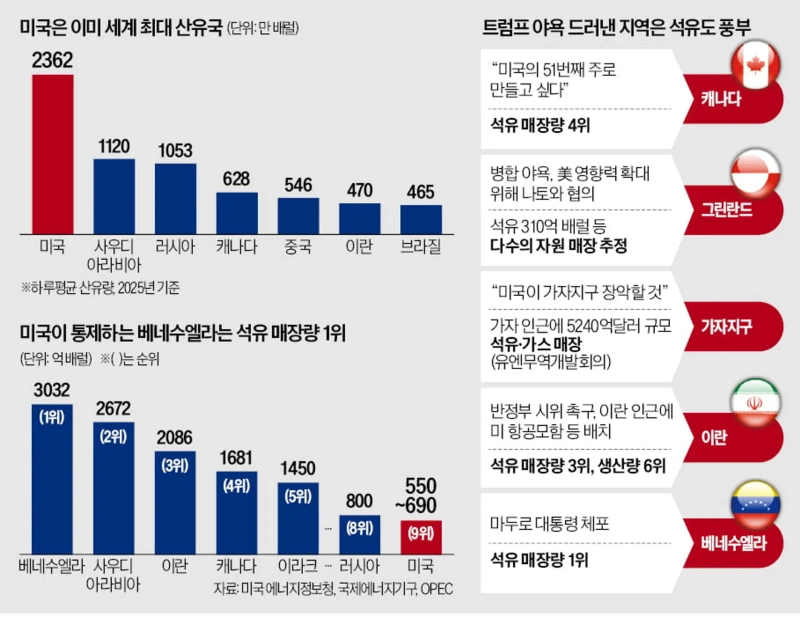
According to the U.S. Energy Information Administration (EIA) on the 3rd (local time), the United States—having become the world’s largest oil producer in 2018 thanks to shale output—is projected to produce about 23.6 million barrels a day on average this year of oil and natural gas. After subtracting domestic consumption of roughly 20.6 million barrels a day, about 3 million barrels a day is expected to be exported.
U.S. oil output last year already matched the combined production of Saudi Arabia (11.2 million barrels a day) and Russia (10.53 million barrels a day), ranked second and third globally. If production rises in Venezuela, over which the United States has gained control, the volume the U.S. can effectively influence increases to 27 million barrels a day. That amounts to 80% of the Organization of the Petroleum Exporting Countries’ (OPEC) output (33.7 million barrels a day). The United States—already exerting formidable influence in oil markets—has become a true ‘superpower’ in the sector.
The Trump administration is also pushing to develop an Alaska gas field where production has been halted. The U.S. is seeking to expand its influence as well in Greenland, a Danish territory believed to hold significant oil and gas reserves, and in the Gaza Strip. If so, America’s clout in the oil market could grow further.
U.S. moves to tighten grip on overseas oil…Trump: ‘Oil control’ after Maduro’s arrest
Eyes on resource-rich Greenland and Canada…says of Gaza: ‘The U.S. will take control’
“My energy policy is defined by maximum production, maximum prosperity, and maximum power.”
U.S. President Donald Trump said this after declaring last October “National Energy Dominance Month.” In his second term, he has also urged expanded production of fossil fuels such as oil and gas, chanting, “Drill, baby, drill (keep drilling).” By intervening in Venezuela early this year to secure control over its oil, he is extending energy dominance across the globe—an ambition that can be seen as “MEGA (Make American Energy Great Again).”
U.S. strengthens energy dominance
The United States is the world’s largest oil producer. Backed by shale output, it overtook then-No. 1 Saudi Arabia in 2018. However, U.S. proven oil reserves are estimated at 55 billion to 69 billion barrels—about one-fifth of Saudi Arabia’s reserves (267.2 billion barrels). Moreover, U.S. shale production costs are higher than those in Saudi Arabia and other producers.
Washington’s plan is to address this by securing control over foreign oil. South America, including Venezuela—No. 1 in global reserves (303.2 billion barrels)—is the first target. It began early this year when the U.S. arrested Venezuelan President Nicolás Maduro, transported him to the United States, and said it would exercise control over Venezuelan oil. Venezuela subsequently scrapped its oil nationalization measures that had lasted 20 years, opening the way for U.S. companies to operate in the Venezuelan oil business. If the U.S. uses low-cost heavy crude secured in Venezuela to replace imports of Canadian oil sands, it is expected to achieve energy self-sufficiency and cement dominance in global energy markets.
The Trump administration’s National Security Strategy (NSS) states that the Western Hemisphere, which includes the Americas, “holds numerous strategic resources,” and specifies that the National Security Council (NSC) and U.S. embassies in each country should identify and report them. Countries other than Venezuela are also expected to face pressure to reflect U.S. interests in their resource development processes.
Greenland, which Trump has eyed; Canada, which he said he wants to make the “51st state”; and the Gaza Strip, which he once said the U.S. wants to “take control of,” are all regions rich in oil and gas. Iran—under maximum U.S. pressure—is also a major country in both oil reserves and production. The United States has currently deployed large-scale military assets to Iran, including a carrier strike group. Trump recently even incited anti-government protesters in Iran, urging them to “take over (government) institutions.” The U.S. appears to be seeking to control or wield influence over resources in these areas following Venezuela. If that happens, the U.S. position in global oil markets would be strengthened further, while the influence of traditional heavyweight OPEC would inevitably be curtailed.
Full mobilization of military and diplomatic tools
The United States is also aggressive in selling oil and gas. A prime example is pressuring India to stop buying Russian crude. India had been importing 1.2 million barrels a day of Russian crude as recently as early this year. That gap will be filled by U.S. crude and Venezuelan crude under U.S. control.
The United States is also increasing exports of its natural gas to Europe, which has been distancing itself from Russia due to the war in Ukraine. Europe has decided to completely halt imports of Russian gas starting next year.
The United States is also blocking distribution routes for Iranian and Russian oil, which are subject to sanctions. So-called “shadow fleets,” registered in countries such as India and Oman, disguise origin by transferring sanctioned crude on the high seas for export. Byun Hyun-ji, a senior researcher at Binghyeonji Industrial Research Institute, said, “Tariffs are followed by legal disputes, but energy control can be pushed more forcefully outside legal boundaries because it is justified on geopolitical grounds.”
The United States is also pressuring allies to increase imports of U.S. energy, using tariffs and security cooperation as leverage. In tariff negotiations last year, the European Union (EU) pledged to purchase $250 billion a year in energy such as U.S. liquefied natural gas (LNG) for three years—$750 billion in total. South Korea agreed to buy $100 billion worth of U.S. energy over four years.
Washington=Lee Sang-eun, correspondent / Kim Dae-hoon, reporter selee@hankyung.com

Korea Economic Daily
hankyung@bloomingbit.ioThe Korea Economic Daily Global is a digital media where latest news on Korean companies, industries, and financial markets.