Bithumb license renewal likely to be postponed indefinitely
Summary
- It reported that Bithumb’s Virtual Asset Service Provider (VASP) license renewal has been delayed for more than a year after expiring in December 2024, and that the exchange is operating under an interim license.
- It reported that the review is likely to be prolonged as ties with financial authorities have deteriorated due to the 620,000-Bitcoin misdistribution incident and past controversies involving a coin lending service and order book sharing with overseas exchanges.
- It said authorities are reviewing whether Bithumb violated segregation custody obligations under the Virtual Asset User Protection Act, noting that by keeping users’ assets in the company wallet, Bithumb effectively failed to maintain segregated custody.
Forecast Trend Report by Period


Financial regulator approval required every three years
On an 'interim license' after expiring in December 2024
Public sentiment sours over 'erroneous coin distribution'
Approval likely deferred until the situation is contained
Potential sanctions for violating segregation requirements
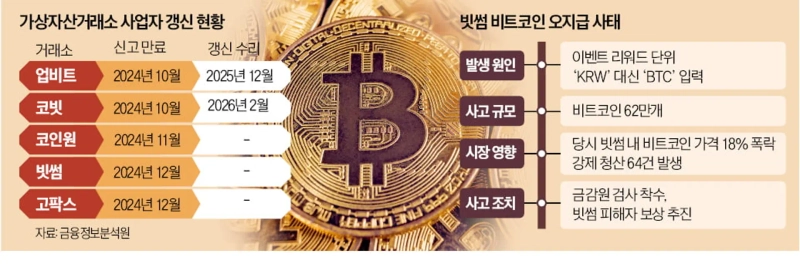
The renewal of the business license for Bithumb, South Korea’s No. 2 virtual asset exchange, is expected to be delayed after controversy erupted over the distribution of 620,000 ‘ghost’ Bitcoins. Bithumb’s license has already expired, and it has continued operating for more than a year under an ‘interim license.’ Observers say the review process could drag on for Bithumb, which has fallen out of favor with financial authorities.
License renewal delayed for more than a year
According to financial authorities on the 12th, the Financial Intelligence Unit (FIU) under the Financial Services Commission is reviewing the renewal of Bithumb’s Virtual Asset Service Provider (VASP) license. Under the Act on Reporting and Using Specified Financial Transaction Information, virtual asset service providers, including exchanges, must renew their business licenses with the FIU every three years. Bithumb’s license expired in December 2024.
The FIU has typically renewed licenses after finalizing the level of sanctions based on inspection findings regarding violations of the Act on Reporting and Using Specified Financial Transaction Information. Upbit’s renewal was accepted in December last year after it was hit with administrative fines totaling 35.2 billion won for violations such as customer due diligence obligations. Korbit also renewed its license on the 6th after a decision was made to impose administrative fines of 2.73 billion won.
Financial authorities had initially planned to hold a sanctions review for Bithumb and complete the renewal review in the first half of this year, but the recent Bitcoin misdistribution incident has complicated matters. On the 6th, Bithumb intended to distribute 2,000 won worth of Bitcoin as part of a customer event, but entered 2,000 BTC instead, mistakenly sending a total of 620,000 Bitcoins. The Financial Supervisory Service has launched an on-site inspection of Bithumb over issues such as weak internal controls.
Authorities say it is, in practice, difficult to hold Bithumb legally accountable for this incident under the grounds for non-acceptance stipulated in the Act on Reporting and Using Specified Financial Transaction Information, which are the basis for deciding on renewal. Those grounds include: △failure to obtain Information Security Management System (ISMS) certification △not conducting financial transactions through accounts that allow real-name verification for deposits and withdrawals △being sentenced to a fine or heavier penalty for violating laws such as the Act on Regulation and Punishment of Criminal Proceeds Concealment or the Act on Prohibition of Financing for Terrorism, with less than five years having passed since completion of the sentence or the date of exemption.
Bithumb had maintained an uneasy relationship with authorities even before this incident. In September last year, controversy arose when only Bithumb was absent from an official meeting with exchange CEOs held for the first time since Financial Supervisory Service Governor Lee Chan-jin took office. At the time, there was speculation that Bithumb had drawn regulators’ ire by pushing ahead with a coin lending service and sharing order books with overseas exchanges despite warnings. It was also reported that Bithumb was excluded from a closed-door meeting on drafting guidelines for corporate virtual asset investment.
Review of potential violation of segregation custody obligations
Within the industry, the prevailing view is that the renewal review will be put on hold until the situation is resolved and Bithumb presents clear countermeasures. A financial authority official said, “For the time being, the likelihood of a renewal decision coming out is low.”
Meanwhile, authorities are reviewing whether they can hold Bithumb accountable under current law even before the second phase of virtual asset legislation is enacted. They are focusing on whether Bithumb properly complied with segregation custody obligations under the Virtual Asset User Protection Act. Under current law, operators must keep their own virtual assets and users’ assets segregated, and must substantively hold the same type and quantity of virtual assets as those entrusted by users. Bithumb has stored users’ deposited virtual assets in the company’s own wallet and recorded transactions only on its books whenever trades occurred. In effect, it did not keep the company’s and users’ virtual assets segregated.
Reporter Shin Yeon-su sys@hankyung.com

Korea Economic Daily
hankyung@bloomingbit.ioThe Korea Economic Daily Global is a digital media where latest news on Korean companies, industries, and financial markets.