Hashed CEO Kim Seo-jun: “Stablecoins are the DNA of the AI era… core infrastructure for the agent economy”
Summary
- Hashed CEO Kim Seo-jun said stablecoins are the digital DNA that powers the AI-era agent economy.
- He said programmable payments based on blockchain and smart contracts, along with a KRW stablecoin, are core infrastructure for the global AI economy and Korea’s AI industry.
- He added that a stablecoin network with openness, privacy protection and regulatory adaptability is needed to enable rational revenue sharing and serve as a bridgehead for global expansion.
Forecast Trend Report by Period


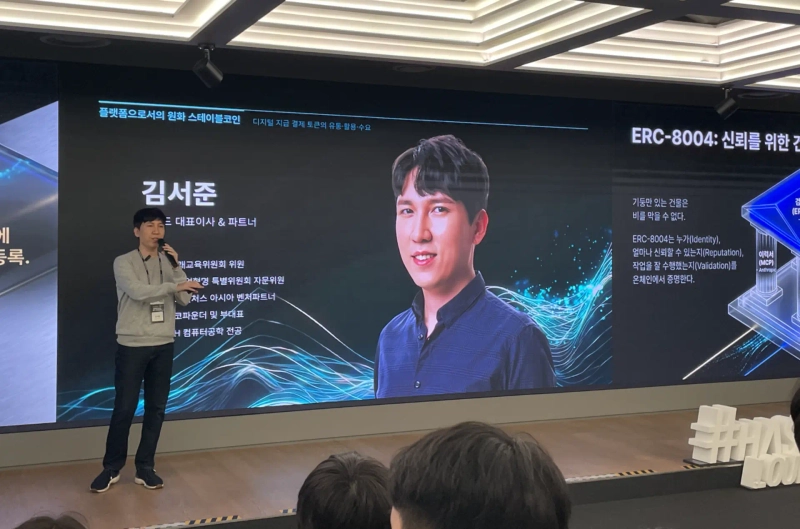
“Viewing stablecoins simply as digital money placed on a blockchain means you are seeing only a fraction of their potential. In the era of artificial intelligence (AI), stablecoins are the digital DNA that powers the agent economy.”
Kim Seo-jun, CEO of Hashed, underscored the point in a keynote address at the conference “KRW Stablecoins as a Platform: Distribution, Use and Demand for Digital Payment Tokens,” held on the 13th at Hashed Lounge in Gangnam, Seoul. “If the Industrial Revolution mechanized human physical labor, the AI revolution is mechanizing the realm of thinking,” he said, adding, “In an environment where hundreds of millions of AI agents emerge as economic actors, we need infrastructure that can prove their identity and reputation and enable instant settlement.”
Kim said stablecoins are drawing increased attention as AI agents proliferate. “In an environment where agents interact globally, payments via traditional financial networks are structurally inefficient,” he said. “Only programmable payment systems built on blockchain and smart contracts can support automated transactions and settlement between agents.”
He particularly stressed the importance of systems for identity verification and reputation validation for agents. “If anonymity was the problem in the early days of the internet, in the agent era the key challenge will be identifying trustworthy entities,” he said. “KYA—Know Your Agent—for verifying agents’ identities, and B2A—business-to-agent—as a business model targeting agents will emerge as new standards.”
As AI-generated content grows, the need for blockchain-based settlement infrastructure is also rising. “Before long, on social networks, content created by agents is likely to surpass content created by humans,” Kim said. “In an environment where high-quality derivative works are produced at scale, existing closed-ledger systems will struggle to handle copyright tracking and settlement.” He added that “only with transparent transaction records based on blockchain networks and programmable settlement structures will it be possible to distribute revenues rationally between original IP owners and derivative creators.”
As design principles for stablecoin networks, he cited openness, privacy protection and regulatory adaptability. “To support a global AI economy, an open architecture must be a given,” he said, recommending that “while transaction privacy should be protected using technologies such as zero-knowledge proofs, this should be paired with systems that allow regulators to monitor illicit activities such as money laundering.”
He also mentioned the strategic need for a KRW stablecoin. “If AI-driven economic activity accelerates domestically as well, then without programmable tokens linked to the local currency, we will ultimately have no choice but to depend on foreign dollar stablecoins,” he said. “A KRW stablecoin can serve as a foundational asset for Korea’s AI industry and a bridgehead for global expansion that connects exports with the content industry.”
He continued: “Stablecoins are not merely a way to cut remittance costs; they are infrastructure that enables a new economic model in which AI and agents interact,” emphasizing that “they should be understood as a network that accelerates the evolution of the economy in the AI era.”

Minseung Kang
minriver@bloomingbit.ioBlockchain journalist | Writer of Trade Now & Altcoin Now, must-read content for investors.