"A won stablecoin is the 'digital DNA' of the AI era… a global 'go-to coin' strategy is needed"
Summary
- Experts said a won stablecoin could become core infrastructure for the AI-agent economy, underscoring the importance of a domestic-currency-based design.
- Lawmaker Byung-deok Min said that to counter global dollar stablecoins, Korea needs a go-to coin strategy combined with content such as K-pop and webtoons, along with legislation centered on conduct regulation.
- Panelists said securing trust at the distribution stage—through wallet (W2W) infrastructure, public blockchains, and risk-based regulation design—will be key to the success of a won stablecoin.
Forecast Trend Report by Period


The rise of the AI-agent economy… calls grow for won-based infrastructure
Execution infrastructure takes shape, including wallet services and sovereign chains
"Success hinges on distribution design… risk management and pacing are also challenges"
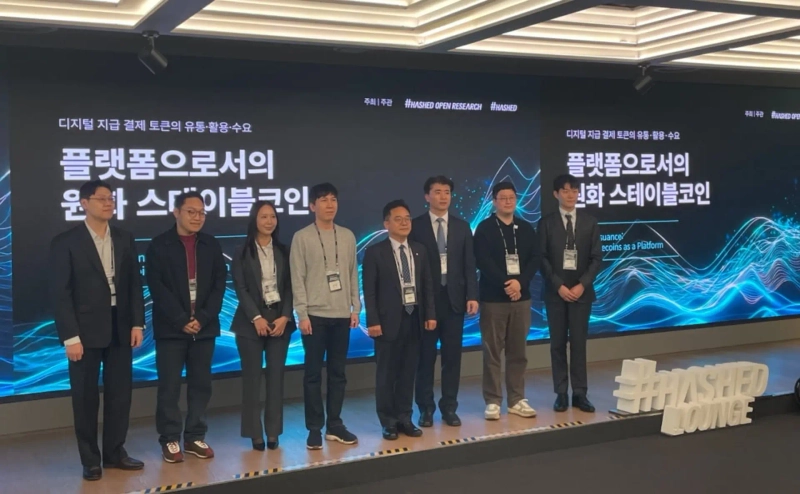
As stablecoins emerge as core infrastructure in the artificial intelligence (AI) era, the 'Won Stablecoin as a Platform: Distribution, Use and Demand for Digital Payment Tokens' conference held on the 13th at Hashed Lounge in Gangnam, Seoul, laid out directions for designing the technology, legislation and execution infrastructure for a won stablecoin. Experts stressed that success or failure will be determined less by speed of adoption than by meticulous institutional and technical design.
In his keynote address, Hashed CEO Seo-joon Kim described stablecoins as "the digital DNA that powers the AI-era agent economy." He said that in an environment where hundreds of millions of AI agents emerge as economic actors, "programmable payment infrastructure is essential" to verify their identity and reputation and enable instant settlement. He explained that blockchain-based programmable payment systems are well suited to handling automated agent-to-agent transactions, with stablecoins serving as the execution tool.
He also underscored the strategic need for stablecoins based on domestic currencies. Kim warned that "if a domestic-currency-based token is absent as Korea's AI economy becomes more active, dependence on foreign dollar stablecoins could become entrenched."

In response, Byung-deok Min of the Democratic Party of Korea proposed a "go-to coin" strategy. "As we are not an issuer of a key currency, to respond to the offensive of dollar-based stablecoins we need to create a go-to coin that people around the world voluntarily choose," he said, adding that Korea must "secure global demand through specialized models combined with cultural content such as K-pop and webtoons."
On legislative direction, he emphasized that a framework centered on conduct regulation rather than entry barriers is needed. Min said, "Issuance should be broadly permitted, but collateral assets and operating conduct should be strictly managed," adding, "Regulation should not be suppression, but guardrails for safe innovation."
In the stablecoin era, wallets become the integrated execution layer… Maroo testnet to be unveiled soon
The industry is also accelerating development of execution infrastructure and services to support stablecoin distribution.
Kyung-hee Son, Vice President at Kakao Pay, said, "A digital-asset wallet is not merely a storage tool; it is the point through which most asset transfers pass, and in the stablecoin era it will become the integrated execution layer for moving assets." She added that there will be a growing need for a structure that can handle fiat currency and stablecoins, digital assets and securities through the same interface.
In particular, she said that minimizing intermediaries through a wallet-to-wallet (W2W) structure could cut global transaction costs from the current 3–5% to around 0.1–1%, while shortening settlement to near real time. A prime early use case is B2B cross-border payments, where large-scale and repetitive transactions occur.
Ho-jin Kim, CEO of Hashed Open Finance, said the company plans to unveil soon the testnet for 'Maroo,' a sovereign Layer 1 blockchain that combines privacy protection with "regulatory adaptability." He said, "Excessive information exposure on public blockchains and ambiguity in regulatory application can constrain mainstream adoption," adding that through Maroo the company will build an environment usable by corporations and institutions via a network that distinguishes processing paths based on transaction characteristics and incorporates zero-knowledge proofs. Maroo will also introduce an account structure dedicated to AI agents and various wallet functions.
"Trust at the distribution stage determines success… public blockchains should be used, alongside calibrated regulation"
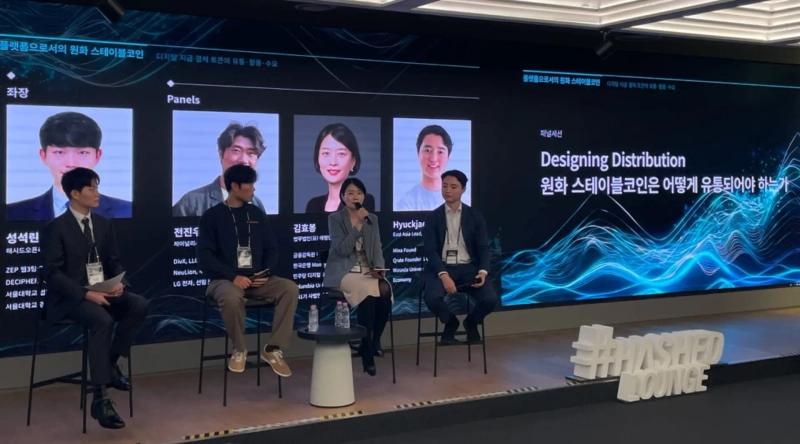
Experts agreed that the success of a won stablecoin depends not only on issuance requirements but also on design and governance at the distribution stage. They stressed that a risk-based approach, the use of public blockchains and a phased regulatory approach must work together.
Jin-woo Jeon, Executive Director at Chainalysis, emphasized the need for a risk-based approach, saying, "Trust in a stablecoin is tested not at issuance, but in the distribution stage." He advised that while a real-time detection system to screen and block high-risk transactions should be a prerequisite, the pace of adoption must also be managed within a controllable range the system can handle. If the balance between speed and control collapses, trust can be shaken as well.
Hyukjae David Park, East Asia Lead at Base, said, "We should pay attention to the trend of major countries accepting public chains as part of regulated infrastructure," adding, "If a won stablecoin is to function as global programmable money, it needs to be designed on a blockchain with interoperability and openness." Citing Japan's JPYC as an example, he added that a structure in which various players participate under clear standards can increase the ecosystem's dynamism. Base is a Layer 2 network developed by Coinbase, a global digital-asset exchange.
On regulation, another view was that differentiated application by stage is necessary. Hyo-bong Kim, an attorney at Bae, Kim & Lee LLC, said, "Because the issuance and redemption stages are the foundation of trust, strict management is necessary," but noted that "if the same level of regulation is applied all the way through the distribution stage, it will be difficult for diverse use cases to emerge." He said a balance is needed that guarantees autonomy in distribution markets within a range that does not undermine financial stability.
Moderator Seok-rin Sung of Hashed Open Research added, "A won stablecoin will be able to take root in the market only if it is designed together with auditable architecture, infrastructure with real-world usability, and a system with clear accountability."
Min-seung Kang, Bloomberg Bit reporter minriver@bloomingbit.io

Minseung Kang
minriver@bloomingbit.ioBlockchain journalist | Writer of Trade Now & Altcoin Now, must-read content for investors.