Trump tariffs had limited impact…U.S. imports hit a record high last year
Summary
- Despite the Trump administration’s tariff policy, the U.S. trade deficit fell only 0.2% while imports hit a record high.
- The U.S. trade deficit with China plunged 31.6% and China’s share of goods imports declined, while trade with Taiwan and Vietnam rose to record levels.
- Experts said it will take more time—beyond 2025—to assess the lasting impact of the Trump administration’s trade policy and where imports will stabilize.
Forecast Trend Report by Period



Donald Trump, the U.S. president, rolled out sweeping tariffs in a bid to reduce the trade deficit, but the measures appear to have delivered limited results. In recent months, a string of analyses has argued that the Trump administration’s tariff hikes have instead increased the burden on U.S. companies and consumers, putting “Trump tariffs” under fire ahead of the midterm elections. Still, some note that steep duties imposed on China pushed the U.S. trade deficit with China to its lowest level in more than 20 years, suggesting the tariff impact warrants closer monitoring.
◆Trade deficit down just 0.2%
The U.S. Commerce Department said on the 19th (local time) that the U.S. trade deficit totaled $901.5 billion last year, down 0.2% from the prior year. The decline was limited even compared with the Joe Biden administration’s figure (2024: $903.5 billion) or 2022, when the deficit hit a record wide gap ($923.7 billion).
Imports, which are directly affected by tariff policy, instead climbed to an all-time high. U.S. imports rose 4.8% ($197.8 billion) from a year earlier to $4.3338 trillion, while goods imports increased 4.3% to $3.4384 trillion. The Washington Post (WP) reported: “Economists said the persistent deficit despite new tariffs underscores the limits of a policy tool long favored by President Trump.”
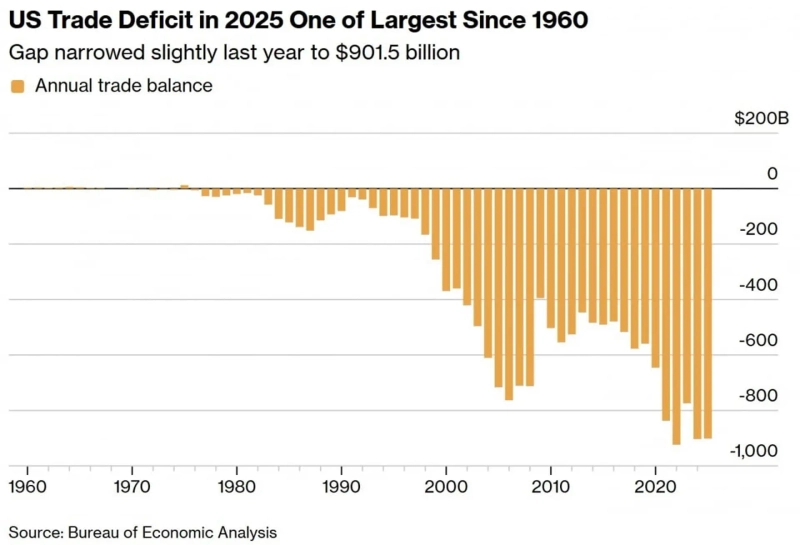
Monthly trade deficit figures also swung widely. After President Trump announced reciprocal tariffs in April last year, he repeatedly revised tariff policy, and tariff rates changed through negotiations with major trading partners including China, the European Union (EU), South Korea and Japan. From January to March last year, companies expanded imports ahead of the rollout of tariff measures, driving the trade deficit to a record high. After the reciprocal tariff announcement, the deficit narrowed, but as trade talks progressed it returned to typical levels in the second half of the year. In particular, the December trade deficit came to $70.3 billion, far above the market estimate of $55.5 billion compiled by Dow Jones.
◆Less imported from China…Taiwan and Vietnam filled the gap
A meaningful shift emerged in trade shares by country. U.S. companies bought fewer Chinese-made products and increased purchases from Taiwan and Vietnam. The U.S. trade deficit with China plunged 31.6% from the prior year ($295.5 billion) to $202.1 billion, the smallest since 2004. China’s share of U.S. goods imports also shrank to 9% from 13%.
As for the deficit with Taiwan, demand for hardware rose amid the boom in building artificial intelligence (AI) infrastructure, pushing the deficit up to $146.8 billion. Vietnam ($178.2 billion) saw trade expand as it served as an alternative manufacturing base to China. Both were record highs. Forbes analyzed that “at the center of changes in U.S. trade patterns are technology, energy self-sufficiency and tariff-avoidance strategies rather than geography.”
Meanwhile, some observers say it is still too early to judge the trade impact of tariffs, given that President Trump’s tariff policy has not been in place for long and policy uncertainty remains high. According to The New York Times (NYT), Bernard Yaros, a U.S. economist at Oxford Economics, said, “It’s still far too early to determine what lasting effects the Trump administration’s trade policy will have,” adding, “We still need to see where imports settle after the inventory effects from large-scale stockpiling in early 2025 fade.”
Reporter Han Kyung hankyung@hankyung.com

Korea Economic Daily
hankyung@bloomingbit.ioThe Korea Economic Daily Global is a digital media where latest news on Korean companies, industries, and financial markets.