U.S. moves from ‘global tariff’ to sector-specific duties… “Batteries and the power grid likely included”
Summary
- The Trump administration said it could raise the global tariff from 10% to 15% and warned it would impose higher tariffs on countries that reverse existing trade agreements.
- The U.S. is reviewing product-specific tariffs under Section 232 of the Trade Expansion Act for six areas including large batteries, the power grid, and telecommunications equipment, and is seeking to increase the effective burden by changing how steel and aluminum tariffs are calculated.
- Through Section 301 investigations, the U.S. could move from China and Brazil to Korea as well, with the possibility of maintaining a 15% tariff; the higher the estimated harm from Korea’s non-tariff barriers, the more a higher tariff rate could be justified.
Forecast Trend Report by Period


Trump: “Higher tariffs for countries trying to play games”
Threatens ‘retaliation’ if trade deals are reversed
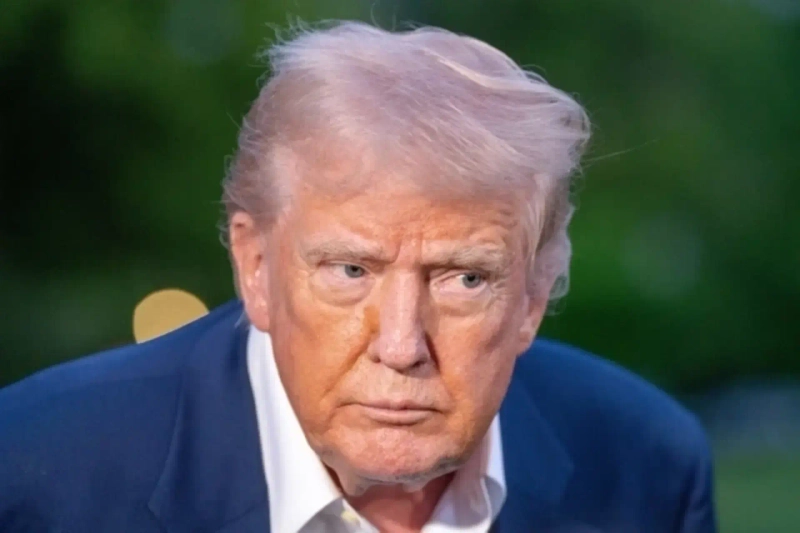
U.S. President Donald Trump threatened to impose higher tariffs on countries that roll back existing trade agreements with the United States, citing a federal Supreme Court ruling that deemed the reciprocal tariffs unlawful.
On 23 (local time), Trump wrote on social media: “If any country wants to play games because of the Supreme Court’s ridiculous decision—especially those that have been ripping off the United States for years and decades—they will face tariffs higher than what they recently agreed to, and something even worse.”
The global tariff Trump said he would impose after the Supreme Court’s ruling took effect at 12:01 a.m. Eastern on 24 (2:01 p.m. Korea time on the 24th). As stipulated in the executive order signed on the 20th, a 10% rate was applied. However, given Trump’s warning that he would raise the global tariff to 15%, it is expected to be increased to 15% in the near term through another executive order or a proclamation. Alongside the global tariff, the Trump administration is moving to use Section 301 of the Trade Act to levy duties on countries engaging in unfair trade, and to expand product-specific tariffs under Section 232 of the Trade Expansion Act.
Sector tariffs offer stronger legal footing
Korea hit with 15% on autos, 50% on steel… expansion to six areas including chemicals under review
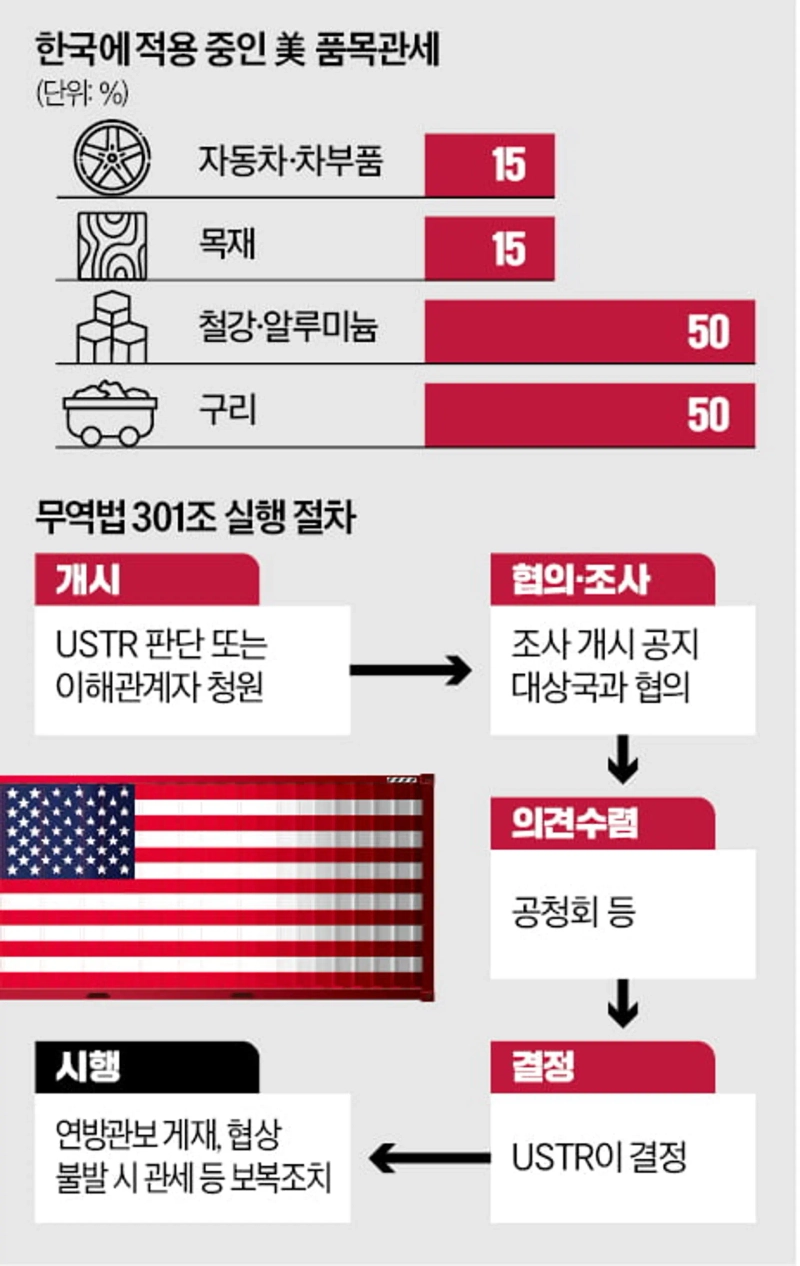
U.S. President Donald Trump has begun pulling out tariff tools prepared after the federal Supreme Court’s ruling striking down reciprocal tariffs. After launching investigations into unfair trade under Section 301 of the Trade Act and bringing into force a “global tariff” under Section 122 of the Trade Act at 12:01 a.m. Eastern on 24 (2:01 p.m. Korea time), the administration has also started reviewing an expansion of sector-specific duties under Section 232 of the Trade Expansion Act. The goal is to maintain tariff levels comparable to the previous reciprocal tariffs.
◇ Considering sector tariffs on batteries and more
The Wall Street Journal (WSJ) reported on 23 (local time) that the Trump administration is preparing to introduce new tariffs—likely in the form of product-specific duties—on six areas on national security grounds: large-scale batteries, cast iron and steel parts, plastic piping, industrial chemicals, the power grid, and telecommunications equipment.
To impose sector tariffs, the Commerce Department must prepare a report on how each item affects national security. The process can take up to 270 days.
The WSJ also said the Trump administration is considering changing the calculation method to increase the effective severity of sector tariffs. For example, steel and aluminum tariffs are currently assessed proportionally based on the share of those raw materials in the value of the finished product. Going forward, the plan under consideration would apply differentiated rates based on metal content but apply them to the entire product price—effectively raising the amount of tariff owed, the WSJ explained. Sector tariffs have stronger legal stability. Trump introduced steel tariffs during his first term, and sector-specific duties are currently in place on autos as well as steel and aluminum. The administration is also pushing to impose tariffs on semiconductors and pharmaceuticals.
◇ Key issue: quantifying harm from non-tariff barriers
Attention is also on how much Section 301 of the Trade Act—used to investigate unfair trade practices and impose tariffs—can substitute for the International Emergency Economic Powers Act (IEEPA). The Office of the U.S. Trade Representative (USTR) has already begun Section 301 investigations into China and Brazil.
Section 301 was previously used in Trump’s first term to impose tariffs on China. However, it did not operate by applying a uniform tariff to all Chinese goods; instead, it imposed different tariffs by industry and product category. That is because Section 301 actions proceed by first calculating damage to specific companies or sectors and then imposing corresponding retaliation. Multiple procedural steps are required, including notifying the counterpart country and holding public hearings. But once implemented, there is no cap such as a maximum tariff rate. Troy Stangarone, former director of the Korea History and Public Policy Center at the Woodrow Wilson Center, said, “If tariffs begin to be imposed on Korea following an investigation, even if it is not as unconstrained as under IEEPA, there is a strong likelihood President Trump could exercise significant authority.”
Unlike IEEPA, which is justified on national security grounds, Section 301 weighs the “degree of harm.” For Korea—which has a free trade agreement (FTA) with the United States—the key issue is non-tariff barriers. The structure is such that higher tariff rates can be justified only by claiming large-scale harm caused by Korea’s non-tariff barriers.
Peter Harrell, a senior fellow at the Carnegie Endowment for International Peace, said at a dialogue hosted that day by the Korea Economic Institute (KEI), “If they want to maintain a 15% tariff on Korea, they would have to investigate many unfair practices, but they probably can do it.” The Trump administration’s push to introduce these Plan B tariffs stems from the fact that the global tariff is, in principle, valid for only 150 days. Any extension would require congressional approval. Senate Democratic Leader Chuck Schumer said, “I will block any attempt to extend it when Trump’s (global) tariff expires this summer.”
Washington=Lee Sang-eun, correspondent selee@hankyung.com

Korea Economic Daily
hankyung@bloomingbit.ioThe Korea Economic Daily Global is a digital media where latest news on Korean companies, industries, and financial markets.