KOSPI’s ‘ultra-fast rally’… market cap tops 5 quadrillion won
Summary
- The KOSPI index broke above 6,000, and the KOSPI market’s market capitalization surpassed 5 quadrillion won.
- Over about a month, retail investors bought more than 19 trillion won of K-stocks and ETFs, signaling that a “second Donghak Ant Movement” is gaining traction.
- The third round of Commercial Act amendments—including mandatory treasury share cancellation—and expectations for improved earnings in semiconductors and financials are being cited as additional upside drivers for the KOSPI.
Forecast Trend Report by Period


5,000 in a month, now 6,000
Up 44% this year alone
Retail investors ‘sweep up’ 19 trillion won in a month
Driving the market’s sprint
Mandatory ‘treasury share cancellation’
Third round of Commercial Act amendments passes the National Assembly
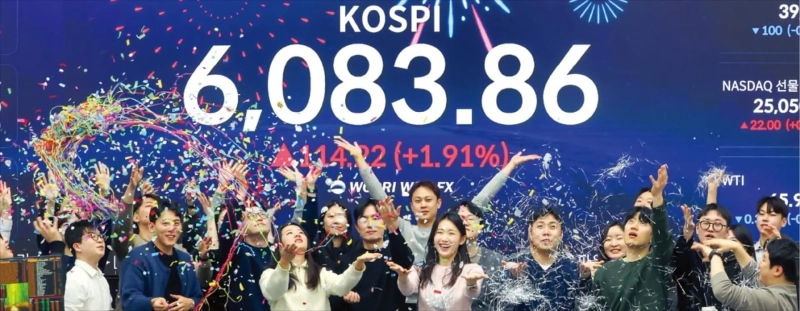
The surging KOSPI index has punched through even the “dream number” of 6,000—just about a month after reaching “5,000” (a KOSPI level of 5,000). It has fully shaken off the decades-long “Korea discount” (undervaluation of Korean equities) and achieved the distinction of ranking No. 1 globally in returns. With solid corporate earnings and policies to modernize capital markets as tailwinds, the market is increasingly being seen as heading into a full-fledged era of a “K-premium.”
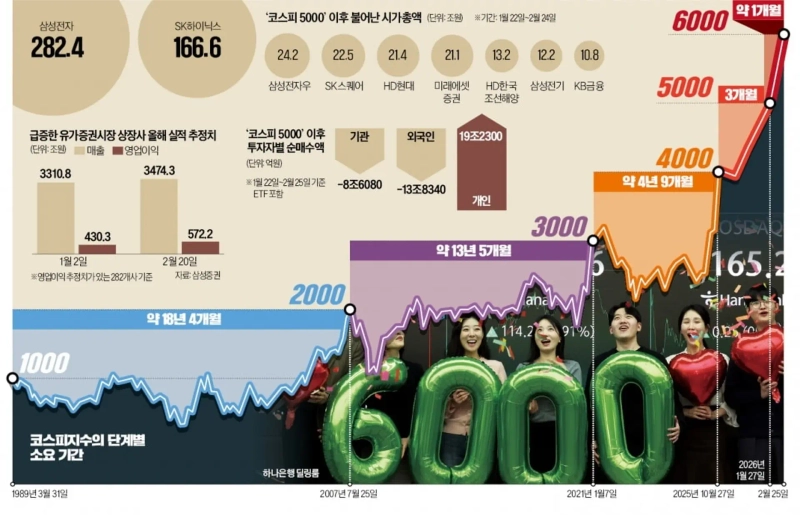
On the 25th, the KOSPI closed at 6,083.86, up 1.91%. The recent pace of gains has been unprecedented. It took about 18 years and 4 months to break from 1,000 to 2,000, 13 years and 5 months to 3,000, and 4 years and 9 months to 4,000—but only three months to reach 5,000, and just one month to clear 6,000. The market capitalization of the KOSPI market (5,016 trillion won) surpassed 5 quadrillion won for the first time ever, overtaking France to settle into ninth place globally.
Following last year’s 76% surge, the KOSPI’s rise this year (44%) also ranks a commanding No. 1 among the Group of 20 (G20). It has widened the gap significantly over No. 2 (Türkiye, 25%) and No. 3 (Brazil, 19%). The rally picked up speed after the index crossed 5,000 on the 22nd of last month, as retail investors gripped by FOMO (fear of missing out) piled in late. “Donghak ants” have snapped up more than 19 trillion won worth of ETFs and stocks on the KOSPI market over the past month.
Samsung Electronics and SK hynix, which each topped 200,000 won and 1,000,000 won the previous day, extended their record runs again, closing up 1.75% and 1.29%, respectively. Hyundai Motor and Kia also surged 9.16% and 12.70%, adding fuel to the index’s rise.
Another pillar supporting the market is the accelerating push for capital-market modernization. On the day, an amendment to the Commercial Act mandating the cancellation of treasury shares passed the National Assembly. It marks the third round of Commercial Act revisions following measures such as introducing directors’ duty of loyalty to shareholders and expanding cumulative voting. Choi Kwang-wook, CEO of The J Asset Management, said, “Korean equities—the biggest beneficiary of the AI revolution—no longer have a reason to trade at a discount,” adding, “If a full-fledged era of shareholder returns opens, the KOSPI could climb to the 8,500 range, around the average price-to-earnings ratio (PER, about 15x) of major countries.”
Retail investors join as ‘scale and makeup’ level up… KOSPI becomes the world’s No. 1 sprinter
Up 1,000 points in a month… the market’s ‘growth ceiling’ has swung wide open
The KOSPI’s record-fast leap from 5,000 to 6,000 reflects a confluence of a semiconductor-led recovery in listed companies’ earnings power and the government’s policies to improve the capital market’s fundamentals. As a breathless rally continued despite concerns of a short-term pullback after breaking the 5,000 barrier, retail investors have been belatedly sweeping up more than 19 trillion won in Korean stocks via ETFs. With investor deposits—often seen as sidelined buying power—standing at 100 trillion won, some are saying a “second Donghak Ant Movement” is now in full swing.
Retail ‘ants’ sweeping up domestic stocks
According to the Korea Exchange, from the 22nd of last month—when the KOSPI first broke above 5,000—through about a month thereafter, retail investors bought a total of 19.23 trillion won worth of securities on the KOSPI market, including ETFs. They have effectively become the protagonists of “6,000.”
Even when the KOSPI broke above 4,000, retail investors showed little interest in domestic equities. Their belief in an upward trajectory was focused on US stocks. What jolted retail buying into the Korean market was FOMO (fear of missing out). As the index approached 5,000, they pulled money out of banks and began chasing domestic equities higher.
Balances in demand deposits and time deposits at Korea’s five largest banks fell sharply last month alone—by 22.4705 trillion won and 2.4133 trillion won, respectively. Retail investors instead concentrated purchases in ETFs. Han Ji-young, a researcher at Kiwoom Securities, said, “The KOSPI’s roughly 8% jump over four sessions after the Lunar New Year holiday came from heavy accumulation of ETFs rather than individual stocks.”
Latecomer retail investors are also showing little hesitation about borrowing on a large scale to invest. The balance of margin loans, which stood at 21.4009 trillion won a year ago, rose 48% to 31.7123 trillion won as of the 23rd. Investor deposits reached 108.29 trillion won, repeatedly setting new records day after day.
Semiconductors pull, financials push
Behind retail investors’ purchases of domestic stocks are earnings expectations for the two bellwether names, Samsung Electronics and SK hynix. With surging demand from AI data centers, not only high-bandwidth memory (HBM) but also commodity memory chips are becoming scarce, pushing semiconductor prices ever higher. Semiconductor exports for the 1st to the 20th of this month totaled $15.115 billion, up 134.1% from a year earlier. Full-year operating profit estimates for Samsung Electronics and SK hynix are 179.7644 trillion won and 153.5068 trillion won, respectively—projected to swell 312.29% and 225.18% year on year.
Thanks to the semiconductor sector’s strength, listed companies’ operating profit on the KOSPI market this year is expected to jump 88% from last year to 572.2150 trillion won. That is why the recent surge has not triggered an intense overvaluation debate. The KOSPI’s 12-month forward PER stands at 10.4x, still around the average of the past decade.
Brokerages expect earnings estimates to keep being revised higher, on the view that the chip shortage will persist as semiconductor manufacturers refrain from aggressive capacity expansion. On the day, Macquarie Securities issued an eye-catching forecast that Samsung Electronics’ and SK hynix’s operating profits this year could reach 301 trillion won and 272 trillion won, respectively, while raising their target prices to 340,000 won and 1,700,000 won.
The government’s determination to support the stock market is also a factor stoking retail demand. While semiconductors, shipbuilding, and defense contributed heavily to the run-up to 5,000, the breakout above 6,000 was led by financials such as brokerages, banks, and insurers. As expectations for expanded shareholder returns grew, financial stocks shed their label as “perennially undervalued sectors.” From the 22nd of last month, when the index crossed 5,000, through the 24th of this month, the list of top gainers in market-cap increase included Mirae Asset Securities (about 21 trillion won) and KB Financial Group (about 11 trillion won). Expanding the window to the full year, sectors such as construction (65.7%), electrical and electronics (59.1%), and financials (41.8%) have posted sharp gains.
Shim Sung-mi/Kang Hyun-woo, reporters smshim@hankyung.com

Korea Economic Daily
hankyung@bloomingbit.ioThe Korea Economic Daily Global is a digital media where latest news on Korean companies, industries, and financial markets.