PiCK
"Will Bitcoin Get Breathing Room"…The 'Jane Street Shock' Rocking Crypto
Summary
- Terraform Labs’ bankruptcy trustee said he has formally launched legal action tied to Bitcoin and Terra–Luna, accusing Jane Street of front-running and market manipulation.
- The report noted claims that Jane Street, as an authorized participant (AP) and market maker for Bitcoin ETFs—particularly BlackRock’s IBIT—used algorithmic trading, short selling, and leveraged-liquidation triggers to drive a decline in Bitcoin prices.
- The report added that industry participants see potential upside if reforms to AP rules and the ETF redemption mechanism strengthen market transparency and competition in liquidity provision, potentially supporting higher Bitcoin prices and a larger crypto market capitalization.
Forecast Trend Report by Period



Allegations of front-running by global quantitative trading firm Jane Street—named as a key player behind the 2022 Terra–Luna collapse—are rattling the cryptocurrency industry. Some analysts say that if the episode leads to stronger transparency in crypto markets, it could ultimately become a catalyst that lifts Bitcoin (BTC) prices.
According to industry sources on the 27th, Todd Snyder, the bankruptcy trustee for Terra–Luna issuer Terraform Labs, recently filed a large-scale damages lawsuit against Jane Street in the United States. The allegation is that Jane Street engaged in front-running based on Terraform Labs’ inside information, helping trigger the collapse of the Terra–Luna ecosystem.
Snyder claimed, “Jane Street exploited market relationships in one of the most significant events in crypto history and manipulated the market to its advantage.”
"Jane Street drove Bitcoin lower"
Following Terraform Labs’ lawsuit, allegations have also surfaced that Jane Street amplified selling pressure in Bitcoin. Some observers believe Jane Street used algorithmic trading to push Bitcoin prices down around 10 a.m. Eastern Standard Time (EST), when U.S. stock markets open.
U.S. crypto influencer Justin Bechler described the pattern by saying, “The drop was sophisticated and algorithmic,” adding that “(the decline) was excessive even relative to overall market conditions.”
Some analyses suggest market manipulation may have been easier because Jane Street served as an authorized participant (AP) for BlackRock’s IBIT, the world’s largest spot Bitcoin exchange-traded fund (ETF). Under U.S. Securities and Exchange Commission (SEC) short-selling rules, APs can be exempted, allowing them to short ETF shares without borrowing them.
Bechler said, “As an AP and market maker (MM) for multiple Bitcoin ETFs, Jane Street had the infrastructure to execute large-scale selling via predictable liquidity channels,” adding that it “could have dumped sell orders into a thin order book right after the market open to push prices down, then triggered liquidations of leveraged traders to create opportunities to buy back at lower prices.”
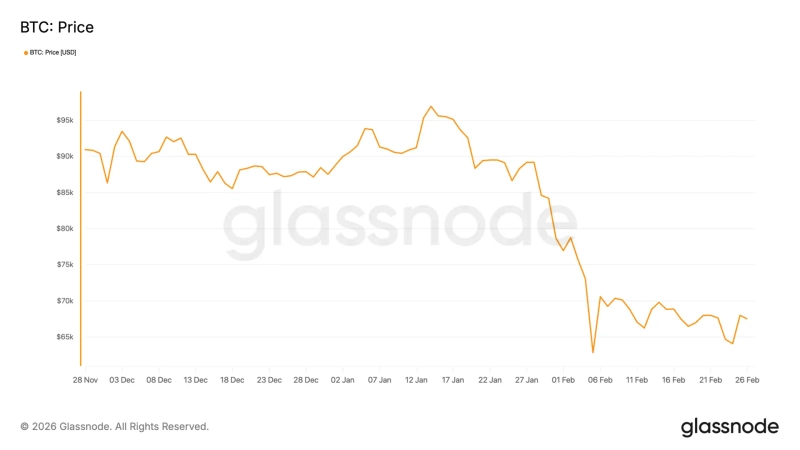
Bitcoin’s rise immediately after the lawsuit was filed also lends weight to these claims. After repeatedly underperforming and falling to the $62,000 range, Bitcoin began a clear upswing on the 24th, and two days later, on the 26th, climbed to the $69,000 range. Over the same period, total cryptocurrency market capitalization increased by nearly $200 billion.
Jeff Park, chief investment officer (CIO) at ProCap, said, “By exploiting regulatory exemptions, APs built short positions without buying spot Bitcoin and hedged with futures, distorting the market’s price-discovery mechanism,” adding, “Bitcoin prices will rise more naturally only if the ETF redemption mechanism and AP incentive structure are revisited.”
"Regulatory overhaul could spur liquidity competition"
Attention is now turning to whether regulations related to APs will be tightened in the wake of the episode. Industry participants say that because these allegations emerged during a transitional period in which crypto markets are being integrated into traditional finance (TradFi) systems, the need for related regulatory reforms is significant.
An industry official said, “If regulations are overhauled, barriers to entry for small and mid-sized market makers could be lowered,” adding, “If that fosters competition in liquidity provision, improved market transparency could increase capital inflows into Bitcoin.”
However, some argue a cautious approach is warranted given the allegations have not yet been closely verified. Bloomberg reported, “(Terraform Labs’) claims have not been verified, so the merits of the lawsuit remain unclear,” adding, “The suit has fueled industry suspicions that Wall Street entered the crypto market viewing volatility as a business model.”
Crypto news outlet CoinDesk said, “For Bitcoin ETFs, APs are allowed to create and redeem shares in an in-kind structure,” adding, “This structure is legal and not market manipulation, but it may have contributed to volatility around 10 a.m.”

JOON HYOUNG LEE
gilson@bloomingbit.ioCrypto Journalist based in Seoul