OpenAI becomes a $1.2 trillion company thanks to a new ‘kkangbu’
Summary
- OpenAI said that by raising $110 billion, it has secured financial leeway and can focus on AI model development, even as it is expected to remain loss-making through 2030.
- It said that through a strategic partnership with Amazon Web Services (AWS) and an AI infrastructure supply contract of up to $100 billion, OpenAI can reduce its dependence on Microsoft by diversifying providers.
- Experts were quoted as saying that the key going forward will be whether OpenAI can prove it is not a “bottomless money pit” and ease concerns about profitability and the AI bubble.
Forecast Trend Report by Period


Raises 159 trillion won from Amazon and others
Nvidia, SoftBank join the round
Biggest ever…rewrites startup history
Altman: “Secured a very long runway”
Worries over a “bottomless money pit” persist
OpenAI, under pressure, cooperates with the Pentagon
“We’ve secured a very long runway.”
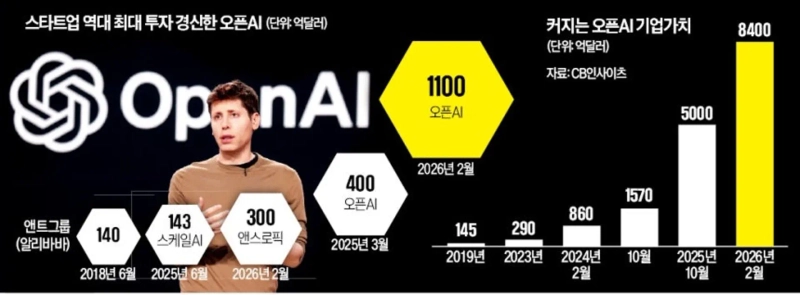
Sam Altman, CEO of OpenAI, described the significance of the company’s $110 billion fundraising announced on the 27th of last month (local time) in those terms. The deal signals that OpenAI—expected to remain in the red through 2030—has secured ample financial leeway through the anticipated initial public offering (IPO) expected after year-end. With this round, OpenAI has eased concerns over competition for computing resources and can focus on AI model development for the time being. Still, some argue that worries about an AI bubble—fueled by circular transactions—will persist until OpenAI moves onto a stable, profitable track.
◇Anxiety soothed for now, but…
The $110 billion OpenAI raised that day is unprecedented for a startup financing. It surpassed the company’s own $40 billion raise in March last year and is more than three times the $30 billion investment Anthropic announced on the 12th.
OpenAI’s latest fundraising was seen as a “barometer” of investor sentiment toward AI foundation models. Skepticism has been growing over how long capital markets can continue to be an inexhaustible well for developing AI models that rival—or surpass—human capabilities. Even Nvidia, which had originally pledged to invest $100 billion, walked back that commitment and concluded its relationship with OpenAI by investing only $30 billion this time.
What helped calm jitters was Amazon Web Services (AWS), Amazon’s cloud unit. The two companies formed a strategic partnership and agreed to expand an AI infrastructure supply contract from $38 billion over eight years to $100 billion. For OpenAI, this means it can diversify AI infrastructure demand away from its heavy reliance on Microsoft (MS) toward AWS.
AWS plans to supply OpenAI with its in-house AI chips, including Trainium4, on a 2-gigawatt (GW) scale. This mirrors how Google is fostering a rival to Nvidia’s graphics processing units (GPUs) by deploying Tensor Processing Units (TPUs) across its cloud services. In addition, OpenAI and AWS will jointly develop AI models tailored to Amazon’s customer-service operations. Bloomberg reported that Amazon will invest $15 billion upfront and will deploy the remaining $35 billion if OpenAI lists its shares or succeeds in developing artificial general intelligence (AGI).
◇“Proving profitability will determine survival”
Although OpenAI has succeeded in raising funds, the broad view is that the road ahead remains challenging. OpenAI said its “future leadership depends on scaling infrastructure fast enough to meet demand,” explaining the rationale for the massive raise. In other words, it intends to keep pouring money in to ensure the virtuous cycle—better model performance → more users → higher revenue → expanded infrastructure—does not break.
Experts agree that how soon OpenAI can prove it is not a “bottomless money pit” will determine the trajectory of the “AI bubble” debate. Attention is also focused on how the stance of its biggest rival, Anthropic—now at odds with the U.S. government—will play out. Citing concerns that AI technology should not be applied to lethal weapons, Anthropic refused cooperation requests from the Pentagon and faces the risk of having all business ties cut. OpenAI, by contrast, has been actively cooperating with the Pentagon and U.S. intelligence agencies, despite criticism that doing so runs counter to its mission of building “safe AI for humanity.”
Silicon Valley = Correspondent Kim In-yeop inside@hankyung.com

Korea Economic Daily
hankyung@bloomingbit.ioThe Korea Economic Daily Global is a digital media where latest news on Korean companies, industries, and financial markets.