"Living on monthly rent while investing in stocks and crypto"…The era of building wealth through jeonse is over
Summary
- The share of monthly rent for Seoul apartments has risen to 54.5%, and the monthly-rent share for all housing to 68.9%, accelerating the 'monthly-rent conversion of jeonse.'
- With fewer jeonse listings, rising jeonse prices, declining move-in volumes, and the fallout from jeonse fraud, preference for monthly rent is becoming pronounced, prompting diagnoses that 'the jeonse era is waning.'
- The report said a growing trend—especially among younger generations—is to choose monthly rent instead of jeonse and use the liquid assets secured for stock and cryptocurrency investment to seek higher returns.
Forecast Trend Report by Period


The age of 'monthly rent'…More than half of Seoul apartment lease deals
Monthly-rent share at 55%…overtakes jeonse
Nearing 70% when villas and studio units are included
Hollywood star Angelina Jolie signed a jeonse contract in 2019 for an apartment near Gwanghwamun in Seoul after her son enrolled at a Korean university. At the time, word had it that Jolie found it remarkable that under the jeonse system—where one can rent a home without monthly payments by putting down only a lump-sum deposit—tenants could live without paying rent. Jeonse, Korea’s distinctive lease arrangement, has long served as a “housing ladder” for ordinary people to build assets and buy a home. But analysts say that since the 2022 “Villa King” jeonse fraud, monthly rent has become the dominant choice not only in the row-house and multi-family market but also in apartments.
According to transaction data released by the Ministry of Land, Infrastructure and Transport on the 2nd, of 13,125 Seoul apartment lease transactions in December last year (new contracts), monthly rent—including semi-jeonse—accounted for 54.5% (7,148 cases). This was the first time the share of monthly rent for Seoul apartments surpassed jeonse on a monthly basis. Expanding the scope to all housing types including studio units and villas, the monthly-rent share reaches 68.9%.
Typically, monthly rent has been a housing option for small studio units and officetels aimed at one- to two-person households. But as jeonse listings shrink due to a shortage of apartment move-ins and contract renewals, and as landlords prefer monthly rent, the “monthly-rent conversion of jeonse” (the spread of semi-jeonse) has gained pace. Among younger people in particular, the asset-management paradigm is also shifting: instead of entrusting landlords with apartment jeonse deposits of several hundred million won, more are using their money for financial investments such as stocks and cryptocurrencies.
Apartment monthly-rent share surpasses jeonse…Don’t sit on a lump sum—invest it
Lee (29), who graduated from graduate school last month, is looking for a monthly-rent home near Hawolgok-dong in Seongbuk-gu, Seoul, convenient for commuting. Because his income exceeds the threshold, it is difficult to obtain the “Youth Jeonse Support Loan,” a jeonse loan product, and with no plan to stay long term, public rental housing is also not easy to access. “If I take out a bank loan to find a jeonse home, once you factor in interest and such, it doesn’t seem much different from monthly rent,” Lee said. “I was also worried about jeonse fraud, so I decided to pay monthly rent.”
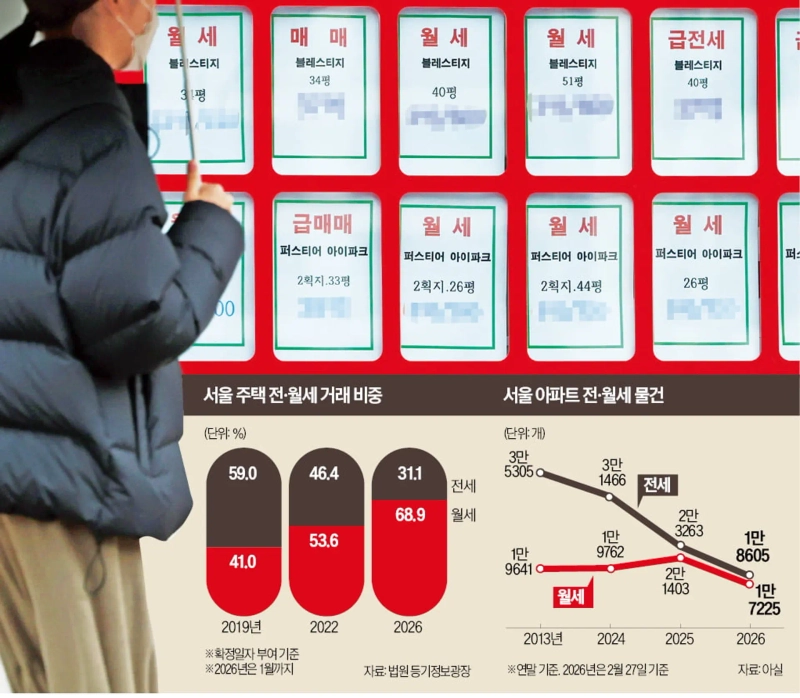
In Seoul’s housing lease market, the share of monthly rent is surging to around 70%. Just 4 to 5 years ago, it hovered around 50%. Demand is rapidly shifting toward monthly rent, a trend attributed to the fallout from villa jeonse fraud, fewer move-in volumes, rising jeonse prices, and more contract renewals.
◇Housing monthly-rent share likely to soon exceed 70%
According to the Ministry of Land, Infrastructure and Transport on the 2nd, of 253,410 nationwide jeonse and monthly-rent housing transactions in January, the share of monthly rent (including semi-jeonse) hit a record high of 66.8% (169,305 cases). Compared with January 2022 (45.6%), it has jumped by more than 20 percentage points in four years. In Seoul, the monthly-rent share of lease transactions reached 68.9% (based on the Court Registry Information Plaza). Forecasts say it will soon exceed 70%.
Apartments, too, saw monthly rent surpass half. Of 13,125 Seoul apartment lease transactions in December last year (new contracts), monthly-rent deals totaled 7,148, or 54.5%. This was the first time on a monthly basis that monthly rent exceeded jeonse. In January this year, it slipped slightly to 51.4% but still remains above half.
The main reason monthly-rent deals are increasing in the lease market is cited as the decline in jeonse listings. According to the real-estate platform Asil, as of Feb. 27 last month, Seoul apartment jeonse listings were tallied at 18,605 households. That is down 41.6% from early last year (as of Jan. 1: 31,814 households). Jeonse listings fell in 23 of Seoul’s 25 districts. In eight districts—Seongbuk-gu (-86.7%), Gwanak-gu (-80.7%), Nowon-gu (-77.1%), Gangdong-gu (-76.9%), Dongdaemun-gu (-75.4%), Gangbuk-gu (-74.4%), Jungnang-gu (-72.6%), and Eunpyeong-gu (-71.9%)—jeonse listings plunged by more than 70%.
As the era of high interest rates fades, landlords also have less incentive to make use of jeonse deposits. Jeonse fraud, which has surfaced mainly in non-apartment properties such as villas, is also a factor fueling preference for monthly rent.
◇“The jeonse era is waning”
With jeonse prices rising amid supply shortages such as declining move-in volumes, the “monthly-rent conversion of jeonse” is accelerating. According to the “Planned Apartment Move-ins” report recently jointly released by the Korea Real Estate Board and Real Estate R114, planned move-ins for Seoul apartments this year are estimated at 27,158 households. That is 58.1% of last year’s level (46,710 households). Next year is expected to fall further to 17,197 households.
Experts expect the share of monthly rent to expand further amid a shortage of jeonse listings. Park Won-gap, senior real-estate expert at KB Kookmin Bank, said, “As jeonse listings become scarce, more tenants are exercising the right to request contract renewal and staying put, and jeonse supply in circulation is shrinking due to requirements such as owner-occupancy obligations tied to mortgage loans.” He added that the phrase “the jeonse era of building wealth is waning” is no longer unfamiliar. “Among younger generations, a shift in the asset-management paradigm is also accelerating the move to monthly rent,” he said. “More young people are choosing monthly rent instead of jeonse and investing the liquidity they secure in stocks and cryptocurrencies in pursuit of higher returns.”
Forecasts increasingly point to a rise in the share of apartment monthly rent following studio units and villas. Lee Eun-hyung, a research fellow at the Korea Research Institute for Construction Policy, said, “Among tenants, cases are increasing where, if they are going to live on monthly rent anyway, they choose apartments with better living conditions,” adding, “The pace at which jeonse is converting to monthly rent has been very fast recently in the apartment market.”
Jung Rak Ahn/Geun-ho Lim/Yu-rim Oh, reporters jran@hankyung.com

Korea Economic Daily
hankyung@bloomingbit.ioThe Korea Economic Daily Global is a digital media where latest news on Korean companies, industries, and financial markets.