PiCK
Bitcoin Whipsaws on Roller-Coaster Ride as US-Iran Military Clash Looms
Summary
- Bitcoin has fallen more than 20% so far this year, slipping below 100 million won, prompting assessments that its appeal as an investment asset has weakened.
- With risk-off sentiment strengthened by the US-Iran airstrikes, the Warsh shock and a tariff offensive, selling pressure on Bitcoin increased, while market sentiment remained in extreme fear territory.
- Some see room for Bitcoin to fall to $50,000, while others view the pullback as a dip-buying opportunity, reflecting a coexistence of bearish and bullish views.
Forecast Trend Report by Period


Risk appetite sours after the 'Warsh shock'
Down more than 20% this year, slipping below 100 million won
Brief dip-buying emerged immediately after airstrikes
Market sentiment in 'extreme fear' territory
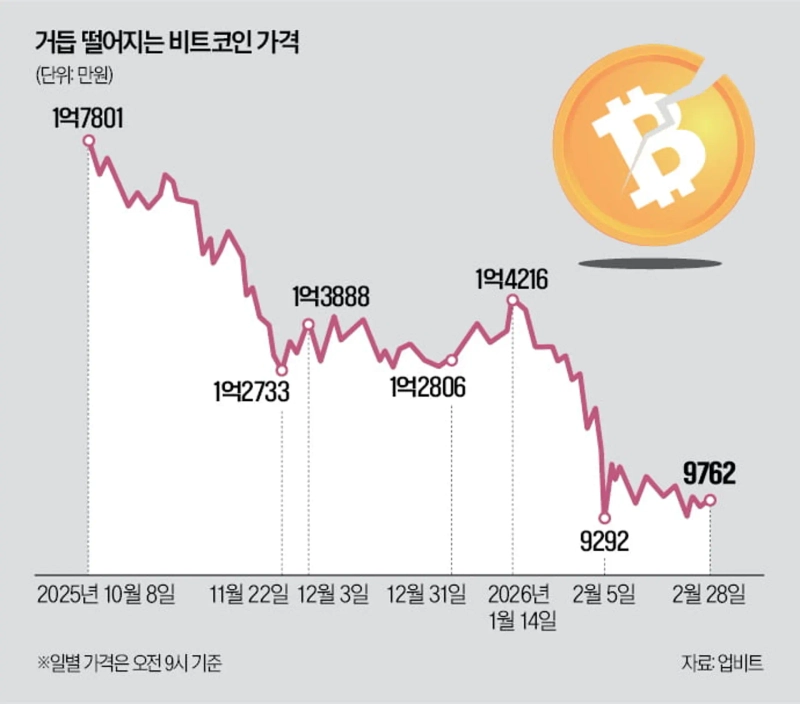
Bitcoin has been in a downtrend for more than a month. It has fallen more than 20% so far this year, dropping below 100 million won. With risk sentiment still frozen in the wake of the so-called "Warsh shock"—after Kevin Warsh, a former US Federal Reserve (Fed) governor known as a hawk (favoring monetary tightening), was nominated as the next Fed chair—military tensions between the United States and Iran have added further headwinds. Some even say its appeal as an investment asset has weakened. Still, others argue that the steep short-term drop has created a buying opportunity. For now, financial markets are expected to remain in a phase where pessimism and optimism coexist.
◇Cooled risk appetite
According to cryptocurrency exchange Upbit on the 3rd, Bitcoin was trading in the 97 million won range as of 9 a.m. on the 1st. It has fallen 23.8% in just two months this year. Since Oct. 9 last year, when it hit an all-time high (intra-day 179.87 million won), it has plunged 45.7% over about four months.
After reports on the 28th last month that the United States and Israel carried out airstrikes on Iran, Bitcoin retreated to around 92 million won in Korea. In general, when market uncertainty spikes sharply—such as during wars or localized conflicts—investors tend to shift funds into traditional safe havens such as the US dollar, gold and US Treasuries to reduce risk. In the process, Bitcoin, classified as a risk asset, is more likely to face heavier selling pressure. It also fell more than 6% in dollar terms, sliding to the low-$63,000 range.
However, Bitcoin staged a technical rebound and recovered to the 97 million won range. This is interpreted as dip-buying interest flowing in after the oversold conditions that emerged immediately following the US-Israel strikes on Iran. In global markets, it traded around $67,000.
The market appears to be taking the view that the geopolitical uncertainty that had briefly intensified following the Iran strikes and Khamenei’s death has partially eased. Some interpret the rebound as an "relief rally" that tends to appear after the worst-case scenario has already been priced in. Bitcoin’s so-called kimchi premium stood at 0.64%. A higher kimchi premium means the domestic trading price is higher than overseas quotes.
The Fear & Greed Index, a gauge of market sentiment, remained at 11, in the "extreme fear" zone. The closer the index is to 0, the more likely investors are to tilt toward fear-driven selling, while levels near 100 are seen as signaling heightened risk of a pullback due to overheating.
Bitcoin’s weakness stands out even more when compared with other assets this year. It was also soft when gold, a representative safe haven, repeatedly notched fresh record highs in January and surged past $5,600 per troy ounce. Considering the S&P 500 and Nasdaq indices have been largely flat, Bitcoin’s price action has also diverged from risk assets such as equities.
Analysts say the "Warsh shock" is weighing heavily on Bitcoin. Concerns that interest rates may not fall—and could even rise—have undermined appetite for risk assets. Because Bitcoin offers neither interest nor dividends, it tends to look less attractive than stocks during periods of rising rates. The crypto industry also argues that a supply-and-demand structure with a high share of leveraged trades funded by borrowing amplified the decline. The claim is that when a negative catalyst triggers a sharp selloff, forced liquidations follow, pushing prices even lower. A key example was the 24th last month, when a global tariff (10%) was imposed on all countries’ exports to the United States. As anxiety grew that the US government could launch another round of tariff offensives, risk sentiment deteriorated and Bitcoin tumbled to the 92 million won range.
◇Deepening pessimism
In the market, pessimism that Bitcoin could fall further is intensifying. Global investment bank Standard Chartered (SC) last month cut its 2025 year-end target for Bitcoin from $150,000 to $100,000. That came just two months after it had sharply revised the target down from $300,000 to $150,000 on Dec. last year. The bank said that if sentiment worsens further, Bitcoin could drop to $50,000 (about 72 million won). Geoffrey Kendrick, Global Head of Digital Assets Research at SC, said, "As outflows from spot crypto exchange-traded funds (ETFs) accelerate and even the possibility of Fed rate cuts has faded," adding, "We expect further capitulation in the coming months."
Confidence in its stability also appears to be wavering. Nouriel Roubini, professor emeritus at New York University known as "Dr. Doom" for predicting the 2008 financial crisis, wrote in a recent contribution to an international opinion platform, "Over the past year of geopolitical crises, gold rose 60%, but Bitcoin’s value fell 6%," adding, "Bitcoin has become a tool that amplifies risk rather than a hedge."
Many investors, however, still believe it is time to buy. Valery Vavilov, CEO of Bitfury, which began as a Bitcoin mining company and has shifted into a blockchain investment firm, said on social media that "this price decline is an opportunity to rebalance portfolios and accumulate Bitcoin at lower levels."
Reporter Kim Jin-sung jskim1028@hankyung.com

Korea Economic Daily
hankyung@bloomingbit.ioThe Korea Economic Daily Global is a digital media where latest news on Korean companies, industries, and financial markets.