Summary
- The Financial Services Commission said it will introduce market makers (MMs) under the Digital Asset Basic Act to provide liquidity to the crypto market and reduce price volatility.
- It said the introduction of market makers is expected to ease price distortions in Korea’s crypto market, including newly listed digital assets, won-denominated stablecoins, and the Kimchi premium.
- It said exchanges such as Upbit and Bithumb, along with professional institutional investors and new crypto trading firms or overseas institutions, will participate as market makers, reshaping Korea’s crypto market into a regulated, liquidity-based market.
Forecast Trend Report by Period


Posting bid and ask quotes for digital assets
Supplying liquidity to curb market distortions
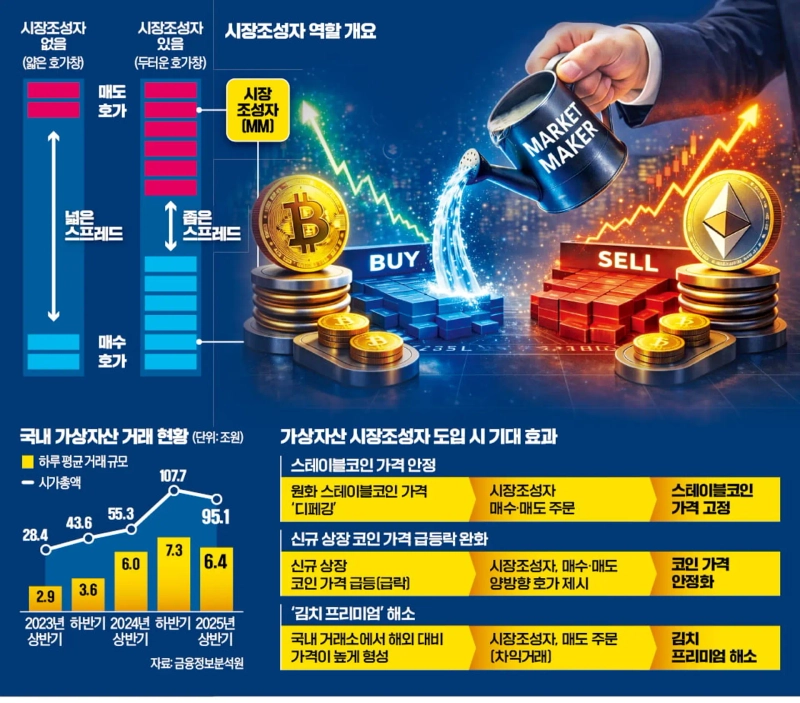
Financial authorities are moving to swiftly introduce a “market maker (MM)” regime to provide liquidity to the crypto market.
The idea is that professional institutional investors—much like in the stock market—would continuously post bid and ask quotes, speeding up trade execution and reducing price volatility. The change is expected to ease chronic distortions in Korea’s crypto market, including excessive price spikes immediately after listings and abnormally high domestic trading prices compared with overseas markets.
According to the National Assembly and the crypto industry on the 3rd, the Financial Services Commission (FSC) plans to include provisions in the Digital Asset Basic Act—set to be announced later this month—that would legalize market-making activity. Based on this, it intends to transplant the market-maker system currently used in the stock market into the crypto market.
A market maker is an entity that provides liquidity by posting both buy and sell quotes for a given asset. By forming a dense order book, it increases execution speed and reduces slippage (the gap between an expected trade price and the actual execution price), a cost incurred during trading.
Market makers are used not only in Korea’s stock market but also on global crypto exchanges such as Binance and Coinbase. In contrast, market-making activity is effectively prohibited in Korea’s crypto market. Under the current Virtual Asset User Protection Act, market making is interpreted as market manipulation.
Market makers are also seen as core infrastructure for establishing a won-denominated stablecoin. When a depegging event occurs—where a stablecoin’s price deviates from 1 won—market makers can use arbitrage to bring the price back to parity. Kim Min-seung, head of Korbit’s Research Center, said, “The role of market makers is essential for the stable circulation of spot Bitcoin exchange-traded funds (ETFs), which will be allowed later, and won-denominated stablecoins.”
Transplanting a stock-style trading system into the crypto market
Authorities bolster efforts to bring the coin market into the mainstream
In October last year, the price of Tether (USDT), the world’s largest dollar stablecoin, briefly surged to 5,700 won on Bithumb, a Korean crypto exchange. At the same time, on global crypto exchanges such as Binance and Coinbase, Tether traded around its usual level of $1. A strange phenomenon occurred in which USDT spiked only on Bithumb. While buying interest in USDT on Bithumb temporarily surged, sell orders were far too scarce—creating a “price distortion.” Financial authorities’ decision to introduce a market maker (MM) regime into the crypto market is aimed at raising the framework for quotes, execution, and liquidity provision to the level of the stock market. With market makers in place, expectations are growing that Korea’s crypto market will be reshaped into a regulated, liquidity-based market.
◇ Professional institutions to participate as market makers
According to the financial sector on the 3rd, the FSC plans to include provisions in the forthcoming Digital Asset Basic Act allowing market-making activity. The plan is to benchmark the stock market’s market-maker system and transplant it into the crypto market. The Capital Markets Act permits “stabilization operations and trading for the purpose of market making” as exceptions to price manipulation. By contrast, the current Virtual Asset User Protection Act lacks such exceptions, meaning liquidity provision can be punished as unfair trading, including price manipulation.
Because institutional investors and ordinary corporations are effectively barred from investing in crypto at present, Korea’s crypto market has relied excessively on retail trading. Under this structure, when supply and demand concentrate at a particular time, the order book thins and prices can be easily distorted—a point that has been repeatedly raised. In line with the “roadmap for corporate participation in the crypto market” announced last year, authorities also set a policy to gradually allow participation by listed companies and corporations registered as professional investors.
◇ Exchanges may also contract directly
The crypto market-maker regime is expected to operate along two main tracks. As the Korea Exchange signs market-maker contracts with 10 securities firms in the stock market, one option under discussion is for crypto exchanges such as Upbit and Bithumb to assign market-making activity to professional institutional investors. In Korea’s stock market, securities firms regularly submit buy and sell orders for roughly 700 stocks listed on the KOSPI and KOSDAQ markets to support trade execution. For example, if many investors want to buy a stock but few are willing to sell, a market maker can fill the gap by placing sell orders.
Another likely model is for foundations or projects that issue crypto assets to sign liquidity-provision agreements with professional institutions. For newly listed digital assets, the market-maker role is essential to prevent prices from swinging abnormally. This is similar to how, when an asset manager issues an ETF, it designates 2–3 securities firms as liquidity providers. An industry source said, “Exchanges such as Upbit and Bithumb making markets directly would amount to wash trading and will likely be prohibited,” adding, “New domestic crypto trading firms or overseas institutions are expected to take on the market-maker role.”
◇ Expectations for easing abnormal price distortions
To date, Korea’s crypto market has suffered a range of side effects due to the absence of market makers. With reliance limited to retail investors’ buy and sell flows, prices of newly listed digital assets have repeatedly surged or plunged abnormally, and stablecoin quotes in the won market have been distorted. Many analyses also attributed the “Kimchi premium”—where crypto trades at an unusually higher price on Korean exchanges than overseas—to the lack of market makers. Kim Min-seung, head of Korbit’s Research Center, said, “If market makers reduce price distortions, investors can cut trading costs.”
Authorities had refrained from introducing market makers to the crypto market partly because of a strong view that “crypto assets = speculative assets.” An industry source said, “We understand the authorities have shifted their stance, recognizing crypto assets as one pillar of a new industry and introducing a market-maker system to bring the market further into the mainstream.”
The view that market makers are essential to introduce a won-denominated stablecoin also appears to have influenced the move. The defining feature of stablecoins is that their value is pegged to fiat currency and the like. When a stablecoin deviates from its reference price on a crypto exchange, market makers can promptly use arbitrage trading to restore it to parity.
▶Market maker
An entity that supplies liquidity so investors can trade at any time by posting both buy and sell quotes for a particular asset.
Seo Hyeong-gyo/Jo Mi-hyeon, reporters seogyo@hankyung.com

Korea Economic Daily
hankyung@bloomingbit.ioThe Korea Economic Daily Global is a digital media where latest news on Korean companies, industries, and financial markets.