PiCK
Trump mentions ground troops: "The toughest attack yet—this hasn’t even started"
Summary
- The U.S.–Iran war is spreading across the Middle East, and Washington said it is signaling even more forceful attacks on Iran together with its allies.
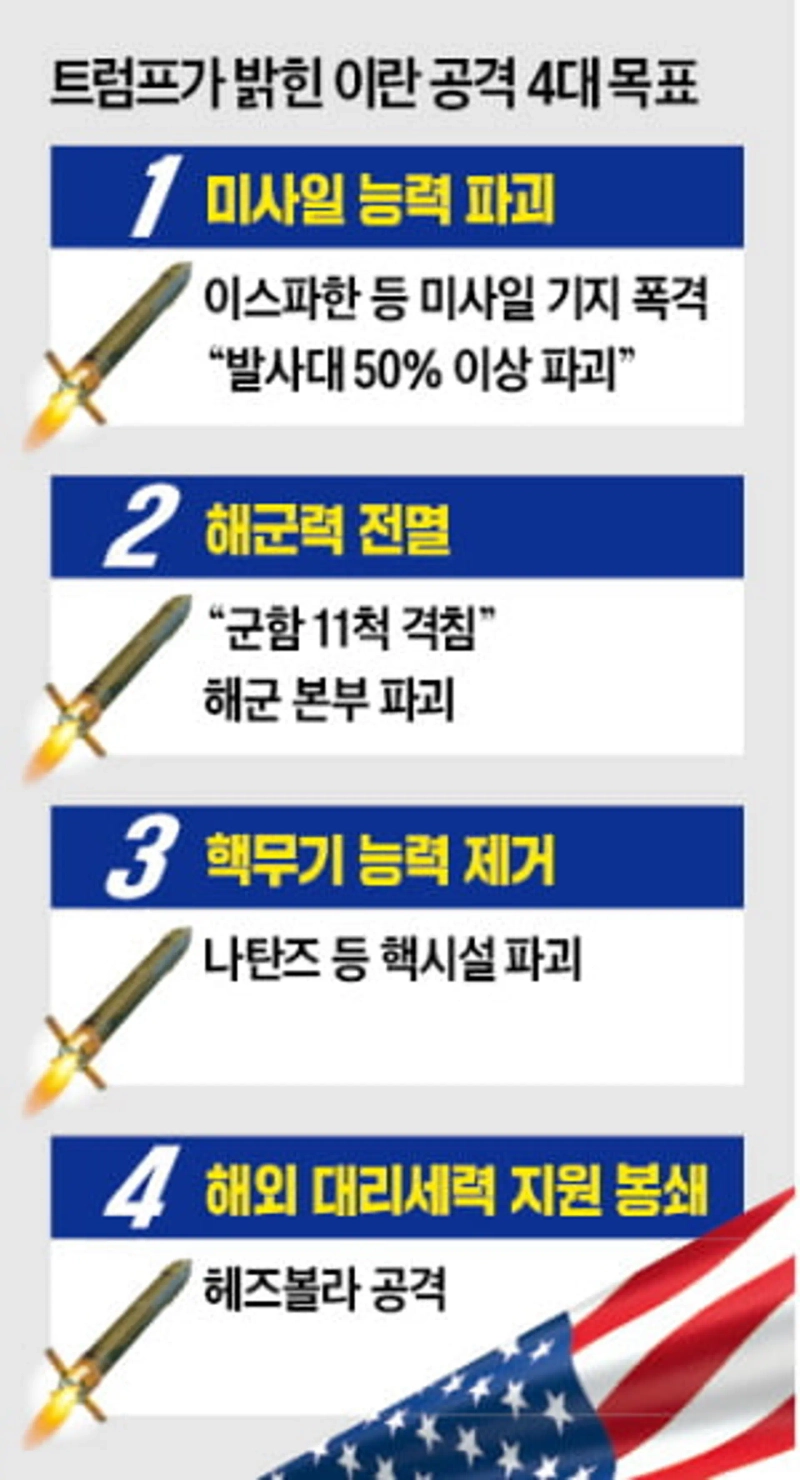
- President Trump presented the military operation’s goals as destroying Iran’s missile capability, annihilating its navy, blocking nuclear weapons acquisition, and ending support for terrorist armed groups.
- Bloomberg said a war of attrition in ammunition and missiles is unfolding due to the large cost gap between Iran’s low-cost 'Shahed-136' drones and the interceptor missiles used to shoot them down.
Forecast Trend Report by Period


U.S.: "The war could last another 4–5 weeks"…signaling a protracted conflict with Iran
U.S. concentrates strikes on Iran’s naval power and more
Iran mounts fierce retaliation…6 U.S. troops killed
Trump hints at deploying 'ground troops'
Ammunition and missile war of attrition emerges as key variable
Europe and six Gulf states rally around U.S.-led camp
The war between the United States and Iran is spreading across the Middle East. As Iran responds indiscriminately to U.S. and Israeli attacks—striking U.S. bases in the region as well as U.S. embassies and airports—the United States has warned of even more forceful attacks.
◇ "The massive wave hasn’t even begun"
Saudi Arabia said on the 2nd (local time) it shot down eight Iranian drones flying toward the capital Riyadh and Al Kharj. The U.S. Embassy in Riyadh was hit by drone attacks twice. Qatar said it "shot down two fighter jets approaching from Iran and intercepted five ballistic missiles and seven drones." As Iran launched indiscriminate attacks across the region, these countries also moved to defend themselves. The United States disclosed that five countries—Qatar, the UAE, Kuwait, Jordan, and Saudi Arabia—are supporting the U.S. with air-defense batteries.
In an interview with CNN, U.S. President Donald Trump signaled additional strikes, saying "the massive wave hasn’t even risen yet." At a Medal of Honor ceremony at the White House, he said, "I expected the war with Iran to take 4–5 weeks, but we have the ability to sustain it longer than that." Secretary of State Marco Rubio also said, "The most powerful blow by the U.S. military hasn’t even happened yet."
The U.S. Department of Defense said at its first press briefing since the outbreak of the war the previous day that it had struck more than 1,000 targets, including command-and-control infrastructure inside Iran, naval forces, and ballistic-missile bases. U.S. Central Command said, "Just two days ago the Iranian regime had 11 vessels in the Gulf of Oman, but today they have none." The U.S. military deployed additional B-1 bombers following B-2 stealth strategic bombers.
◇ Trump: "No aversion to ground troops"
Trump, who even mentioned ground forces, also laid out four objectives for the Eber military operation. He said, "First, destroy Iran’s missile capability; second, annihilate their navy; third, ensure the world’s leading state sponsor of terrorism never obtains a nuclear weapon," adding, "Finally, we will prevent the Iranian regime from continuing to arm and support terrorist armed groups outside its borders." He did not mention regime change.
He also did not rule out the possibility of deploying ground forces. In an interview with the New York Post, he said he has "no aversion" to ground troops. However, in an interview with NewsNation, he said, "There will be no need to send in ground troops." If ground forces are deployed, the character of the war itself could change completely. Still, the likelihood of a U.S. ground deployment is low given the risk of rising U.S. casualties. So far, six U.S. troops have been killed. While the possibility of Israel deploying ground forces has been raised, it is still unclear whether Israel will make such a decision.
There is also a view that Iran is striking a range of targets with low-cost drones and conventional weapons to deliberately accelerate ammunition depletion. Bloomberg analyzed that while Iran’s flagship drone, the "Shahed-136," costs around $20,000 (30 million won), interceptor missiles used to shoot it down cost $4 million (about 6 billion won).
◇ Europe joins the defensive effort
With the war now underway, allies and Gulf states appear to be coalescing around the United States. After the six GCC members declared their response stance, support from allies including Europe has also followed. UK Prime Minister Keir Starmer allowed the United States to use UK military bases for the Iran air campaign, limited to defensive purposes. The UK’s RAF Akrotiri base in Cyprus was later hit by Iranian drone attacks.
Still, Starmer drew a line, saying he would not participate in U.S. and Israeli airstrikes on Iran. Greece said it would defend Cyprus and sent warships and fighter jets to the area. France also dispatched warships near Iran.
Washington=Correspondent Lee Sang-eun selee@hankyung.com

Korea Economic Daily
hankyung@bloomingbit.ioThe Korea Economic Daily Global is a digital media where latest news on Korean companies, industries, and financial markets.