PiCK
Overnight FX rate ends at 1,485.7 won… briefly tops 1,500 won intraday for the first time in 17 years
Summary
- The won-dollar exchange rate briefly broke above 1,500 won in overnight trading and ended at 1,485.7 won, the highest level since the global financial crisis.
- The report said a spike in WTI crude—driven by a Strait of Hormuz blockade and a halt to crude production at Iraq’s Rumaila oil field—added to upward pressure on the won-dollar exchange rate.
- It said the dollar index (DXY) rose on growing safe-haven demand, and that a weaker won could intensify upward pressure on prices and fuel concerns about monetary tightening.
Forecast Trend Report by Period


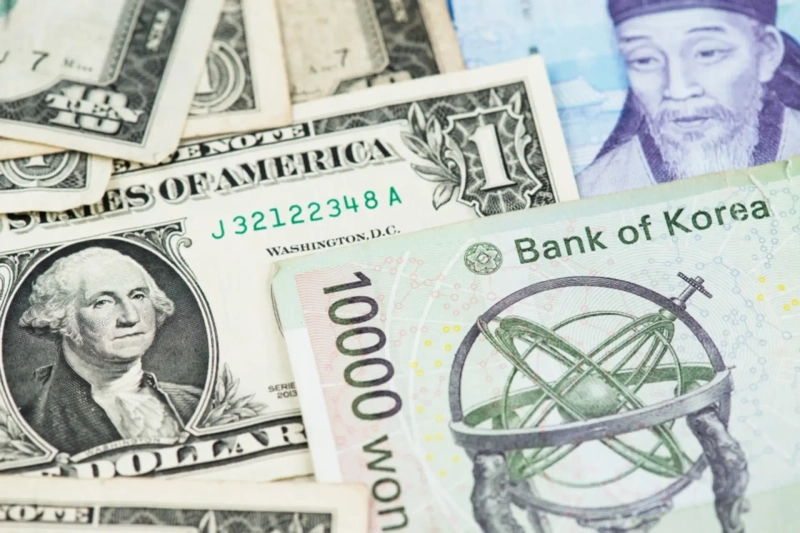
The won-dollar exchange rate briefly surged above 1,500 won in overnight trading, hitting its highest level since the global financial crisis.
At 2 a.m. on the 4th (Korea time), the won-dollar rate closed at 1,485.7 won, up 46 won from the previous session’s close in the Seoul market. This marks the biggest one-day gain since Nov. 6, 2008 (64.80 won). Back then, however, overnight trading had not yet been introduced.
Compared with the daytime session (9:00 a.m.–3:30 p.m.) close of 1,466.1 won, it rose by 19.6 won. After entering the New York session around the 1,475-won level, the won-dollar rate came under upward pressure amid jitters over global energy supply and demand.
The move was driven by Iraq’s suspension of crude production at Rumaila—its second-largest oil field—following Iran’s move to block the Strait of Hormuz. April-delivery West Texas Intermediate (WTI) crude at one point jumped more than 9% from the previous session.
As demand for safe-haven assets spread, the dollar index (DXY), which tracks the greenback against six major currencies, climbed as high as 99.685 intraday. In tandem, the won-dollar rate briefly spiked to 1,506.5 won (per Korea Money Brokerage). It was the first time the rate broke above 1,500 won intraday since March 2009.
Cho Yong-gu, a researcher at Shinyoung Securities, said, “With the Strait of Hormuz blockade, safe-haven demand is likely to become pronounced in financial markets this week,” adding that “a rising won-dollar rate could broaden upward pressure on prices, and from a monetary-policy perspective, if inflation crosses a threshold, it could stoke concerns about tightening.”
Noh Jeong-dong, Hankyung.com reporter dong2@hankyung.com

Korea Economic Daily
hankyung@bloomingbit.ioThe Korea Economic Daily Global is a digital media where latest news on Korean companies, industries, and financial markets.