With domestic demand slump, China sets this year’s growth target at 4.5–5%…the lowest in 35 years
Summary
- China said it lowered this year’s economic growth target to 4.5–5% for the first time in four years, reflecting weak domestic demand and external uncertainty.
- China said it will maintain an expansionary fiscal stance, including a fiscal deficit of about 4% of GDP, 1.3 trillion yuan in ultra-long special government bonds, and 4.4 trillion yuan in special-purpose bonds.
- China said it will pursue technological self-reliance and build new growth engines by raising the central science and technology R&D budget by 10% (to 426.4 billion yuan) and expanding investment in advanced-technology industries.
Forecast Trend Report by Period


NPC opens…first acknowledgment of entering a ‘medium-speed growth’ phase
Xi, ahead of a fourth term, puts emphasis on fundamentals
Iran war adds uncertainty to energy supply
Growth target lowered for the first time in four years
Issuance of 276 trillion won in government bonds to boost domestic demand
R&D budget up 10% to 90 trillion won
Competition with the U.S. for ‘tech supremacy’ continues
The Chinese government presented a 4.5–5% economic growth target for this year—the lowest in 35 years. It effectively marks the first official acknowledgment that the country has entered a medium-speed growth phase (4–7% annually). Analysts say the leadership made the decision despite concerns it could be seen as waning confidence in the economy, taking into account internal and external factors including a tariff war and regime stability.
Fundamentals over growth-rate showmanship
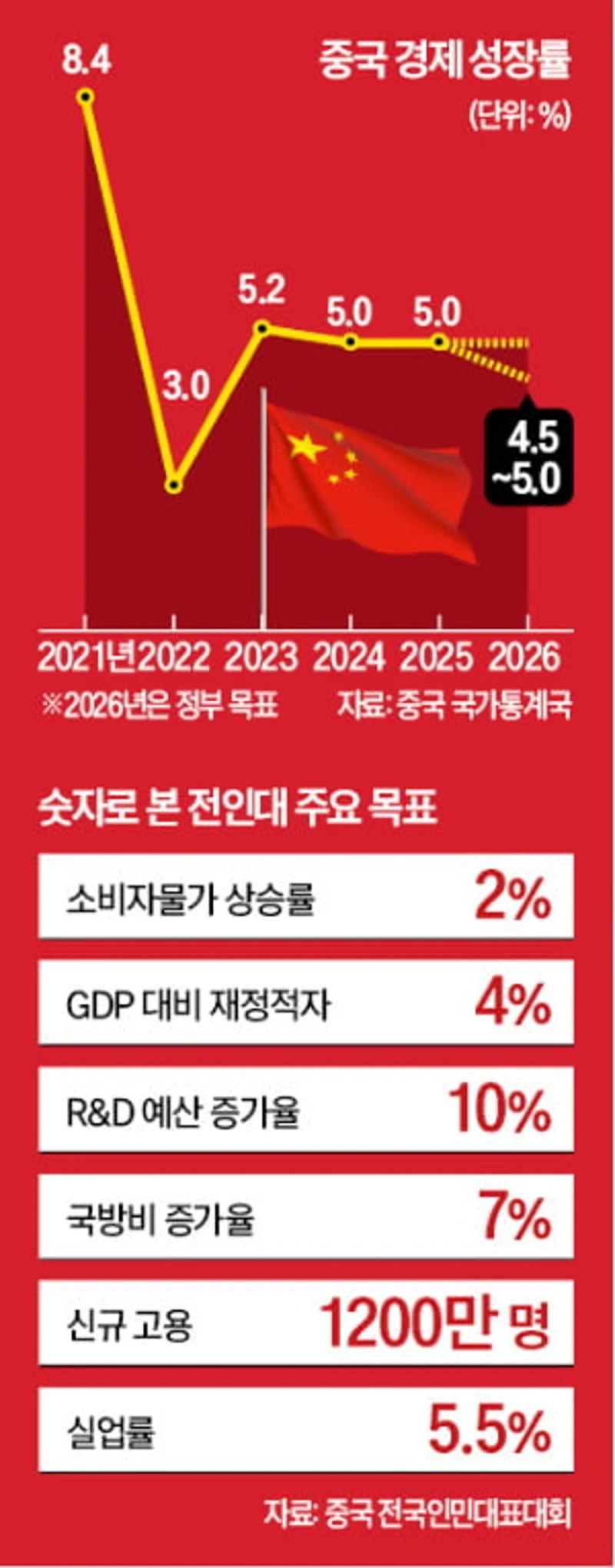
Chinese Premier Li Qiang said in the government work report at the opening session of the 14th National People’s Congress (NPC) on the 5th that the government would “uphold the task of seeking progress while maintaining stability.” The target is a downward adjustment for the first time in four years, from the “around 5%” target maintained over the past three years. It is the lowest since 1991, when stability was prioritized amid the aftermath of the Tiananmen Square crackdown (a 4.5% target). China did not set a growth target during the COVID-19 pandemic (2020). From 2023 through last year, the government set a “around 5%” target for three consecutive years and met it each year at 5.2%, 5%, and 5%, respectively.
The downward revision is interpreted as a decision reflecting continued weakness in the property sector—once a driver of China’s rapid growth—along with sluggish domestic demand, while factoring in external uncertainty such as U.S. tariff pressure and strikes on Iran. Rather than pushing aggressive stimulus to hit an “around 5%” target, the aim is to set a more realistic goal and focus on fundamentals such as industrial restructuring and boosting domestic demand.
Despite a U.S. Supreme Court decision invalidating reciprocal tariffs, U.S. President Donald Trump continues tariff pressure and tech containment aimed at China. On top of that, U.S.-Israeli strikes on Iran are shaking China’s energy supply chain. This underscores risks to exports and traditional manufacturing, China’s core growth engines. Deflationary pressure (falling prices amid an economic downturn) is also intensifying, making it urgent for President Xi Jinping to manage public sentiment as he seeks a fourth term.
Bloomberg said, “This cut in the growth target signals that the Chinese government is willing to tolerate some slowdown while looking for sustainable growth drivers,” adding, “It will seek growth engines that can replace property and infrastructure investment, which previously carried growth.”
Fiscal policy will keep an expansionary stance. The fiscal deficit ratio remains about 4% of GDP, as last year. The deficit is planned at 5.89 trillion yuan (about 1,253 trillion won), up 230 billion yuan from last year. The judgment is that, in an uncertain domestic and external environment, maintaining a record-high fiscal deficit is necessary to meet the growth target.
90 trillion won for science and technology R&D alone
The government will also issue 1.3 trillion yuan in ultra-long special government bonds to support major infrastructure projects and subsidies encouraging consumer spending. It also plans to issue an additional 300 billion yuan in special government bonds to bolster capital at state-owned commercial banks. The quota for special-purpose bonds for local governments—aimed at infrastructure investment and debt reduction—is 4.4 trillion yuan.
Regarding the 15th Five-Year Plan (2026–2030), China said it will keep GDP growth at a reasonable level over the next five years and double per-capita GDP in 2035 versus 2020 to reach the level of a moderately advanced country. Notably, this year’s five-year plan for the first time includes a goal to “achieve a noticeable increase in the share of consumption in GDP.”
Seemingly mindful of U.S. dominance in advanced technology, China plans to continue massive investment in cutting-edge sectors. This year’s central government science and technology R&D budget is set at 426.4 billion yuan, up 10% from a year earlier. Last year, China spent a total of 387.7 billion yuan on science and technology R&D. China will accelerate efforts toward greater technological self-reliance by increasing investment in advanced-technology industries.
Premier Li said, “While keeping the focus of economic development on the real economy, we will support the building of a modernized industrial system by developing real productive forces based on local conditions,” outlining plans to expand smart manufacturing and foster smart factories and supply chains, as well as develop smart buildings. China also plans to strengthen the application base for advanced technologies such as semiconductors, aerospace, biotechnology, quantum science and technology, and future energy. It will also focus on cultivating talent to support technological self-reliance.
Beijing=Correspondent Kim Eun-jung kej@hankyung.com

Korea Economic Daily
hankyung@bloomingbit.ioThe Korea Economic Daily Global is a digital media where latest news on Korean companies, industries, and financial markets.