Gasoline prices surge straight to 1,800 won with no lag… President Lee: “Price gouging by exploiting a crisis”
Summary
- The nationwide average retail gasoline price at gas stations surged well past 1,800 won per liter, jumping by nearly 150 won in just four days.
- The government said it would review a designated maximum price system for gasoline under the Price Stabilization Act and warned of a tough crackdown on gas stations’ hoarding and price gouging.
- The government said it would consider caps by region and fuel type and encourage voluntary price declines through real-time disclosure of wholesale prices.
Forecast Trend Report by Period


Cabinet meeting reviews Middle East situation… orders review of “price cap for oil”
‘Price cap’ revived for the first time in 50 years
Up 200 won in a day even though it’s not a crisis
Considering caps by region and fuel type
Intensive crackdown on hoarding and stockpiling from the 6th
Gas stations: “If we raise the supply price all at once
the shock to consumers is big, so we’re reflecting it in stages”
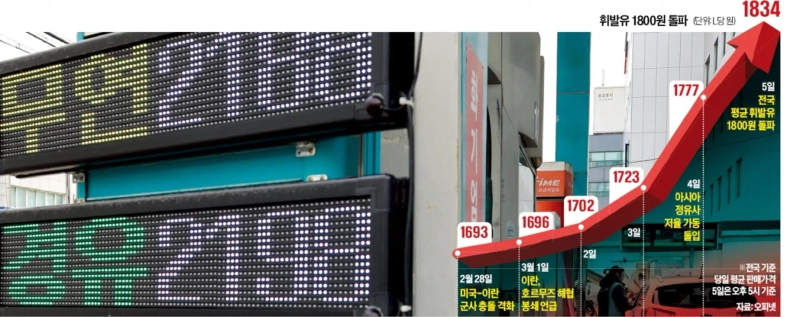
President Lee Jae-myung has pulled out the hardline option of a “designated maximum price system,” targeting gas stations that sharply raised fuel prices, because the spike in global crude prices—typically reflected in domestic gasoline prices with a lag of 1–3 weeks—was immediately passed through with no delay. As of the 5th, the nationwide average retail price of gasoline at gas stations jumped well past 1,800 won per liter for the first time in 3 years and 7 months. It rose by nearly 150 won in just four days from 1,695.89 won (closing price basis) on the 1st. Gas stations argued that price hikes were unavoidable as inventories are being depleted rapidly amid a rush of demand to fill up before further increases, and as refiners’ supply prices are expected to rise sharply starting next week.
Will a ‘price cap’ return after 50 years?
At a Cabinet meeting on the 5th, the president instructed relevant ministries to review applying the designated maximum price system under Article 2 of the Price Stabilization Act to gasoline whose retail prices have risen. The system is a measure in which the government sets an upper limit on the selling price of a specific item. Violations are punishable by up to two years in prison or a fine of up to 20 million won, and excess profits are to be recouped by the government. If implemented, it would effectively revive the “maximum price system for petroleum products,” which has been shelved for more than 50 years since the 1970s oil shock.
Kang Yoo-jung, the presidential spokesperson, said, “The president strongly rebuked the behavior of gas stations that raised fuel prices by nearly 200 won per liter in a single day, and ordered a strict response to rip-offs that exploit a crisis.”
While international crude prices have surged in the wake of Iran’s move to block the Strait of Hormuz, they remain in the $80s per barrel. Nor has a domestic crude supply crisis emerged. Even so, the government believes gas stations are raising prices too sharply and reaping excessive profits.
According to Opinet, the oil price information system, as of 5 p.m. that day the nationwide average gasoline price rose 56.84 won per liter from the previous day to 1,834.32 won. Diesel prices also jumped by more than 100 won in a single day, reaching the 1,830-won range, underscoring the steep uptrend. With some locations seeing fuel prices rise by 100 won or 200 won in just one day, freight vehicle drivers and others are voicing complaints that “gas stations have gone too far.”
“Unavoidable to preemptively reflect wholesale price hikes”
Gas stations explain that because they must replenish inventories at higher wholesale prices going forward, they have no choice but to reflect those increases in current retail prices in advance. An official at a gas station in Jagok-dong, Seoul, said, “We raised gasoline prices by 60 won from the previous day, but compared with roadside stations in the Gangnam area, we’re still on the cheaper side,” adding, “There’s talk that refiners could sharply raise supply prices next week, so nearby stations are gradually spreading the increases.”
Refiners set gasoline supply prices by taking Singapore petroleum product benchmarks, multiplying by the exchange rate, and adding a certain margin. They may also notify agents of expected supply prices a week in advance. Each gas station then sets and posts its prices autonomously, taking into account its own inventories and local competition.
Government signals crackdown on “excess profits”
Following the president’s directive, the government will move to crack down hard on excessive price hikes by retailers. If it introduces a maximum price system, it plans to set caps by region and fuel type. Starting on the 6th, it will deploy an inspection team from the Ministry of Trade, Industry and Energy to intensively crack down on gas stations’ hoarding and stockpiling. The government also plans to disclose in real time the “wholesale price (purchase price)” at which refiners supply fuel to gas stations to encourage voluntary price declines, and to quickly establish a basis for administrative penalties against “rip-off pricing.”
However, concerns are emerging that if the Strait of Hormuz blockade persists, international petroleum product prices will continue to climb, blunting the effectiveness of government measures. Cho Hong-jong, a professor of economics at Dankook University, said, “If you forcibly suppress prices, the cost is ultimately passed on to future consumers,” adding, “Targeted support using tax measures and policy financing is needed for low-income groups that are hit directly in their livelihoods.”
Ha Ji-eun / Kim Ri-an / Kim Dae-hoon, reporters knra@hankyung.com

Korea Economic Daily
hankyung@bloomingbit.ioThe Korea Economic Daily Global is a digital media where latest news on Korean companies, industries, and financial markets.