PiCK
Altcoin market stays on 'wait-and-see' despite Bitcoin rebounding to $70,000… “An unstable market lacking buying demand” [Kang Min-seung’s Altcoin Now]
Summary
- Despite Bitcoin reclaiming $70,000, the broader altcoin market is said to remain unstable as trading volume and buying demand are insufficient.
- Even with expectations around the US CLARITY Act and sharp rallies in some names, institutional participation is low and the Fear & Greed Index remains in 'Extreme Fear,' limiting the scope for a sustained rally.
- With macro uncertainty including the Middle East war and a surge in global oil prices, the market is maintaining a wait-and-see stance, while some experts interpret the decline as a long-term buying opportunity.
Forecast Trend Report by Period



The altcoin market, which had rebounded alongside Bitcoin (BTC), is again coming under downward pressure amid concerns over a prolonged war and rising tensions in the Middle East.
“An unstable rebound lacking buying demand… eyes on whether the CLARITY Act passes”
With Bitcoin reclaiming $70,000, trading volume and total market capitalization across the broader digital-asset market appear to be recovering slightly. In the altcoin market, however, performance dispersion among tokens is widening.
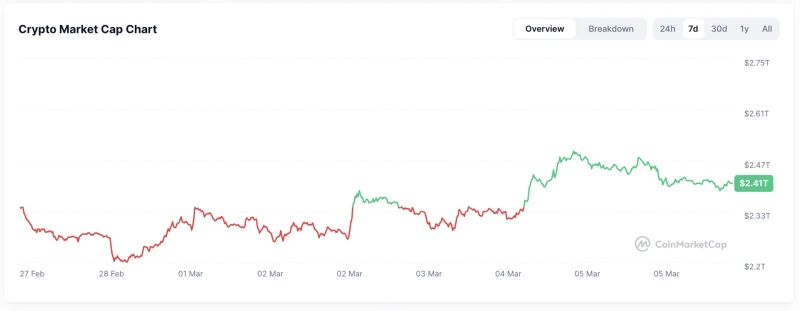
According to CoinMarketCap, a global digital-asset (cryptocurrency) market data site, as of the 6th the total cryptocurrency market capitalization stood at about $2.41 trillion, up about 5.7% from a week earlier ($2.28 trillion).
Over the same period, daily spot trading volume was tallied at about $232.6 billion, slightly higher than a week earlier ($193.3 billion). Even so, volume remains low compared with last year’s peak of $1 trillion or early last month’s $645.9 billion.
The market is increasingly being seen as one where, rather than fresh capital flowing in, existing liquidity is rotating among altcoin names.
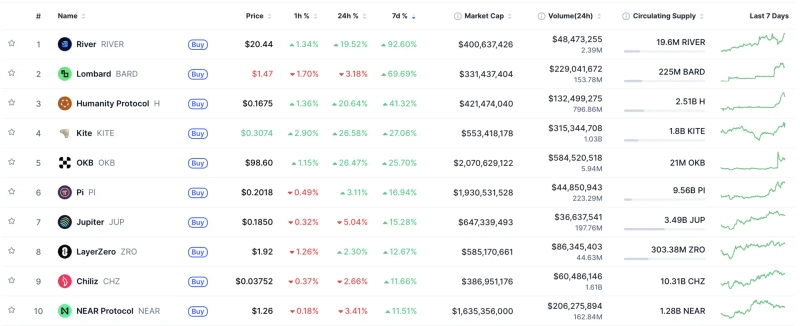
Even within the altcoin market, dispersion by token was pronounced amid Bitcoin’s rebound.
In the mid-cap segment, River (RIVER) led the gains, jumping 84.8%, followed by OKB (OKB) 23.5%, Pi (PI) 17.2%, Jupiter (JUP) 16.2%, and NEAR Protocol (NEAR) 11.1%.
Lombard (BARD) 72.8%, Humanity (H) 47.7%, BuildOn (B) 45.2%, and Siren (SIREN) 25.6% also posted strong gains.
Among smaller-cap tokens, many names logged outsized increases, including Sign (SIGN) 96.7%, Sahara AI (SAHARA) 58.1%, Form (FORM) 52.8%, and JellyJelly (JELLYJELLY) 50.5%.
Some in the market said policy expectations around the CLARITY Act also acted as a factor behind the rise.
Earlier, on the 4th, US President Donald Trump said, “If the digital asset market structure bill (the CLARITY Act) isn’t passed, the crypto industry could be handed over to China or other countries,” adding that “passing the CLARITY Act is the next step toward making the US the world’s digital-asset capital.”
Some observers also see signs of funds moving preemptively into assets expected to benefit from the bill. Even so, others say the market’s supply-demand foundation has yet to recover sufficiently.
Digital-asset market maker Wintermute said in its weekly research report that “institutional participation is markedly lower than it was from September to November last year,” adding, “Back then, volume was substantial especially when prices were weak, but at current price levels the lack of buying demand makes the market feel unstable.” It also assessed that “with fewer investors seeking outsized returns, it is difficult for most tokens to sustain a continued rise.”
‘A technical rebound within a downtrend’… digital-asset market still cautious
Experts say that because the recent rebound looks more like short-term sector rotation than a structural recovery in demand, near-term direction remains uncertain.
Alex Kuptsikevich, chief analyst at FxPro, said, “The fact that the total digital-asset market cap briefly broke above $2.5 trillion intraday to mark a four-week high could be a signal suggesting the market may shift into a growth phase after forming a bottom.”
However, he noted that “this rise could also end up being no more than a short-lived bounce within a bear market driven by a Bitcoin short squeeze.” The fact that the Crypto Fear & Greed Index has stayed in “Extreme Fear” for nearly a month is also cited as a source of market anxiety.
At the same time, the Middle East situation is slipping back into a renewed phase of tension. With the possibility being raised that fighting in Iran could expand into a ground war, market uncertainty is growing. The risk of a renewed inflation pickup from a prolonged war and uncertainty over the interest-rate path also remain headwinds.
In particular, global oil prices have continued to surge in the wake of an attack on an Iranian oil tanker, amplifying volatility in the macro backdrop. This is also seen as adding downside pressure to the altcoin market.
Another view is that the recent rebound resembles a seasonal pattern that has repeated around US midterm elections. Crypto analyst Benjamin Cowen said, “Bitcoin’s move to rebound into early March after last month’s low is closer to a pattern that has repeated in midterm election years.”
He added, “In past cases, prices reversed lower after the early-March high, and then continued to set a lower low again in April to May,” forecasting that “the market may only confirm a true bottom as early as May, or around October when investor capitulation (capitulation·mass selling) emerges.”
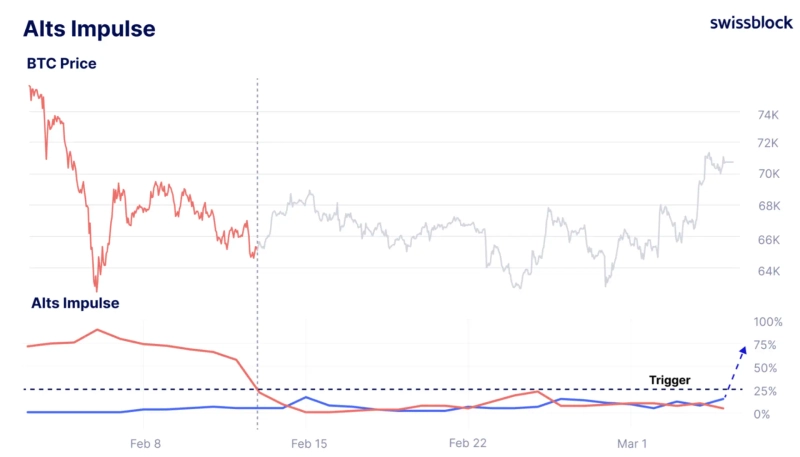
Against this backdrop, a wait-and-see mood still dominates across the market. Swissblock, a crypto analytics firm, said that day, “Despite Bitcoin’s recent breakout move, momentum indicators across altcoins remain in the neutral zone.”
Swissblock said the indicator must clearly break above the 25% threshold for a broad uptrend to emerge. If Bitcoin remains rangebound, short-term opportunities could open up for altcoins, but a clear catalyst is needed to spark a rally.
Some see the pullback as a long-term buying opportunity. Crypto strategist Michaël van de Poppe said, “Gold’s valuation relative to Bitcoin, the bellwether crypto, falling to levels below the lows of 2015, 2018 and 2022 means the crypto market is extremely undervalued.”
He added that “the fact that Ethereum (ETH) is valued below the network’s total value locked (TVL) could also be a historical bottom signal.” He predicted that “if volatility in gold and silver stabilizes going forward, funds are likely to rotate into Bitcoin.”
Kang Min-seung, Bloomingbit reporter minriver@bloomingbit.io

Minseung Kang
minriver@bloomingbit.ioBlockchain journalist | Writer of Trade Now & Altcoin Now, must-read content for investors.