PiCK
"The Iran war could last more than a year"…A worst-case outlook emerges
Summary
- Iran’s missile-launch capability has fallen sharply since the outbreak of war and is expected to drop to an inconsequential level after next week.
- However, Iran could continue a Strait of Hormuz blockade by leveraging drones—with a monthly production capacity of 10,000—and more than 5,000 mines.
- At the current rate, Iran’s drones could be depleted within a month, but depending on tactical development, concerns have been raised that the threat to the Strait of Hormuz could continue for more than a year.
Forecast Trend Report by Period


Iran has lost 60% of its missiles, turns to drones and mines
Analyzing Iran’s military capability
Iran’s missile strikes down 90%
Could lose launch capability as early as next week, but
Uses about 10,000 drones and about 5,000 mines
Possibility of prolonged Strait of Hormuz blockade
As the war between the U.S. and Israel on one side and Iran on the other—sparked on the 28th of last month—entered its sixth day, Iran’s missile-launch capability has fallen sharply. Iran, however, is expanding the scope of its attacks, including striking a tanker more than 900 km from the Strait of Hormuz with an unmanned drone on the 5th (local time). Analysts say the war’s trajectory and the likelihood of it dragging on will hinge on Iran’s ability to sustain operations.
◇ Missile-launch capability sharply diminished
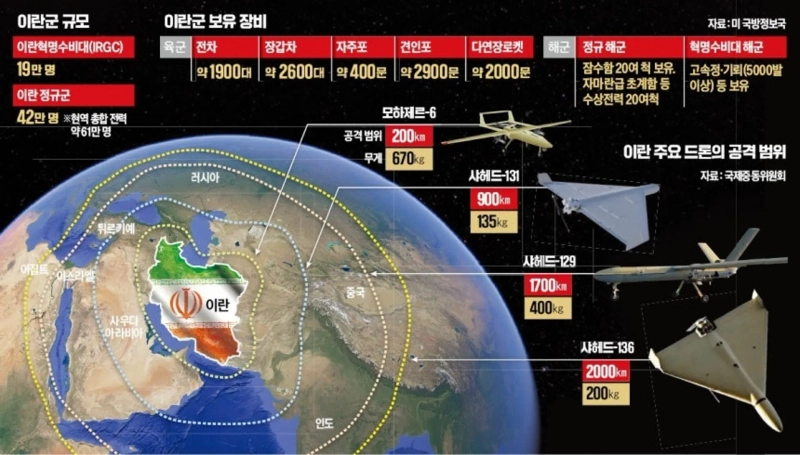
Iran’s ballistic-missile launch capability—until recently the single biggest threat to the U.S. and Middle Eastern countries—has deteriorated. U.S. President Donald Trump said at an event at the White House that day, “When Iran fires missiles, we are hitting the launchers within four minutes.” He added, “Air-defense weapons and air-defense networks have been removed, and the air force no longer exists,” claiming that “(Iran’s) missiles and launch capability have each fallen by about 60% and 64%, respectively.”
Israel is offering a similar assessment. IDF Chief of Staff Eyal Zamir said, “We destroyed 60% of Iran’s ballistic-missile launch bases and 80% of its air-defense systems.” According to U.S. Central Command (CENTCOM), Iran’s ballistic-missile attacks are down 90% compared with the first day of the war.
The key is that the number of launchers capable of firing ballistic missiles is shrinking dramatically. Without launchers, more than 2,000 ballistic missiles Iran possesses also become useless. The U.S. and Israel, which have seized air superiority, are said to be destroying mobile missile launchers whenever they emerge from tunnels and other sites. That is why some analyses say, “Once next week passes, Iran’s missile-launch capability will be reduced to an inconsequential level.”
◇ Drones and mines as factors that could prolong the war
The problem is Iran’s attack drones, with Iran regarded—alongside China and Türkiye—as an advanced drone power. Iran is known to have the capacity to produce 10,000 drones a month. It is believed to possess more than 10,000 Shahed drones alone, capable of carrying a 30 kg bomb and flying about 2,000 km to strike targets across the Middle East. These drones can be launched virtually anywhere without dedicated launchers. Nor is it easy to locate and destroy every drone factory concealed underground across Iran.
Tankers, meanwhile, are easy targets for drones. It is effectively impossible to protect the hundreds of tankers operating in the Strait of Hormuz and the Persian Gulf from drone attacks.
More than 5,000 mines Iran holds are another variable that could prolong a blockade of the Strait of Hormuz. Iran has effectively lost its naval power after losing 24 vessels over the past three days. But laying mines can be done without warships, using small boats and mini-submarines. A military source explained, “Once mines are laid, they are difficult to clear.”
Of course, given the intelligence capabilities demonstrated by Israel and others during the war, Iran’s drone-production capacity is also likely to be curtailed quickly. Some assessments say that if Iran launches drones at the current pace, its drone stockpile could be depleted within a month. However, Iran is also said to be developing tactics to use fewer drones more effectively as the war continues. As a result, concerns are mounting that Iran’s threat to the Strait of Hormuz could persist for more than a year.
Kim Dong-hyun, 3code@hankyung.com

Korea Economic Daily
hankyung@bloomingbit.ioThe Korea Economic Daily Global is a digital media where latest news on Korean companies, industries, and financial markets.