Aluminium prices surge on Hormuz blockade… highest in four years
Summary
- It reported that international aluminium prices hit a four-year high at $3,397.25 per ton.
- It said the blockade of the Strait of Hormuz and disruptions to aluminium smelting facilities in the Middle East are fueling concerns over global supply instability.
- It reported that Goldman Sachs forecast prices could rise to $3,600 per ton if Middle Eastern aluminium production is halted for a month.
Forecast Trend Report by Period


Output cuts decided in succession amid safety concerns
Middle East accounts for 8% of global smelting capacity
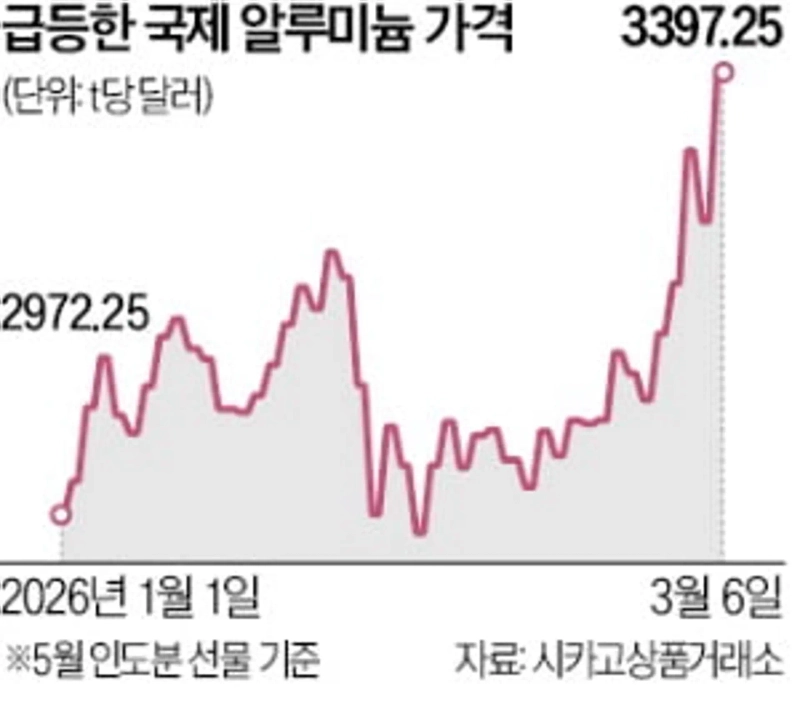
International aluminium prices have jumped to the highest level in four years. The rise reflects a string of production disruptions stemming from instability in the Middle East, along with a sharp deterioration in the reliability of maritime logistics.
According to the Chicago Mercantile Exchange (CME) on the 8th, May-delivery aluminium futures settled at $3,397.25 per ton, up 4.8% from the 6th. It is the highest level since March 2022.
Analysts say heightened geopolitical risks following U.S. and Israeli airstrikes on Iran have pushed aluminium prices higher. After Iran declared it would block the Strait of Hormuz in retaliation, shipping in the area has effectively come to a standstill. As a result, both exports and imports of Middle Eastern aluminium are being disrupted.
David Wilson, a commodities strategist at BNP Paribas, said the Middle East’s aluminium smelting facilities have annual processing capacity of 7 million tons, accounting for about 8% of global aluminium smelting capacity. He added that if aluminium shipments from the region continue to be disrupted, the impact on the global aluminium market would be significant, with Europe in particular likely to be hit hard.
Earlier, Aluminium Bahrain (Alba), a major global aluminium supplier, declared a contractual "force majeure" issue to some customers and notified them that it may be unable to ship products, potentially delaying contract fulfillment. Force majeure is a legal clause that allows parties to be excused from contractual obligations when faced with circumstances beyond their control. Alba, based in Bahrain in the Middle East, said the move was due to disruptions in transits through the Strait of Hormuz and was unrelated to the operation of its smelter.
Market participants warned that if logistical bottlenecks persist, other Middle Eastern smelters could also declare force majeure and halt shipments. Qatalum, a joint-venture smelter between Norwegian and Qatari firms with annual output of 650,000 tons, began a phased production shutdown on the 3rd. It said it plans to suspend production in stages through the end of March and expects a full restart to take 6–12 months. Goldman Sachs forecast that if aluminium production in the Middle East is halted for a month, prices could rise to $3,600 per ton.
Reporter Ju-wan Kim kjwan@hankyung.com

Korea Economic Daily
hankyung@bloomingbit.ioThe Korea Economic Daily Global is a digital media where latest news on Korean companies, industries, and financial markets.