"Data center leasing sells out" vs. "wave of scrapped expansion plans"
Summary
- CoreWeave and Nebius said GPU computing capacity has sold out, with long-term contracts and even upfront payments increasing.
- Oracle and OpenAI reportedly scrapped their Texas data center expansion plan due to funding issues, and are moving ahead with job cuts and a review of selling a business unit.
- TD Cowen and the infrastructure industry said there is a risk that AI infrastructure capex is overheating, and that the financial sector’s judgment will sway the AI infrastructure market, the stock market, and order intake.
Forecast Trend Report by Period


AI bubble debate reignites
AI computing companies such as CoreWeave
"Now even long-term contracts and upfront payments"
Oracle scraps Texas expansion plan
Weighs selling a business unit to raise funds
Spotlight on whether Big Tech can finance investment
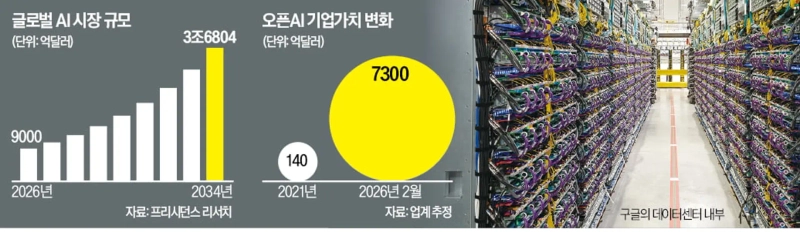
The debate over an artificial intelligence (AI) bubble is increasingly diverging between the AI industry and the financial sector. While AI companies building out infrastructure say their server leasing capacity has sold out, cases are simultaneously emerging in which data center expansions are shelved for lack of funding. With AI firms finding it difficult to cover infrastructure investment with profits alone, movements in the financial sector—including investment banks—are expected to determine the pace of AI infrastructure expansion going forward.
◇Data center leasing sells out this year
Brannin McBee, chief development officer (CDO) of CoreWeave, said at a Morgan Stanley conference held in the U.S. on the 4th (local time) that "demand for AI computing is 'insatiable,'" adding that "all the GPU computing capacity the company can provide this year has already been sold." He also disclosed that customers are increasingly seeking to lock in capacity for the long term, with contract terms lengthening from around three years in 2023 to about five to six years now. CoreWeave, a U.S. high-performance AI cloud computing company backed by Nvidia, is moving to build out data centers with 3.1 GW (gigawatts) of capacity for customers by next year.
Mark Boroditsky, chief revenue officer (CRO) of Nebius, another AI infrastructure builder, also said that day, "Some customers are even making upfront payments to secure data center capacity," adding that "GPU (graphics processing unit) supply is tight, and prices are rising even for prior-generation models."
The two companies are categorized as leading "neo-cloud" players. Unlike incumbent cloud providers such as Amazon Web Services (AWS) and Google Cloud that offer general-purpose services to a wide range of enterprise customers, neo-cloud refers to emerging AI infrastructure companies that concentrate their data centers on AI compute. Lambda and Crusoe are also cited as representative players.
◇Texas data center expansion scrapped
In contrast, cases of additional investment being halted are also occurring at the same time. According to Bloomberg on the 7th (local time), Oracle and OpenAI have scrapped plans to expand a data center to be built in Abilene, Texas, from 1.2 GW to 2 GW. The talks reportedly broke down directly due to Oracle's financing issues.
Last month, Oracle said it would raise $50 billion (about KRW 74 trillion) this year through corporate bond and equity issuance to invest in AI infrastructure. However, the amount falls short of the funding needed for Oracle's Texas and Wisconsin facilities ($38 billion) and a New Mexico data center ($20 billion). The industry believes Oracle will find it difficult to raise additional funds through financial markets. As a result, Oracle is considering cutting 30,000 jobs this month and selling Cerner, the healthcare software unit it acquired in 2022 for $28.3 billion. OpenAI and Oracle have an AI infrastructure buildout plan totaling $500 billion (about KRW 743 trillion).
U.S. investment bank TD Cowen said in a report last month, "The pace of AI infrastructure buildout may be progressing faster than actual demand," arguing that capital spending sentiment around related facilities has become overheated even as a clear AI profit model has yet to be established.
Cautious views are also emerging within the infrastructure industry. An executive at a South Korean power equipment company that is heavily affected said, "Google, Amazon and others have poured all their profits into investment so far, and additional investment will ultimately have to be raised externally," adding, "The financial sector's assessment of the AI infrastructure market will likely determine the stock market and order intake."
Kang Hae-ryeong / Silicon Valley = Correspondent Kim In-yeop hr.kang@hankyung.com

YM Lee
20min@bloomingbit.ioCrypto Chatterbox_ tlg@Bloomingbit_YMLEE