If FX rates surge, gasoline could hit '3,000 won'... Unable to either raise or cut rates
Summary
- It reported that global crude oil prices and gasoline prices are surging on Middle East-driven supply reductions, heightening concerns about stagflation.
- It said the oil-price spike is pushing the United States and China into a dilemma where neither rate cuts nor economic stimulus will be easy.
- It reported that in South Korea, a weaker exchange rate and a surge in oil prices are raising the possibility that gasoline could exceed 3,000 won per liter, stoking fears of a repeat of the 1970s oil shock.
Forecast Trend Report by Period


Middle East-driven oil-price 'shock'... 'S' fears spread
Prolonged US-Iran war... stagflation alarm bells
Kuwait, UAE cut crude output... WTI breaks above $90
US labor market cools... domestic gasoline prices jump in the 10% range
Middle Eastern countries are moving in quick succession to cut oil production as the blockade of the Strait of Hormuz following the war between the United States and Iran ripples through the region. As the supply reduction begins to bite in earnest, global crude prices vaulted past $90 a barrel in one leap. Rising oil prices are stoking concerns that they could simultaneously fuel inflation and depress consumption, ushering in stagflation (economic stagnation amid high inflation).
According to Bloomberg on the 7th (local time), Abu Dhabi National Oil Company (ADNOC) said in a statement that it is "reducing crude output to address storage constraints." The UAE, the world's third-largest crude producer, has been producing more than 3.5 million barrels a day. Kuwait, the fifth-largest oil producer, also said it is "reducing output across both oil fields and refineries." It cut 100,000 barrels that day and increased the reduction to 300,000 barrels starting on the 8th.
Iraq, which was hit by Iranian missile and drone attacks, also reduced crude production. Saudi Arabia shut its largest refinery, and Qatar closed the world's largest liquefied natural gas (LNG) export terminal.
The tightening in energy supply is expected to further fan the rally in oil prices, which posted the biggest weekly gain on record. West Texas Intermediate (WTI) surged as high as $93 a barrel on the New York Mercantile Exchange on the 6th, the highest level in two years. The weekly gain reached 35.63%, the largest since records began in 1983. The same day, Brent crude futures (for May delivery) on London’s ICE Futures exchange jumped 8.52% to settle at $92.69 a barrel—its biggest increase since March 2022.
Meanwhile, as the US labor market cools faster than expected, voices warning of an impending shift into stagflation are growing louder. US nonfarm payrolls for February, released on the 6th, fell by 92,000 from the previous month, far below market expectations for a 50,000 increase. Stephanie Roth, a strategist at Wolfe Research, said, "For every $20 rise in oil prices, US GDP growth falls 0.1% and inflation rises 0.4%."
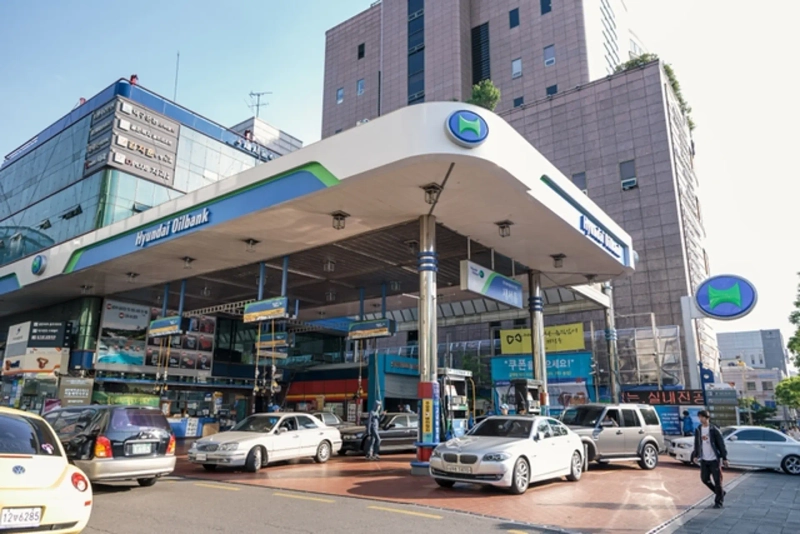
Some argue that South Korea has also entered the orbit of stagflation. According to Opinet, the price information system run by the Korea National Oil Corporation, the nationwide average gasoline price at gas stations stood at 1,895.34 won per liter, up 11.9% from Feb. 28.
If the situation drags on, some experts say domestic gasoline prices could top 3,000 won per liter.
Stagflation fears as oil prices surge
Warning that "global crude could hit $150 within weeks"... countries face a dilemma of high inflation and slowing growth
Gulf states are cutting oil output one after another. After Iran blocked tanker traffic through the Strait of Hormuz, storage space became scarce even for oil that is produced. Goldman Sachs projected that if the Hormuz issue is not resolved, global crude prices could exceed $100 a barrel this week. Saad al-Kaabi, Qatar’s energy minister, warned that "all exporters in the Gulf region will soon be forced to declare force majeure," adding that "oil prices could jump to around $150 within a few weeks." With a spike in oil prices increasingly treated as a foregone conclusion, fears of "stagflation"—simultaneous growth slowdown and a surge in prices—are spreading worldwide.
◇ Unable to cut rates even as jobs weaken
The United States was the first to ignite the fear. The Bureau of Labor Statistics (BLS), under the US Department of Labor, announced on the 6th that nonfarm employment fell by 92,000 from the previous month. That was far below the forecast (an increase of 50,000). The reading is interpreted as a sign the labor market is weakening earlier than expected, even though the impact of the war that broke out on Feb. 28 was barely reflected.
The problem is that the Iran-driven spike in oil prices has made it harder to expect a rate cut from the US central bank, the Federal Reserve (Fed). JPMorgan Chase estimated that for every 10% rise in oil prices, US inflation increases by 0.1% point while economic growth declines by 0.2% point.
China is under similar pressure. The South China Morning Post (SCMP) in Hong Kong said, "Rising oil prices are translating into higher energy costs in China," adding that "economic growth is stalling and inflation could be pushed higher, leading to stagflation."
Paul Krugman, a professor at Princeton University, said, "Unlike during the oil shocks of the 1970s, inflation expectations are relatively stable now, so the likelihood of a wage-price spiral is small," but added that "(the war) could be the straw that breaks the camel’s back for the US economy, which is already carrying a heavy load."
◇ Will the 1970s oil shock repeat?
South Korea is seen as more vulnerable to the Iran crisis than the United States or China. The country relies on imports for more than 90% of its energy, and about 70% of crude imports and 20% of liquefied natural gas (LNG) pass through the Strait of Hormuz. Moreover, if risk-off sentiment spreads amid a prolonged war and the won-dollar exchange rate surges, gasoline prices could exceed 3,000 won per liter, some observers say. According to Opinet, the nationwide average gasoline price rose to 1,895 won per liter on the 8th.
An official in the shipping industry said, "Global crude prices, which were around $60 a barrel before the war, have already topped $90, and very large crude carrier (VLCC) charter rates, which were about $150,000 a day, have jumped more than threefold," adding that "that alone is a factor that could raise domestic fuel prices by about 500 won."
The Bank of Korea, when holding the benchmark rate steady at 2.50% per year on the 26th of last month, projected that the current rate level would be maintained even six months later. With economic growth forecast at 2% this year, the need to cut rates to prop up the economy has diminished, and with a K-shaped recovery in which only semiconductors are booming, it is also difficult to raise rates. Overall industrial production, which posted growth of 0.7~1.0% in November-December last year, fell 1.3% in January. Construction investment (construction output) also plunged 11.3% in January.
The problem is that the Iran war has worsened conditions. A surge in oil prices has raised the likelihood of inflation while also amplifying fears of a growth slowdown. With the foreign-exchange and housing markets still unstable, observers say a dilemma in which the BOK can neither cut nor raise rates is likely to persist for some time.
As a result, anxiety is also growing that a scenario like the 1970s oil shock could be replayed. After the first oil shock erupted in the wake of the Fourth Arab-Israeli War in 1973, oil prices, which had been $3 a barrel, jumped to $12. The following year, South Korea’s consumer inflation rate hit 24.3%, while economic growth slowed to 7.7%—about half the previous year’s 14.9%.
Ahn Sang-mi / Washington=Lee Sang-eun, correspondent / Jung Young-hyo / Kim Dae-hoon, reporters saramin@hankyung.com

Korea Economic Daily
hankyung@bloomingbit.ioThe Korea Economic Daily Global is a digital media where latest news on Korean companies, industries, and financial markets.