Global oil tops $100 a barrel… will the KOSPI ride another ‘roller coaster’? [Market Preview]
Summary
- With global oil topping $100 a barrel, the KOSPI is increasingly likely to see a highly volatile market.
- If the Middle East conflict becomes protracted, concerns could grow over inflation, delayed rate cuts, and rising Treasury yields.
- Amid war risk, beneficiaries such as defense and refinery stocks could attract flows, alongside a money move to the KOSDAQ and potential profit-taking in KOSDAQ ETFs.
Forecast Trend Report by Period


‘iShares MSCI Korea’ (EWY)
Plunged 6.42% overnight
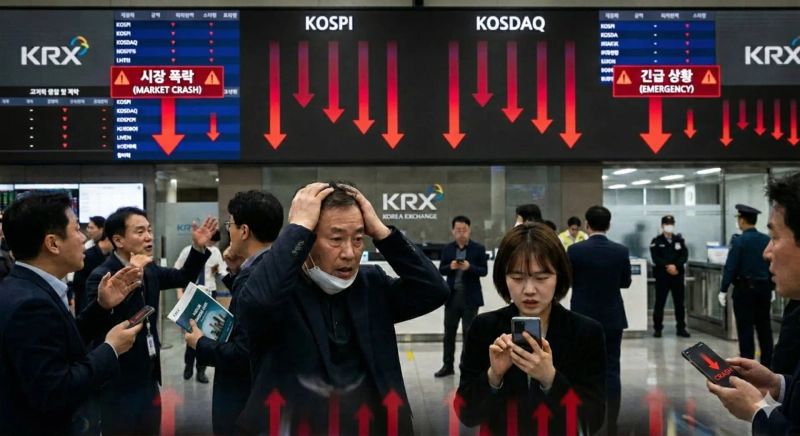
With global oil prices climbing above $100 a barrel and U.S. stock index futures sliding sharply, South Korea’s stock market on the 9th is increasingly likely to see roller-coaster trading.
Last week, the KOSPI fell 10.7%. After briefly breaking above the 6,300 level, the index quickly slid to the 5,000 level following the Iran situation, then rebounded more than 9% to recover 5,500—underscoring heightened volatility.
Lee Kyung-min, a researcher at Daishin Securities, said the KOSPI reversed sharply lower amid armed conflict between the U.S., Israel and Iran, while downside volatility was amplified after the market had posted a standout rally versus global peers. “For the time being, swings driven by Middle East issues and whether the conflict becomes protracted look unavoidable,” he said.
With the Iran situation sending international oil prices surging, volatile trading is expected to persist for now. According to Bloomberg, in Asian trading on the 9th (local time), West Texas Intermediate (WTI) rose as much as 15% early in the session to $104.61 a barrel. North Sea Brent also topped $102 a barrel. The move reflects an effective blockade of the Strait of Hormuz due to the Iran war, prompting oil-producing countries to cut output.
Markets expect inflation risks to grow if the oil rally continues. That could delay interest-rate cuts by the U.S. central bank (Fed) and push Treasury yields higher. Saad al-Kaabi, Qatar’s energy minister, said in an interview with the UK’s Financial Times, “If the conflict is not resolved swiftly, crude prices could rise to $150 a barrel within weeks,” adding, “This could potentially bring down the global economy.”
As global oil moves above $100 a barrel, U.S. stock index futures—ahead of the start of weekly trading—are also plunging. Futures for the Dow Jones Industrial Average, the S&P 500 and the Nasdaq 100 are all down in the 1% range.
Given South Korea’s heavy dependence on Middle Eastern energy, the impact from rising oil prices is expected to be larger. Lee Sung-hoon, a researcher at Kiwoom Securities, said, “Early this week, amid concerns over war risk, downside worries for equities are intensifying,” adding, “Sector rotation is likely to emerge toward beneficiaries such as defense and refinery stocks that gain from war and higher oil prices.”
He also said the “money move” from the KOSPI to the KOSDAQ is likely to continue this week. “While the KOSPI fell in the double digits amid panic selling last week, the KOSDAQ posted declines in the 3% range,” he said. “Expectations for the government’s KOSDAQ revitalization policy remain valid,” but he added that “right after the launch of KOSDAQ active exchange-traded funds (ETFs) this week, profit-taking selling could emerge amid perceptions of a ‘buy the rumor, sell the news’ fade.”
Reporter Yang Ji-yoon yang@hankyung.com

Korea Economic Daily
hankyung@bloomingbit.ioThe Korea Economic Daily Global is a digital media where latest news on Korean companies, industries, and financial markets.