"Even if the Iran war ends, global oil prices won’t plunge"…Which stocks to buy now? [Analysis+]
Summary
- Securities industry experts said global oil prices are likely to remain in the $90–$110 per barrel range even after the US-Iran war ends.
- They assessed that amid a sustained rally in global oil prices, investment in energy-related names such as petroleum development, renewable energy and secondary batteries looks promising.
- They said that amid oil price volatility and uncertainty in global energy markets, shipbuilding stocks—especially those tied to FLNG, FSRU and Suezmax-class oil tankers—could benefit.
Forecast Trend Report by Period


"Gulf states may single out 'low oil prices' as the cause of the US-Iran war"
Renewables, secondary batteries and shipbuilding seen as beneficiaries of a prolonged high-price environment
As volatility in global oil prices has widened in the wake of the war between the United States and Iran, securities industry experts are leaning toward the view that even after the conflict ends, the likelihood of global oil prices falling back to pre-war levels in the short term is low. They also assessed that if global oil prices continue their surge, investment opportunities may lie in energy-related names such as petroleum development, renewable energy and secondary batteries.
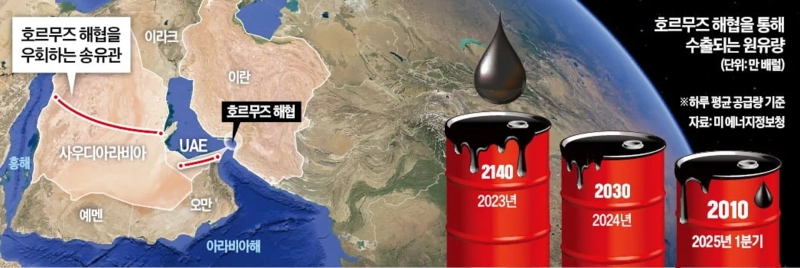
Global oil prices have been highly volatile. West Texas Intermediate (WTI) futures neared $120 per barrel before falling back into the $90 range. On the 9th (local time), the front-month WTI futures contract traded on the New York Mercantile Exchange settled at $94.77 a barrel—41.41% higher than on the 28th of last month ($67.02 per barrel), before the US attacked Iran. The move reflects the effective blockade of the Strait of Hormuz, through which 20–25% of global volumes of crude oil and liquefied natural gas (LNG) pass, triggered by the US-Iran war.
In particular, intraday on the 9th WTI futures briefly spiked to $119.48 a barrel, after Mojtaba Khamenei—expected to take a hard line against the US—was elected as Iran’s next supreme leader. He is the second son of Supreme Leader Ayatollah Seyyed Ali Khamenei, who was killed in US air strikes.
Adding to the pressure, reports that Saudi Arabia’s state oil company Aramco has also begun output cuts—following the United Arab Emirates (UAE), Iraq, Kuwait and Qatar, which have faced a shortage of storage tanks for oil pumped from fields as export routes were blocked—also pushed global oil prices higher.
Finance ministers from the Group of Seven (G7), including the US, issued a joint statement saying they could take necessary steps, including releasing strategic petroleum reserves, to respond to the spike in global oil prices. Afterward, global oil prices showed signs of stabilizing, and US President Donald Trump’s suggestion of a possible early end to the war helped press prices down into the $80 range.
If soaring global oil prices stoke inflation in the US, it would be politically damaging for President Trump, who must face midterm elections in November. In the previous US presidential election, criticism that former President Joe Biden failed to curb surging prices fueled public sentiment, and Democratic candidate Kamala Harris lost to President Trump.
Because global oil prices fueling inflation is politically lethal for a US administration, an analysis drawing attention suggests that Gulf states will seek to prevent global oil prices from falling back to pre-war levels even after the US-Iran war ends. Lee Chung-jae, a researcher at Korea Investment & Securities, said, "If global oil prices had been above $100 per barrel before this war broke out, the likelihood that the US would have launched a large-scale attack on Iran would have been very low."
He added, "Gulf states may judge low oil prices to be the root cause of this situation," and analyzed that "Gulf states could conclude that when high oil prices raise their geopolitical importance, national security is strengthened and they can foster service and high-tech industries such as logistics, tourism and information technology (IT)."
Conversely, after the war ends, oil demand could surge in the short term. That is because countries around the world may move to prepare for renewed military tensions in the Middle East. The US strategic petroleum reserve stands at 415 million barrels, just 60% of maximum storage capacity.
Lee forecast, "Even after the US-Iran war ends, global oil prices are likely to remain in the $90–$110 range, rather than $50–$75 per barrel."
Korea Investment & Securities advised investors to focus on sectors that could benefit as countries worldwide move to shore up energy security amid the continued rally in global oil prices. That could translate into expanded development of new oil fields and renewable energy.
An expansion in renewable energy demand to hedge against geopolitical risks was also seen as a positive for South Korea’s secondary battery industry, as resistance could grow to reliance on Chinese energy storage systems (ESS).
Shipbuilding stocks may also be promising. Kim Yong-min, a researcher at Yuanta Securities, said, "Uncertainty in the global energy market underpins our call to increase weighting in the shipbuilding sector," adding, "Over the mid- to long-term, names likely to see greater benefits include Samsung Heavy Industries, which has strengths in floating LNG production, offloading and storage facilities (FLNG); HD Hyundai Marine Solution, tied to the floating LNG terminal (FSRU) theme; and Daehan Shipbuilding, linked to Suezmax-class (the maximum size that can pass through the Suez Canal) oil tanker theme."
Han Kyung-woo, Hankyung.com reporter case@hankyung.com

Korea Economic Daily
hankyung@bloomingbit.ioThe Korea Economic Daily Global is a digital media where latest news on Korean companies, industries, and financial markets.