PiCK
Bitcoin whipsaws around $70,000 amid Middle East war…ETF inflows and on-chain stability signal a rebound? [Kang Min-seung’s Trade Now]
Summary
- Analysts said that as Bitcoin continues to swing in the $70,000 range, whether it can break above the $74,000 resistance could become an inflection point for the near-term uptrend.
- According to reports, net inflows into spot Bitcoin ETFs are continuing and on-chain indicators are showing a gradual stabilization trend, but they noted that the foundation to support a medium-term uptrend is not yet robust.
- With on-chain and derivatives indicators pointing to easing defensive positioning and MVRV signaling a potential long-term bottoming zone, analysts highlighted the $68,400 support and $74,000 resistance as key price levels.
Forecast Trend Report by Period


With Middle East tensions and concerns over Trump tariffs, Bitcoin (BTC) continues to fluctuate around the $70,000 level. Analysts say whether it can break above the $74,000 resistance could be a near-term inflection point for an upswing.
As of 6:48 p.m. on the 12th, Bitcoin was trading at $69,943 on Binance’s USDT market, up about 0.30% from the previous day (₩100.251 million on Upbit). The “kimchi premium,” which indicates the price gap between overseas and domestic exchanges, stood at -0.80%.
Oil and trade risks grow amid Middle East uncertainty…US core PCE inflation in focus
Recently, global equities and crypto markets have been highly volatile depending on developments in the Middle East. With the prospect of a prolonged war and rising pressure on oil prices coming into focus at the same time, market participants are watching US inflation data.
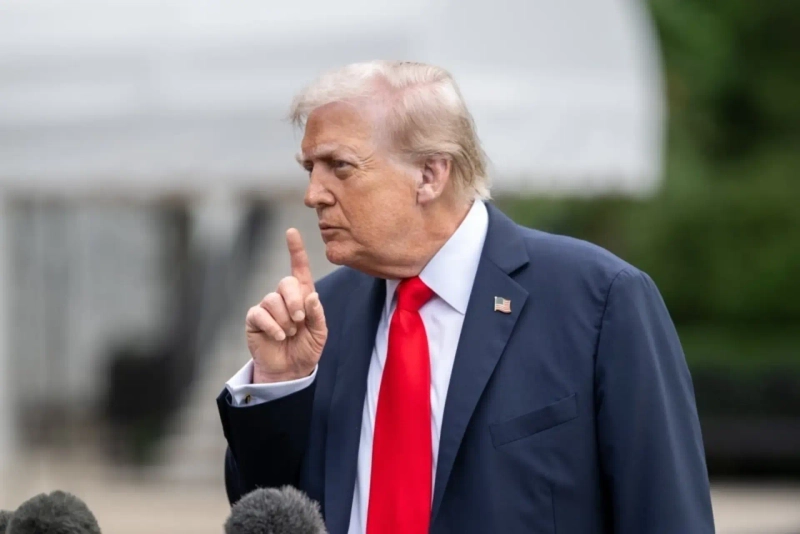
US President Donald Trump on the 11th (local time) said regarding the war with Iran that “we won,” while adding that “military operations will continue until the mission is completed.” In a speech in Kentucky the same day and an interview with Axios, Trump said “there are virtually no targets left to strike,” adding that “we’re far ahead of schedule, which was originally planned for up to six weeks, and we inflicted more damage than expected.” He went on to say, “It will end whenever I want it to end,” signaling confidence about the situation.
Still, views are split on when the war will end. Israel has maintained that it will continue operations until all military objectives are achieved, while Iran’s Islamic Revolutionary Guard Corps (IRGC) has warned that the US and Israel could face a prolonged war of attrition.
Military tensions surrounding the Strait of Hormuz remain elevated. Reports have emerged that Iran has begun laying mines in the strait, and there have also been incidents of attacks on vessels in nearby waters. Cargo volumes passing through the strait are also said to have dropped sharply compared with pre-conflict levels. As pressure for international oil prices to rise grew amid the tensions, the International Energy Agency (IEA) decided to release a record 400 million barrels of strategic reserves to stabilize prices.
At the same time, worries are mounting that Trump-driven global trade frictions could reignite. The Office of the US Trade Representative (USTR) announced in the Federal Register that it would launch a probe under Section 301 of the Trade Act, listing a total of 16 economic entities—including South Korea, China, Japan and the European Union (EU)—as targets. Section 301 allows the US to take retaliatory measures such as tariffs against unfair or discriminatory policies by foreign governments. The move is seen as an attempt to indirectly restore reciprocal tariffs after the US Supreme Court judged such tariffs, based on the International Emergency Economic Powers Act (IEEPA), to be unlawful.
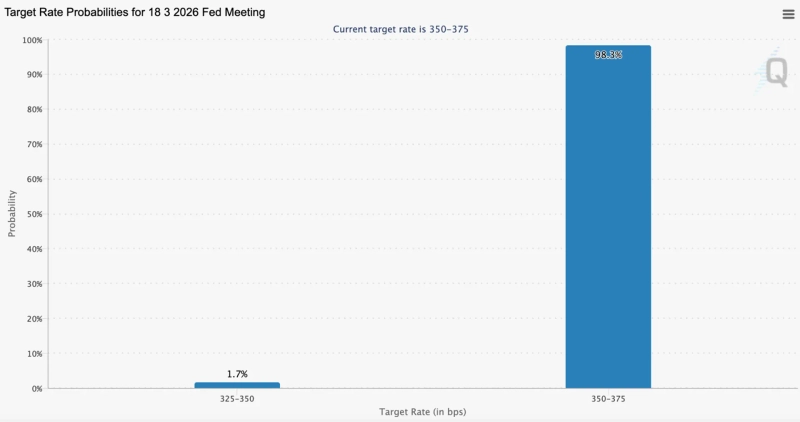
Market participants are also paying attention to inflation pressure stemming from higher oil prices. Attention is focused on the US January core Personal Consumption Expenditures (PCE) price index, due at 9:30 p.m. Korea time on the 13th. PCE is the indicator the Federal Reserve (Fed) considers most important when assessing inflation. If it comes in above expectations, bets on monetary easing later this year could retreat again. As of 6 p.m., CME FedWatch showed a 98.3% probability that the Federal Open Market Committee (FOMC) will keep rates unchanged at its March meeting.
ETF inflows resume…but the medium-term upside base remains limited
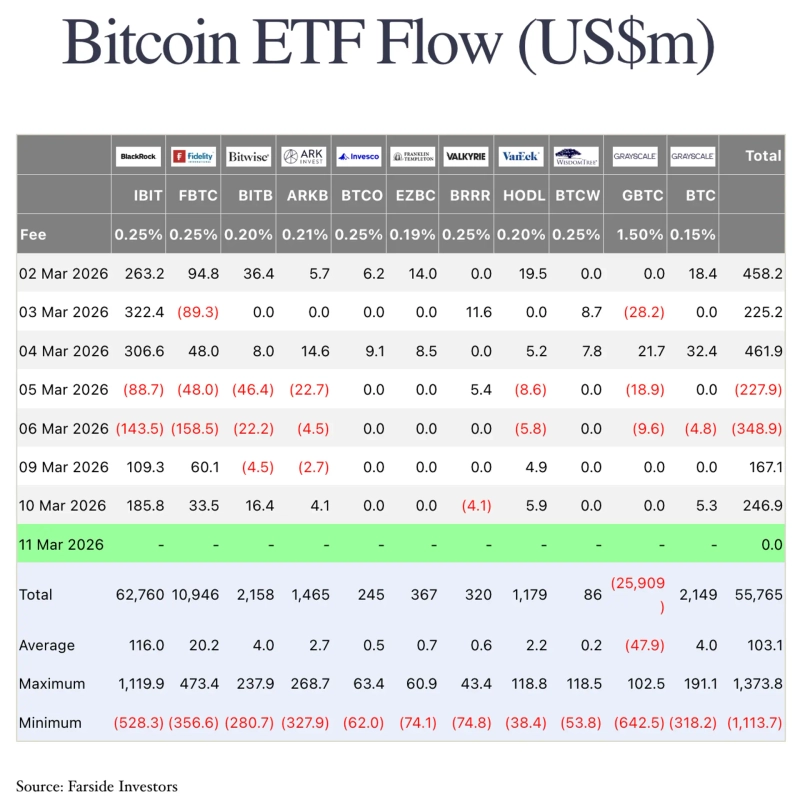
Spot Bitcoin exchange-traded funds (ETFs) saw net inflows of $568.50 million (about ₩841.5 billion) last week (2nd–6th). Net inflows have continued this week as well, pointing to improving supply-demand conditions.
In its weekly research report on the 11th, Binance Research said “Bitcoin’s share of trading activity in the US ETF market has risen again over the past week,” adding that “this is a positive sign that US investors’ trading interest is returning.” It also noted that “historically, Bitcoin has risen after US midterm elections in all three past instances, with an average gain of about 54%.”
On-chain indicators are also showing signs that the market is gradually stabilizing. In its weekly report, on-chain analytics firm Glassnode said “Bitcoin is holding up relatively well despite the macro overhang of war,” adding that “even after a short-term pullback around $74,000, momentum, ETF inflows and profitability metrics are showing a gradual improvement.” However, it cautioned that “the current accumulation intensity is not strong enough,” and that “the foundation to support a medium-term uptrend is not yet robust.”
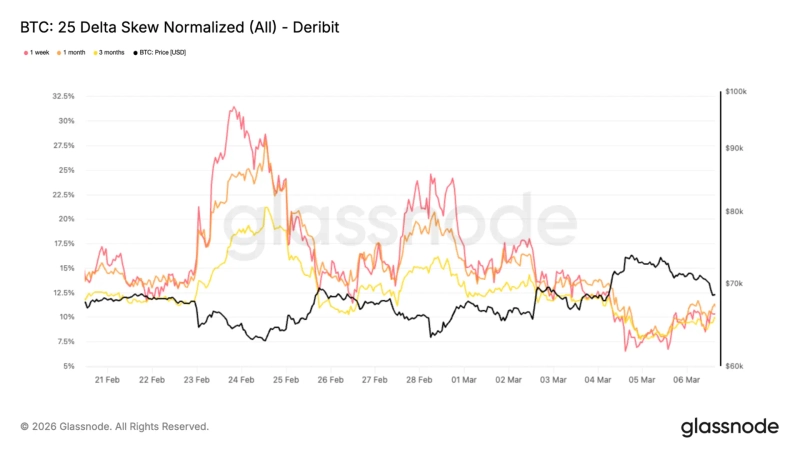
Crypto exchange Bitfinex also said in its weekly report that “trading activity in the derivatives market has contracted sharply, resembling a ‘ghost town,’” and that “price discovery is increasingly being driven by spot demand rather than leveraged derivatives.” It added that “as a significant portion of the selling pressure accumulated in the derivatives market has recently been absorbed, market structure is gradually stabilizing,” and that “in an environment of compressed volatility, a rebound that retraces part of the drawdown is possible.”
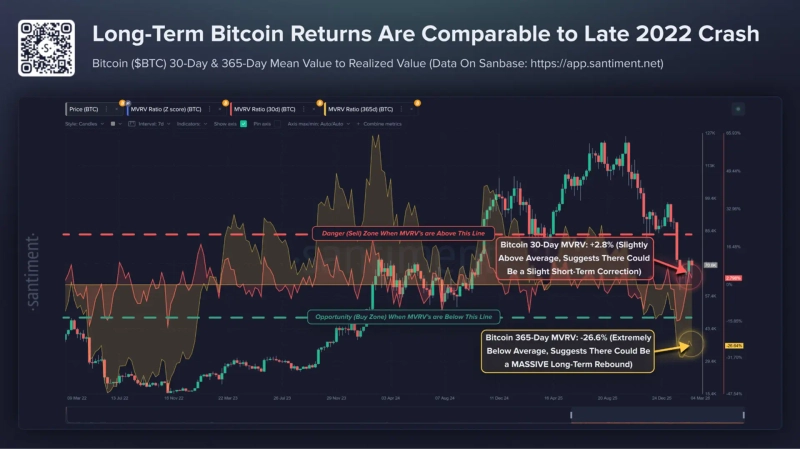
From a long-term investment perspective, signals suggesting a possible bottoming zone were also detected. On-chain analytics firm Santiment said, “Bitcoin’s MVRV on a 30-day basis suggests the potential for a short-term pullback, but on a 365-day basis it indicates the market may already have reached a long-term bottom zone.” MVRV is an indicator that compares market price with the on-chain average acquisition price.
“Bitcoin locked in a $70,000 tug-of-war…next resistance at $74,000”
Analysts say Bitcoin’s near-term price trajectory could diverge depending on whether it breaks through the $70,000 resistance zone.
Ayush Jindal, a NewsBTC analyst, said, “If Bitcoin breaks above the $70,000–$70,500 resistance zone, room could open for a move to $71,200 and $72,000.” He added, “Conversely, if the $68,400 support breaks, a correction could extend to $68,000 and $67,250, and even to $66,500.”
Rakesh Upadhyay, a Cointelegraph analyst, said, “Buyers are currently trying to keep Bitcoin above $68,815,” adding that “if this level holds firmly, the door could open to a retest of last week’s high of $74,508.” He said, “Conversely, if the price falls below $68,815, the attempt to rise could weaken and downside pressure toward the $60,000 area could increase.”
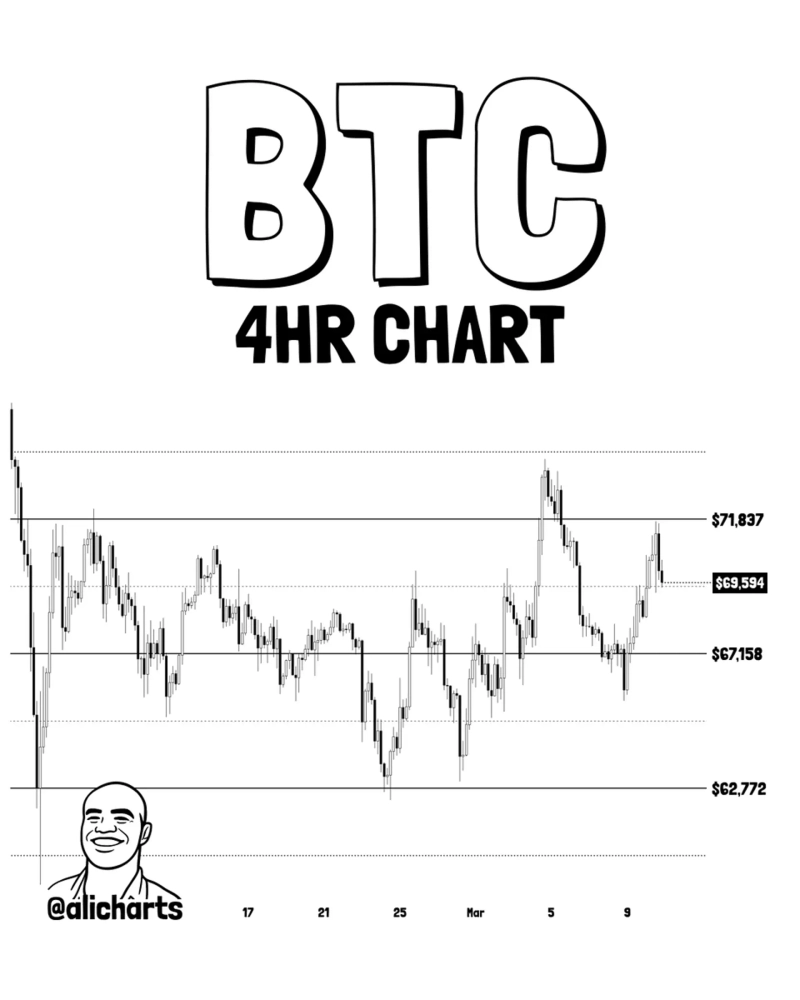
However, some argue it is still difficult to say the near-term trend has turned bullish. Alex Kuptsikevich, chief analyst at FxPro, said, “The near-term peak formed over the past 10 days came in at about $71,700, lower than last week’s peak of $74,500,” adding that “this can be interpreted as a sign that selling pressure still exists in the near term.” He said, “The area around $74,000 is acting as strong resistance,” and that “whether it decisively breaks above this zone will be a key inflection point for the near-term trajectory.”
Kang Min-seung, Bloomingbit reporter minriver@bloomingbit.io

Minseung Kang
minriver@bloomingbit.ioBlockchain journalist | Writer of Trade Now & Altcoin Now, must-read content for investors.