PiCK
US Speeds Toward Perpetual Futures…Will the Crypto Derivatives Landscape Shift?
Summary
- The US CFTC said it is laying the institutional groundwork to introduce perpetual futures and will announce related details soon.
- It reported that if the US allows perpetual futures, it is likely to absorb part of global liquidity, including a derivatives market of about $1.16 trillion and $441 billion in OI.
- It analyzed that if the Crypto Market Structure Act (Clarity Act) is enacted alongside the introduction of perpetual futures, a full-scale entry by US institutions could reshape the market landscape for US exchanges and derivatives.
Forecast Trend Report by Period


US CFTC: "We will introduce perpetual futures"
Announcement likely next month
Aiming to draw hundreds of billions of dollars in liquidity into the US
US institutions may also enter in force
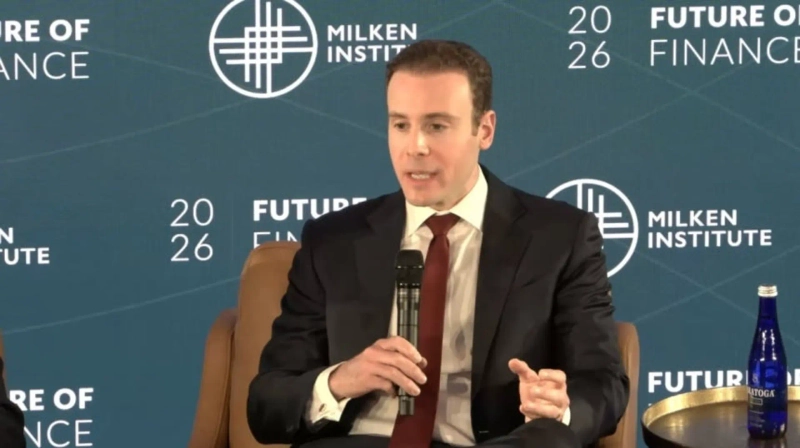
"We need to bring liquidity that has gone offshore back to the United States."
The remark was made earlier this month by Michael Selig, chairman of the US Commodity Futures Trading Commission (CFTC), at the Milken Institute’s “Future of Finance 2026” conference.
Selig said, “Over the next month or so, we are putting in place the institutional foundations to introduce ‘Perpetual Futures’ in the true sense in the United States,” adding that “we will announce details soon.”
The industry assessed this as “cutting to the core of the Trump administration’s crypto policy.” President Trump has previously stressed that the US should become the “global crypto capital” and pull back domestic liquidity that has flowed overseas.
Perpetual futures are a derivative product found only in the crypto market. Unlike futures contracts in traditional finance (TradFi), they remove the maturity structure and track underlying assets such as Bitcoin through funding rates. In crypto markets, perpetual futures account for more than 70% of total trading volume.
Will the global crypto market order change?
The main reason Selig is emphasizing the introduction of perpetual futures is to channel massive liquidity into US markets.
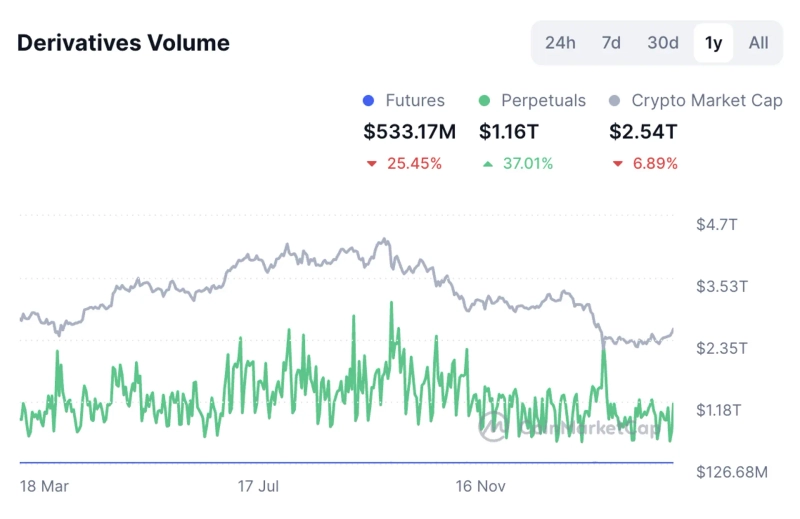
According to CoinMarketCap, as of the 17th, crypto perpetual futures trading volume stands at about $1.16 trillion (about 1,727 trillion won). Open interest (OI), which indicates the size of market positions, totals about $441 billion (about 656 trillion won). If the US allows perpetual futures, it becomes more likely to absorb part of the hundreds of billions of dollars in liquidity formed in global markets.
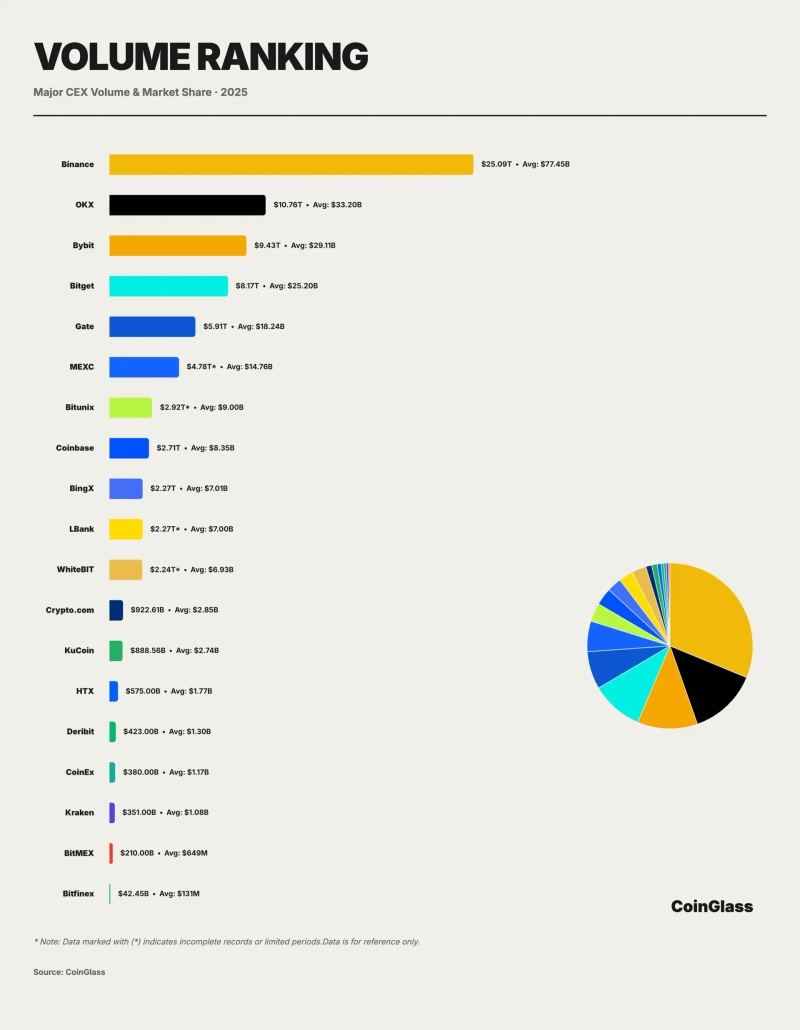
It also appears to reflect concerns that US crypto exchanges have been unable to exert much influence in the derivatives market. According to on-chain analytics firm CoinGlass, based on centralized exchanges (CEX), the top five in crypto derivatives market share last year were Binance, OKX, Bybit, Bitget and Gate, together accounting for about 70% of the overall market.
By contrast, Coinbase, the largest US crypto exchange, ranks only eighth by share. Other US crypto exchanges Crypto.com and Kraken are 12th and 17th, respectively. CoinGlass noted that “top exchanges in (derivatives share) have built a virtuous cycle on the back of a liquidity advantage,” adding that “those that have not are inevitably exposed to ongoing pressure of share erosion.”
Separately, if the enactment of the “Crypto Market Structure Act (Clarity Act),” currently pending in the US Senate, dovetails with the rollout of perpetual futures, large-scale institutional money is seen as likely to flow into US exchanges.
Bok Jin-sol, lead at Populous Research, said, “As the crypto industry grows, demand among US institutions for perpetual futures trading is also rising,” adding, “If US institutions enter the (perpetual futures) market in earnest, the landscape of the exchange industry could change.”
Lee Jun-hyung, BloombergBit reporter gilson@bloomingbit.io

JOON HYOUNG LEE
gilson@bloomingbit.ioCrypto Journalist based in Seoul