KOSPI Seen Reclaiming 6,000… Institutions Post Record ₩3.1tn Net Buying
Summary
- The report said institutional investors posted record net buying of ₩3.1094tn on the KOSPI, sending the index surging to 5,925.03.
- It said Samsung Electronics and SK Hynix jumped to close at ₩208,500 and ₩1,056,000, respectively, with their combined market-cap weight breaking above 40.61% for the first time on record.
- It said experts and Morgan Stanley suggested the KOSPI could break above its prior peak and potentially rise toward 8,500, premised on strength in semiconductors and corporate governance reform.
Forecast Trend Report by Period


“200,000-won Samsung” and “1,000,000-won Hynix” return
Up more than 5% on a semiconductor surge
Samsung Electronics–SK Hynix weight tops 40% for first time
Institutions net buy ₩2.5tn of the semiconductor top two
Foreigners also flip back to net buying after a long hiatus
Morgan Stanley: “KOSPI 8,500 is possible”
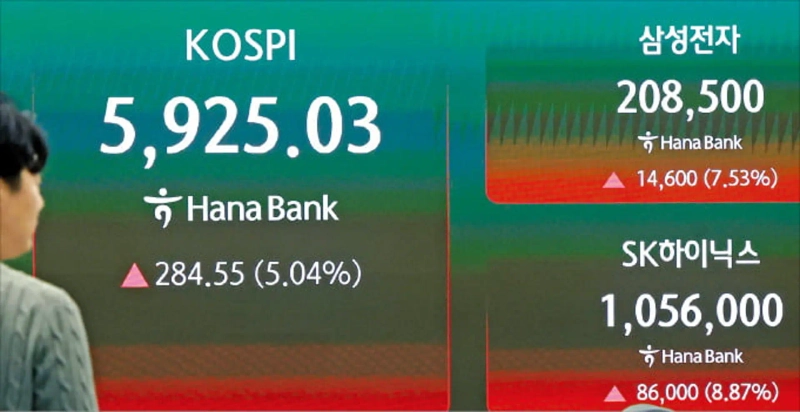
Institutional investors executed the largest net buying ever recorded on the Korea Exchange, helping the KOSPI reclaim its highest level since the Iran war. Foreign investors, who had kept selling in the wake of the conflict, also returned to domestic equities, putting the market within reach of retaking the 6,000 mark.
KOSPI recovers to post-war high
On the 18th, the KOSPI closed at 5,925.03, up 5.04% from the previous session. By closing price, it was the highest since last month’s 27th (6,244.13), before the outbreak of the war between the US and Iran. After opening at 5,767.10—up 2.24% from the prior close—the index extended gains into the afternoon.
Semiconductor bellwethers such as Samsung Electronics and SK Hynix surged. Samsung Electronics rose 7.53% to close at ₩208,500, and SK Hynix jumped 8.87% to ₩1,056,000, returning to the “200,000-won Samsung” and “1,000,000-won Hynix” milestones. Their combined share of total market capitalization on the KOSPI was tallied at 40.61%, exceeding 40% for the first time on record.
Lee Kyung-min, team head at Daishin Securities’ Asset Research Division, said, “Investor sentiment toward semiconductors strengthened through Nvidia GTC, and Samsung Electronics announced at its shareholders’ meeting a final dividend of ₩3.75tn and a ₩16tn treasury-share retirement plan, drawing a value-up trade across Samsung group stocks.” The KOSDAQ closed at 1,164.38, up 2.41% from the previous session.
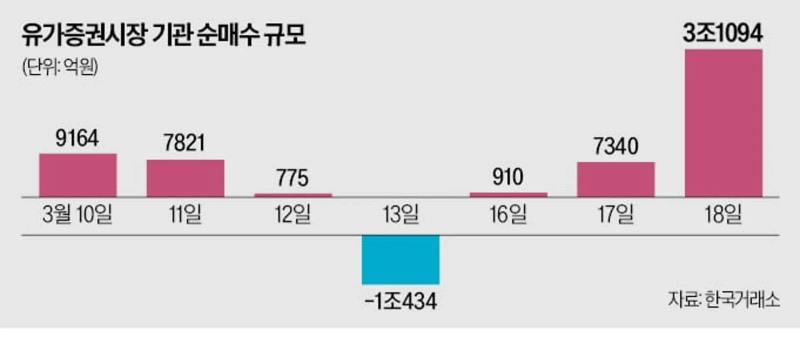
The day’s rally was led by institutions. Institutional investors posted net purchases of ₩3.1094tn on the main board, the largest on record, topping the previous peak of ₩2.7123tn set on Feb. 9.
Institutions have contributed significantly to the market’s recent recovery. After continuing net selling immediately after the war, they flipped to clear net buying starting on the 10th, extending net purchases in six of the past seven trading sessions.
The stocks institutions picked were semiconductors. From the 10th to the 17th, the most net-bought name by institutions was SK Hynix (₩1.3095tn), followed by Samsung Electronics (₩1.2066tn), another semiconductor bellwether.
In line with the government’s policy to foster the KOSDAQ market, they also bought heavily KODEX KOSDAQ 150 (₩382.1bn) and KODEX KOSDAQ 150 Leverage (₩308.1bn). Doosan Enerbility (₩312.1bn), SK Square (₩232.3bn), Kia (₩203.5bn), Doosan (₩125.2bn) and Hyundai Motor (₩121.7bn) also ranked high in net buying.
Foreign investors, who had left the Korean market after the war, also turned to net buying. They posted net purchases of ₩888.5bn on the day. Foreigners had mainly sold semiconductor stocks since the conflict began, but on the day they shifted toward buying again, including SK Hynix.
“Focus on Samsung Electronics’ earnings next month”
Experts are leaning toward the possibility that the semiconductor-led uptrend may continue. Kim Byung-yeon, head of investment strategy at NH Investment & Securities, said, “With semiconductor prices already up, additional increases in logistics costs due to the Iran war are expected to push semiconductor prices higher,” adding, “When Samsung Electronics’ earnings are released next month, the KOSPI could break above its previous high.”
Morgan Stanley said in a report that the KOSPI could rise to as high as 8,500 within two years. The forecast assumes geopolitical risks do not worsen further and instead stabilize, and that the pace of ongoing corporate governance reform is maintained or accelerates somewhat.
Morgan Stanley noted, “Korean equities have undergone a meaningful pullback from recent highs amid rising global geopolitical risks and pressure from energy prices,” adding, “At the same time, the pace of structural corporate reform has been steadily maintained, and policy initiatives have laid the groundwork for pushing reforms forward.”
Kang Jin-gyu/Lee Seon-a, reporters josep@hankyung.com

Korea Economic Daily
hankyung@bloomingbit.ioThe Korea Economic Daily Global is a digital media where latest news on Korean companies, industries, and financial markets.