China piles up strategic oil reserves ‘five times the U.S.’… delays releases despite supply crunch
Summary
- China has secured 1.5–2.0 billion barrels of strategic reserves but is not taking part in the IEA’s release of emergency stockpiles.
- China increased crude imports by 16% and expanded its resource stockpiling budget to 110.68 billion yuan.
- With China tightening export controls on petroleum products and fertilizer inputs and halting urea export permits, concerns are growing that the global supply crunch could worsen.
Forecast Trend Report by Period


Preparing for a prolonged Middle East war
Secures 112 days’ worth of crude with 2 billion barrels
Built up reserves starting two months before the war
Cuts exports of petroleum products and fertilizer inputs
Worsens the global shortage of related raw materials
China, which has amassed the world’s largest strategic oil reserves, is responding by curbing exports of petroleum products and the like rather than releasing its stockpiles. While the move is intended to brace for a prolonged conflict in the Middle East, critics say it is exacerbating global supply tightness for related raw materials.
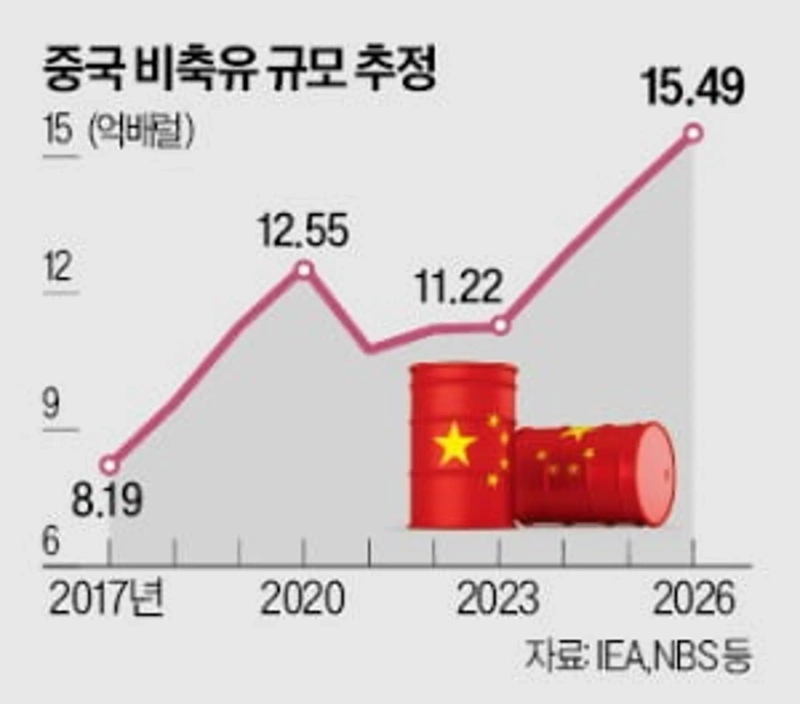
On the 18th, the Financial Times (FT), citing an analysis of data from the International Energy Agency (IEA) and others, estimated China’s oil stockpiles at more than 1.5 billion barrels. Research firm Gavekal puts the figure at over 2 billion barrels—about five times the holdings of the United States, the world’s second-largest holder of strategic reserves (415 million barrels). Bernstein Research, a global market-research firm, said that “with just 1.4 billion barrels, China could replace crude imports for 112 days.”
The IEA said on the 12th that its 32 member countries agreed to supply a total of 400 million barrels of emergency reserves to the market. The United States will release about half of that, or 172 million barrels. South Korea will release 22.46 million barrels. China is not an IEA member and therefore will not release reserves.
Some analysts say China increased its stockpiles in advance in anticipation of a war between the United States and Iran. FT reported, “According to Chinese customs data, China boosted crude imports by 16% year on year in January and February even though the increase was not supported by rising domestic demand.”
Last year, the Chinese government set this year’s resource stockpiling budget at 110.68 billion yuan (about KRW 23.9079 trillion), up 8.1% from the previous year. Andrea Ghiselli, a professor at the University of Exeter in the U.K., said, “China could not have predicted the exact date of a U.S. and Israeli strike on Iran, but it seems to have anticipated to some extent what would happen.”
According to Reuters, the Chinese government on the 11th instructed domestic companies to immediately halt exports of petroleum products as well. Clyde Russell, Reuters’ Asia commodities columnist, said, “China can argue that securing crude in an uncertain environment is a prudent precaution,” but added that “its reluctance to release massive oil stockpiles is an effort to reap huge profits by exporting refined fuels to a desperate Asian market.”
As crude supplies tighten, China is responding by controlling exports of oil-related products and raw materials to curb demand rather than releasing reserves. Early in the war, China was the first in the world to declare export controls on petrochemical products. It is also tightening export controls on fertilizer-related raw materials. The Strait of Hormuz accounts for one-third of global seaborne trade volume in fertilizer inputs as well. China is the world’s largest producer of ammonium phosphate, a nitrogen-and-phosphorus compound fertilizer made through the chemical reaction of phosphoric acid and ammonia.
Reuters reported that the Chinese government has not issued a single export permit for urea this year, a step aimed at securing domestic supply ahead of the spring planting season. Some analyses say the government expanded export controls amid recent global supply jitters. Last week, the Chinese government released state-held fertilizer stockpiles onto the domestic market. The China Nitrogen Fertilizer Industry Association said, “If the conflict in the Middle East is prolonged, global urea output could decline, but China is expected to achieve a record production target of 76.5 million t this year.”
Reported by Kim Ju-wan / Kim Eun-jung, Beijing correspondent kjwan@hankyung.com

Korea Economic Daily
hankyung@bloomingbit.ioThe Korea Economic Daily Global is a digital media where latest news on Korean companies, industries, and financial markets.