[Q&A] Powell: "The Iran war is the most important variable for monetary policy" [Fed Watch]
Summary
- Chair Jerome Powell said the most important variable for monetary policy going forward is the Iran war, and that an energy-price shock could become an inflation factor.
- Powell said keeping the median year-end policy rate at 3.4% reflects expectations that inflation will improve gradually and that upward pressure on prices will ease as tariff effects fade.
- Powell said the outlook for rate cuts is being maintained, but only if disinflation actually materializes, and that he views as very serious the risk that inflation expectations could become unsettled due to higher oil prices and repeated shocks.
Forecast Trend Report by Period


Disclosed at a press conference after the June 18 FOMC meeting
Energy shocks from the Iran war could become an inflation factor
Median year-end policy rate held at 3.4%
Inflation pressure eases as tariff effects fade
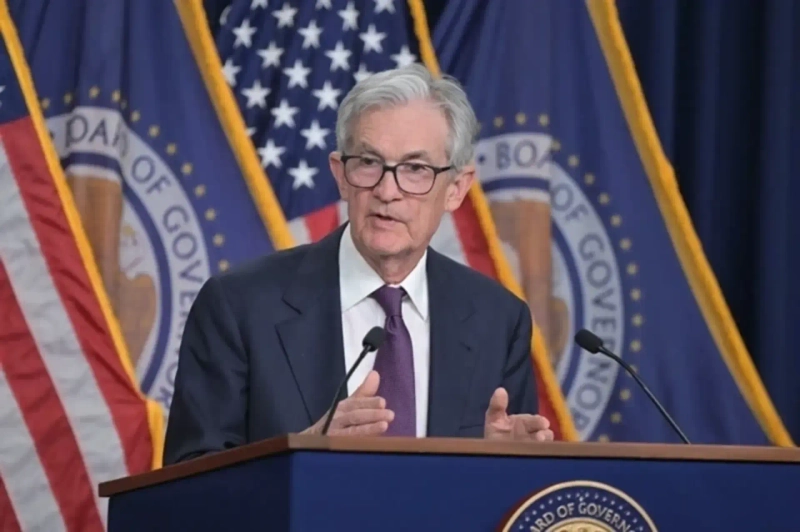
Jerome Powell, chair of the U.S. central bank (Fed), said that following tariffs, an energy-price shock stemming from the Iran war could become an inflation factor.
Powell made the remarks at a press conference held after the Federal Open Market Committee (FOMC) meeting on the 18th (local time). He also made clear that the Iran war is the most important variable for monetary policy going forward.
Powell added, however, that the decision to keep the median year-end policy rate at an annual 3.4% in the Summary of Economic Projections (SEP) released that day was basically due to expectations that inflation would improve, albeit gradually. He said that in particular, after midyear, once the impact of tariffs is reflected as a one-off, a trend of gradually easing upward pressure on prices is expected to emerge. Below is the Q&A.
▶ With oil prices rising due to the Middle East conflict, inflationary pressure appears likely to increase. Is it appropriate to treat such price increases as temporary and approach policy accordingly? In particular, how do you take into account the fact that inflation has already been above target for five years.
"First, we are fully aware of how inflation has moved over the past few years, and that the progress we have made toward price stability has been repeatedly undermined by a series of shocks. Recently, tariffs were a major shock, and now there is the possibility that a new factor—higher energy prices—could be added.
What we are watching especially closely this year is whether we continue to see progress on inflation through declines in goods prices. Tariffs are a one-time price-level increase, so over time they get reflected across the broader economy, and ultimately that effect should fade. That is exactly the process we want to confirm.
Core inflation is currently around 3%, and a significant portion of that—roughly 0.5 to 0.75 percentage points—can be attributed to tariffs. So the key is to see whether prices actually slow as the tariff effects dissipate.
Until we see that, it is not the stage to discuss whether we can 'look through' higher energy prices from a policy perspective.
Of course, traditionally, central banks have treated energy-price shocks as transitory and excluded them from policy judgments. But that approach is only possible when the premise is that inflation expectations remain well anchored.
The situation is different now. We have already experienced an environment in which inflation has run above target for about five years. In that context, simply saying 'this shock is also temporary' may not be appropriate. So we are approaching this very carefully and will weigh all factors together in our assessment."
▶ (In the SEP) the inflation outlook was revised up and the growth and employment outlooks were little changed. Why, then, is the outlook for rate cuts still being maintained.
"There are 19 Fed participants, and each has their own forecast and judgment. The median itself did not change, but internally there was a shift toward fewer rate cuts. For example, some participants revised their expectations from two cuts to one.
Even so, the reason the outlook for rate cuts is still being maintained is basically because of the expectation that inflation will improve, albeit gradually. In particular, after midyear, we expect to see a pattern in which the impact of tariffs is reflected as a one-off and then upward pressure on prices gradually eases.
But what I want to be clear about is that this rate path is conditional. If the disinflation we expect does not materialize, rate cuts will not happen."
▶ Is the upward revision to the 2026 inflation outlook due to higher oil prices.
"It is true that the oil-price effect is included to some extent, but that is not the whole story. Oil prices can also feed into core prices to some degree.
Still, this upward revision reflects not simply oil prices, but also that progress toward (disinflation) in goods prices and tariffs-related developments has been slower than expected. We do expect that progress to emerge eventually, but the fact that it is slower than anticipated is reflected in this forecast."
▶ How do you view the possibility that higher oil prices will negatively affect consumption and growth.
"To be honest, nobody can know for sure. The impact could be large or small, much smaller than expected or much larger than expected. If high oil prices persist for a long period, they could weigh on consumption and reduce disposable income. But whether that situation will actually occur is uncertain.
This forecast is not based on certainty, either—it is simply based on reasonable assumptions in an uncertain situation."
▶ The U.S. is a net energy exporter. Doesn't that offset the effects of higher oil prices.
"There is an offsetting effect to some extent. Because the U.S. is a net energy exporter, higher oil prices lead to higher earnings for energy companies, which can spur investment and expand employment.
But the important point is that companies do not increase investment simply because oil prices rise temporarily. Firms make investment decisions only when they are confident that higher oil prices will persist for a considerable period.
So at this point, the offset may be limited, and overall the structure is one in which consumption and employment face downside pressure while prices face upside pressure."
▶ If tariff inflation is treated as 'temporary' and oil-driven inflation is also treated as 'temporary,' couldn't that undermine policy credibility.
"That point is very important, and we are deeply aware of it. Over the past few years we have experienced multiple shocks—pandemic, tariffs, and now an energy shock. When these repeated shocks accumulate, inflation expectations can become unanchored.
We view that risk very seriously. At the same time, it is not desirable to overreact to any single shock. We will make the best judgment we can based on the data and facts we are given, and maintaining policy credibility is also a very important objective.
Above all, what matters most is maintaining confidence in the 2% inflation target, and we will take the steps needed to do so."
▶ What is the basis for believing that current monetary policy can lower inflation.
"The current policy rate can be seen as positioned between neutral and restrictive—that is, mildly restrictive.
A key part of the disinflation process going forward is that the tariff effects gradually fade. As that process proceeds, goods prices may return to levels similar to the past.
But we also have to consider downside risks in the labor market. If policy becomes overly restrictive, it could have negative effects on employment. So we are balancing upside risks to inflation against downside risks to employment."
▶ Can the current situation be viewed as stagflation.
"No. Stagflation refers to a situation like the 1970s, when both unemployment and inflation were very high. Today, unemployment is close to its long-run average, and inflation is not at a level that high.
That said, it is appropriate to view the current environment as a 'tense situation' in which upside risks to inflation and downside risks to employment exist at the same time.
▶ What will you do if a successor chair is not confirmed.
"Under the law, I will continue to perform my duties as acting chair. Also, I have no plan to step down from the Fed (as a governor) until the Justice Department investigation is concluded.
▶ What does the future policy direction depend on.
"The most important variable is how the situation in the Middle East develops. We will have more information by the next meeting, and we will make our judgment accordingly.
Given the very high level of uncertainty at present, it is not appropriate to assume a particular path."
New York = Correspondent Park Shin-young / Washington = Correspondent Lee Sang-eun nyusos@hankyung.com

Korea Economic Daily
hankyung@bloomingbit.ioThe Korea Economic Daily Global is a digital media where latest news on Korean companies, industries, and financial markets.