Spreading 'cost-push inflation'… central banks worldwide hold rates steady in succession
Summary
- The Fed said it held the federal funds rate at an annual 3.50–3.75% and signaled that rate cuts could be delayed this year.
- It reported that the central banks of the U.S., Canada and Japan are collectively maintaining a hold stance amid Middle East geopolitical risks and concerns over a surge in energy prices.
- It said that as the Fed raised its forecasts for PCE inflation and core PCE, judging that disinflation is slowing, the market’s expectations for rate cuts have retreated sharply.
Forecast Trend Report by Period


Fed holds rates steady at an annual 3.5–3.7% on the 18th
Bank of Canada and Bank of Japan also on hold
Iran war raises fears of a surge in energy prices
Bracing for inflation from logistics and raw material costs
With volatility rising in global oil prices after U.S. and Israeli strikes on Iran, central banks around the world—including the U.S. Federal Reserve (Fed) and the Bank of Japan—have moved in succession to hold interest rates steady. Global investors had at one point expected central banks to continue easing as inflation cooled, but uncertainty over energy prices is pushing back the timing of any rate cuts.
If bottlenecks persist at the Strait of Hormuz in Iran—through which 20% of the world’s crude oil passes—a sharp rise in oil prices would be inevitable, heightening concerns over broader increases in logistics and raw-material costs.
Powell: "Facing an energy shock"
On the 18th (local time), the Fed held a Federal Open Market Committee (FOMC) meeting and kept the target range for the federal funds rate at 3.50–3.75%.
In its statement, the Fed assessed that "economic activity has been expanding at a solid pace," while noting that "job gains have remained low" and "the unemployment rate has shown little change." It also underscored that "inflation remains somewhat elevated."
The statement, in particular, clearly reflected heightened vigilance over geopolitical risks. The Fed said, "uncertainty about the economic outlook remains high," adding that the impact of the Middle East situation on the U.S. economy is uncertain.
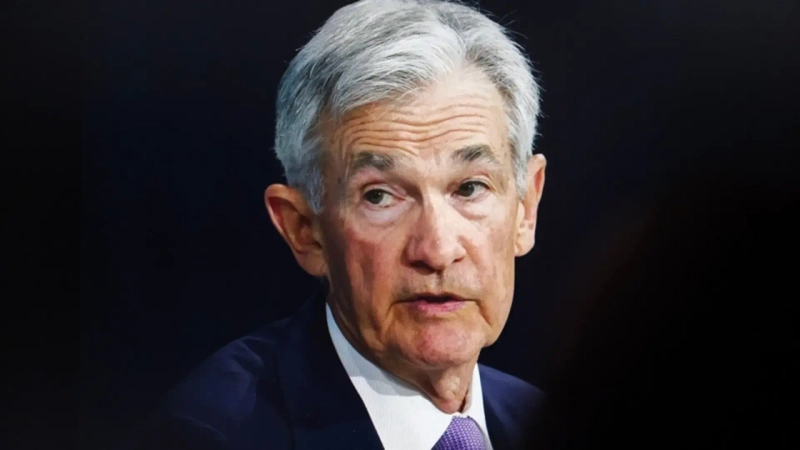
At a press conference the same day, Chair Jerome Powell said, "Over the past five years, we have experienced a tariff shock and the (COVID-19) pandemic, and now we are facing an energy shock of considerable size and duration." He added, "We don’t know what that shock will actually look like," while noting he is "concerned that such a situation could negatively affect inflation expectations and cause problems."
However, he drew a line on the possibility of stagflation. "In the 1970s, when we experienced stagflation, both unemployment and inflation were very high," he said. "Now, unemployment is close to its long-run average, and inflation is not that high."
Inflation outlook raised
The Summary of Economic Projections (SEP) released the same day showed a higher inflation path than previously, indicating greater policy uncertainty.
Fed officials projected this year’s personal consumption expenditures (PCE) inflation at 2.7%, a sharp upward revision from the 2.4% forecast in December. Core PCE was also raised to 2.7%, reflecting a view that disinflation is proceeding more slowly than expected.
By contrast, the growth outlook improved slightly. The forecast for real gross domestic product (GDP) growth this year was revised up to 2.4% from 2.3%. The unemployment rate was unchanged at 4.4%, suggesting the labor market is expected to remain relatively stable.
There was little change in the projected rate path. Fed officials put the median policy rate at 3.4% at end-2026, keeping it near the current level. The rate is expected to remain in the low-3% range in 2027–2028, and the longer-run neutral rate was set at 3.1%.
Markets, however, are increasingly betting that the Fed will be unable to cut rates this year, let alone in the first half. According to CME Group’s FedWatch, interest-rate futures priced in a 93% probability that the Fed will hold rates at the current level through June, up sharply from 38% a month earlier. The probability of no rate cuts at all by year-end rose to 52% from just 5% a month ago.
A line of central banks holding steady
The Bank of Canada also held a monetary policy meeting that day and said it kept its policy rate unchanged at 2.25%. In its post-decision statement, the Bank of Canada said, "The Middle East war has increased volatility in global energy prices and financial markets and heightened risks to the global economy," adding that "the scope and duration of the conflict, and its economic effects, remain highly uncertain." It also said that, in addition to energy supply disruptions, transport bottlenecks caused by an effective closure of the Strait of Hormuz could affect supplies of other raw materials such as fertilizer.
The Bank of Japan also held its policy rate steady at "around 0.75%" on the 19th, in line with market expectations.
The BOJ said, "Unstable movements have been seen in international financial markets, and crude oil prices have risen sharply, making it necessary to pay close attention to future developments."
It also noted that a spike in crude prices could widen the pace of increases in Japan’s consumer prices.
New York=Correspondent Park Shin-young nyusos@hankyung.com

Korea Economic Daily
hankyung@bloomingbit.ioThe Korea Economic Daily Global is a digital media where latest news on Korean companies, industries, and financial markets.