PiCK
What did Powell say to sound hawkish…Bitcoin re-enters the ‘fear zone’ [Kang Min-seung’s Trade Now]
Summary
- Experts said Bitcoin is in a directionless phase, pointing to $75,000 on the upside and $65,000 on the downside as key price levels.
- On-chain and technical analysts said that depending on support/resistance at $71,158·$72,000·$73,344·$74,508, the door could open to a drop toward $65,000 or a rise toward $84,000.
- Katie Stockton said Bitcoin remains in a neutral zone and needs to reclaim around $75,000 to expect a more constructive upside trajectory.
Forecast Trend Report by Period


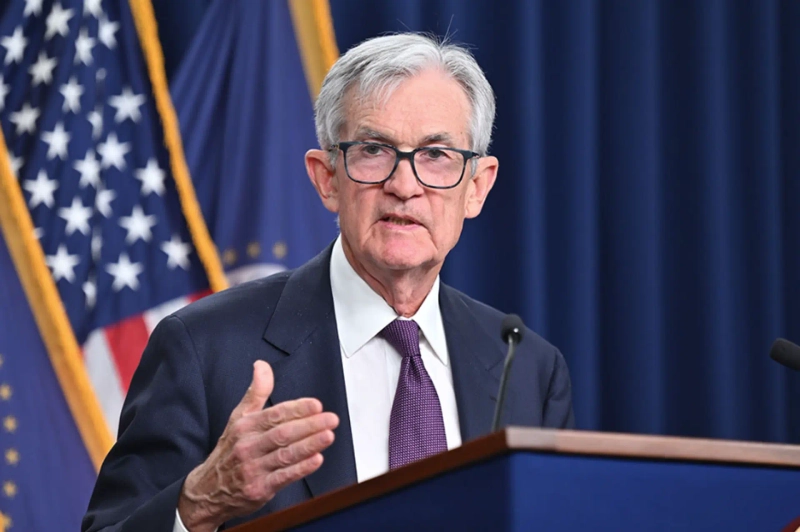
Amid escalating geopolitical tensions in the Middle East, Bitcoin (BTC) is showing a loss of near-term upside momentum following hawkish (favoring tighter monetary policy) remarks by Jerome Powell, head of the U.S. central bank (Fed). Experts are watching the risk of a break below the $65,000 support level, while viewing whether it can reclaim $75,000 as a key variable for a trend reversal.
As of 18:46 on the 19th, Bitcoin was trading at $70,424, down about 5.1% from the previous day on Binance’s USDT market (KRW 104.71 million on Upbit). The kimchi premium— the price gap between overseas and domestic exchanges— stood at -0.61%.
Fed flags energy shock…upside inflation risks come into focus
Global equities and crypto markets saw volatility pick up as Powell’s remarks came across more hawkish than expected. Selling pressure was also observed across risk assets, including Bitcoin.
On the 18th (local time), the Federal Reserve (Fed) held the March FOMC meeting and left the policy rate unchanged at 3.50–3.75%, extending its hold for a second consecutive meeting. In its statement, the Fed said “economic activity has been expanding at a solid pace,” while assessing that “inflation remains somewhat elevated.” Despite expectations for disinflation, energy-driven price pressures have emerged as a swing factor, increasing uncertainty around the policy path.
In a press conference immediately after the meeting, Powell said, “We went through the tariff shock and the pandemic, and now we are facing an energy shock of significant size and duration.” He added, “We don’t know what that shock will actually look like, but we are concerned it could affect inflation expectations.”
The Fed also raised its forecast for the personal consumption expenditures (PCE) inflation rate this year to 2.7% from 2.4%, signaling that disinflation could proceed more slowly than expected. Meanwhile, it slightly lifted its growth forecast to 2.4%, suggesting the economic backdrop is likely to remain relatively stable.

Middle East–driven geopolitical risks are rising as a key macro variable by stoking volatility in energy prices. After Iran’s gas fields and refining facilities were attacked, global oil prices surged 5–6% in a short period, and concerns over supply disruptions have intensified amid the risk of bottlenecks in the Strait of Hormuz. Tensions have also persisted as President Donald Trump voiced dissatisfaction with allies’ lukewarm response over the issue of deploying forces to the Strait of Hormuz.
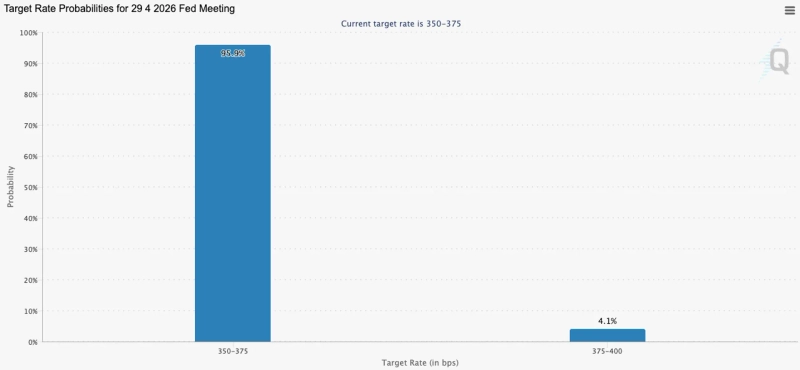
Market participants are focused on inflation uncertainty and the potential for shifts in rate policy. According to CME FedWatch, the probability of rates being held at the April FOMC meeting was priced at 95.9%, with a 4.1% chance of a hike. The probability of rates staying on hold through June jumped to 93%, while the odds of no rate cuts this year surged to 52% from 5%.
“ETF inflows rebound…but derivatives market remains bearish”
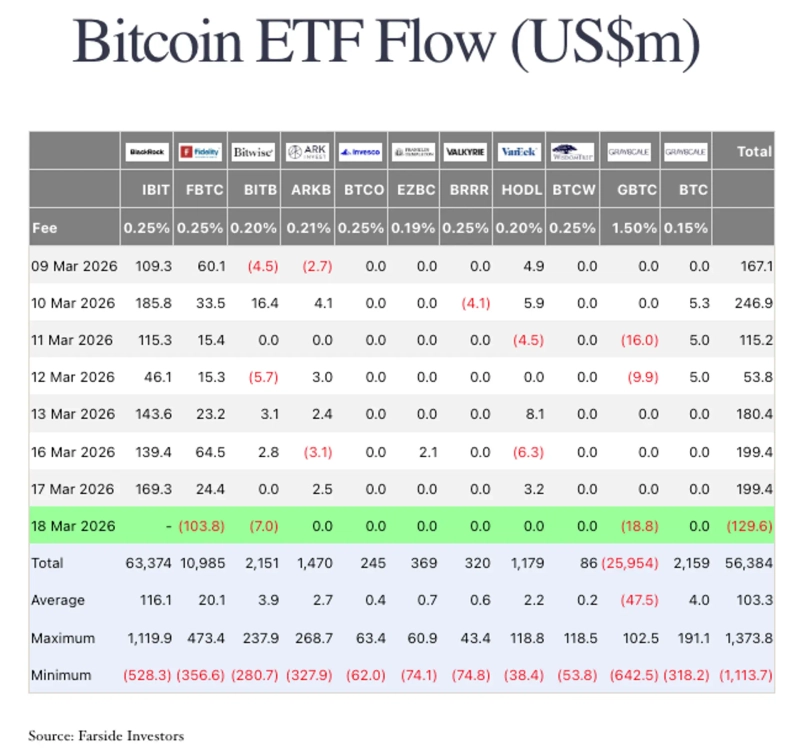
Spot Bitcoin exchange-traded funds (ETFs) saw net inflows of $763.40 million (about KRW 1.1447 trillion) last week (9th–13th), and the inflow trend has continued since. The resumption of institutional inflows is being read as an improvement in supply-demand dynamics.
On the 18th, on-chain analytics firm Glassnode said in its weekly research report, “Over the past month, ETF inflows have rebounded, and institutional investor demand is increasing again,” while cautioning that “it is difficult to confirm a bull market based on a single price rebound.”
It added, “Bitcoin is likely to trade in the air-gap range between $72,000 and $82,000 in the near term,” and “if it absorbs selling pressure over the coming weeks and holds above $70,000, it could open room for additional upside toward around $78,000 and $82,000.” An air gap refers to a price zone where historical trading accumulation was limited, meaning overhead supply resistance tended to be relatively weak.
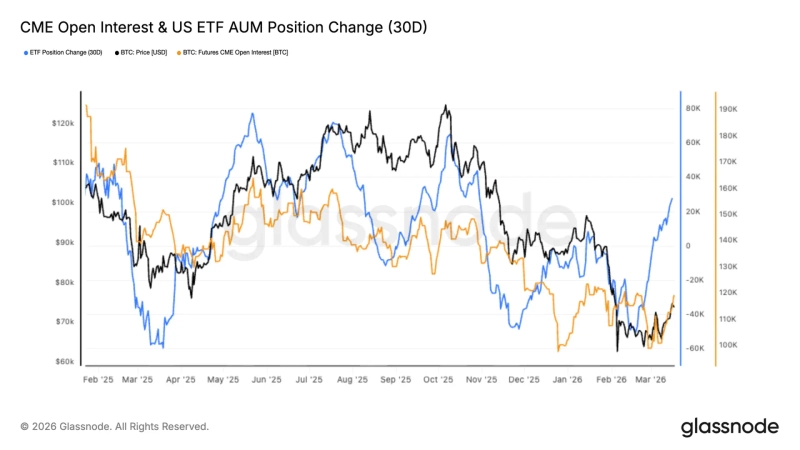
In contrast, derivatives markets have not shown a clear bullish signal. Global crypto exchange Bitfinex said in its weekly report that “Bitcoin open interest (OI) stands at $50.3 billion, up 14% from multi-year lows.” It added, “Short positions are holding a slight edge in derivatives markets, and annualized funding rates are in negative territory,” and analyzed that “the recent rise in OI appears largely driven by the build-up of sell (short) positions responding to the price increase, and it is hard to view it as fresh buying.”
Open interest (OI) refers to the size of outstanding positions that have not been closed in derivatives markets. Generally, rising OI indicates broader participation and can increase the likelihood of greater price volatility. However, because this OI increase appears skewed toward selling positions, it is difficult to interpret it as a straightforward bullish signal.
Over the longer term, analysts say the move toward clearer U.S. regulation could be supportive for the market. Previously, on the 18th, the U.S. Securities and Exchange Commission (SEC) and the U.S. Commodity Futures Trading Commission (CFTC) released joint guidance explaining standards for applying securities laws to crypto assets. Binance Research said the guidance “clarifies the criteria for classifying digital assets and can ease regulatory uncertainty.” It added that this “will serve as an administrative linkage leading into the CLARITY Act, a crypto market structure bill currently being discussed in the Senate.”
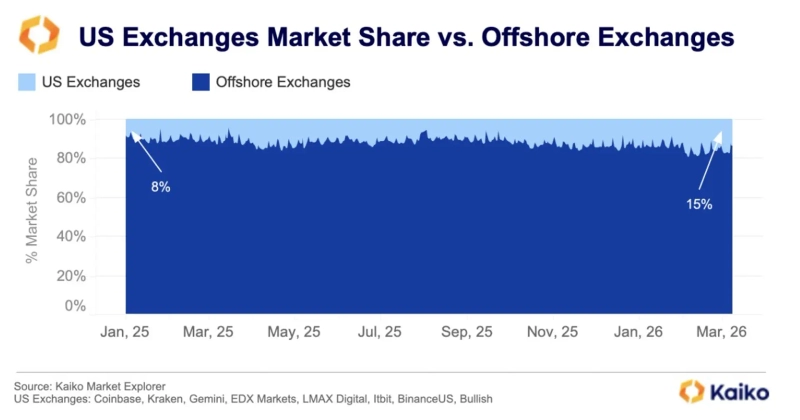
In fact, the U.S. share of the crypto market is also rising. Crypto data firm Kaiko said, “U.S. exchanges’ share of the spot market expanded from 8% to 15% over the past year,” adding that “Bitcoin liquidity in the U.S. is deeper and growing faster than on overseas exchanges.”
Bitcoin re-enters the fear zone…$65,000 support put to the test
Experts say that even as Bitcoin attempts a short-term rebound, it has yet to establish a clear direction, pointing to $75,000 on the upside and $65,000 on the downside as key levels.
Analysts note that despite rebound attempts, sentiment remains subdued. Quant trading firm Presto Labs assessed that “as Bitcoin extends its decline, it has re-entered the ‘extreme fear’ zone.” The view is that Powell’s hawkish remarks have constrained improving market sentiment, and expectations for rate cuts later this year have also weakened following developments involving Iran.
Markets are increasingly focused on growing downside pressure while upside headwinds remain. DailyForex analyst Christopher Lewis said, “If Bitcoin breaks below the $72,000 area, the door opens to a decline toward $65,000.” He added, “If price clears $76,000, the move could extend toward $84,000.”
Rakesh Upadhyay, a researcher at Cointelegraph, also said, “If Bitcoin falls below $71,158 on a daily basis, the uptrend could weaken, and downside pressure could then expand toward the $65,000 support level.” He added, “Conversely, if Bitcoin breaks above the $74,508 resistance level decisively, it could open room for additional upside toward $84,000.”
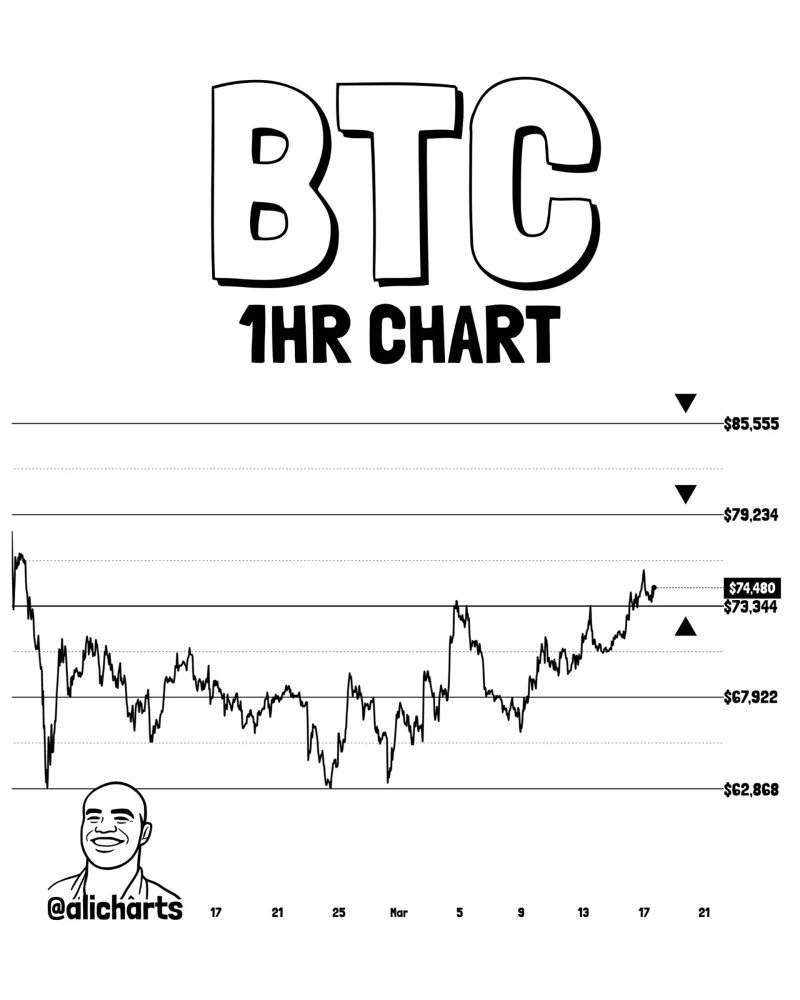
Katie Stockton, founder of Fairlead Strategies, said, “Bitcoin remains in a neutral phase, and it is hard to say the risk-on environment has resumed,” adding that “it needs to reclaim roughly the $75,000 level to expect a more constructive upside trajectory.”
Kang Min-seung, BloombergBit reporter minriver@bloomingbit.io

Minseung Kang
minriver@bloomingbit.ioBlockchain journalist | Writer of Trade Now & Altcoin Now, must-read content for investors.