Currencies are plunging one after another because of the war… yet one is ‘holding up on its own.’ What’s the secret? [Global Money X-File]
Summary
- Amid a weaker tone across Asian currencies driven by the Middle East war and sharp swings in global oil prices, the dollar index (DXY) has stayed strong, the report said.
- Malaysia, supported by its status as a net energy exporter and capital inflows tied to advanced tech industries, has seen the ringgit (MYR) show unusually strong resilience among Asian currencies.
- While the currencies of energy importers such as the Japanese yen, Indian rupee, Thai baht and South Korean won plunged, China’s yuan (CNY) was limited to a modest decline thanks to capital controls and policy intervention, the report said.
Forecast Trend Report by Period


Malaysian ringgit holds firm despite broad Asian currency declines

As the fallout from the war in the Middle East intensifies, Asian currencies have been shaken sharply. With the Strait of Hormuz—a critical chokepoint for global crude flows—fully blocked, global FX markets began pricing currencies not on interest-rate differentials or macro indicators, but on whether each country has secured its own “energy sovereignty.”
Wild swings in global oil prices
According to Bloomberg on the 25th, international oil prices have been seesawing in recent days. That followed U.S. President Donald Trump—who had issued a “48-hour ultimatum” to Iran—suddenly saying he was holding productive talks with Tehran and postponing attacks for five days.
Brent crude futures, the global benchmark, stood at $102.73 a barrel as of 3:52 p.m. Korea time on the 24th, up about 2.8% from the prior close ($99.94). Earlier, Brent futures ended trading on the 23rd down 10.9% from the previous session, reflecting the impact of Trump’s announcement to hold off on an Iran strike.
As supply chains for crude and other commodities have been disrupted by the Middle East shock, the U.S. dollar’s dominance in FX markets has strengthened further. According to Investing.com, the dollar index (DXY)—which measures the dollar’s average value against six major currencies including the euro, yen and pound—rose from 97.61 on the 27th of last month to breach 100.15 intraday on the 23rd.
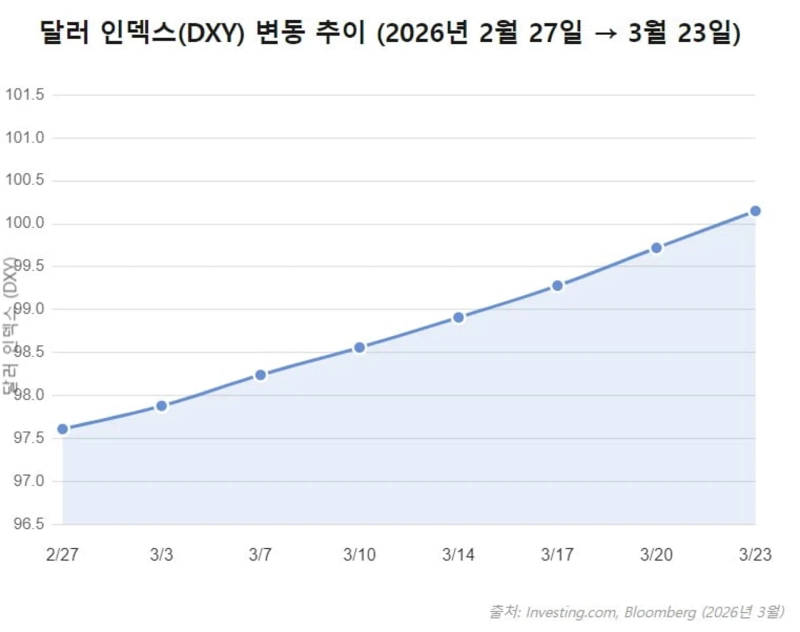
In times of global crisis, global capital tends to concentrate where liquidity is deepest and perceived safety is highest. Another factor is that the U.S., which has secured its position as the world’s largest crude producer since the shale revolution, is seen as less vulnerable to an energy shock originating in the Middle East.
Malaysian currency strength
By contrast, most Asian currencies weakened over the same period. Still, there were signs of divergence. The Malaysian ringgit (MYR)’s unusual resilience and the Japanese yen (JPY)’s decline were notable.
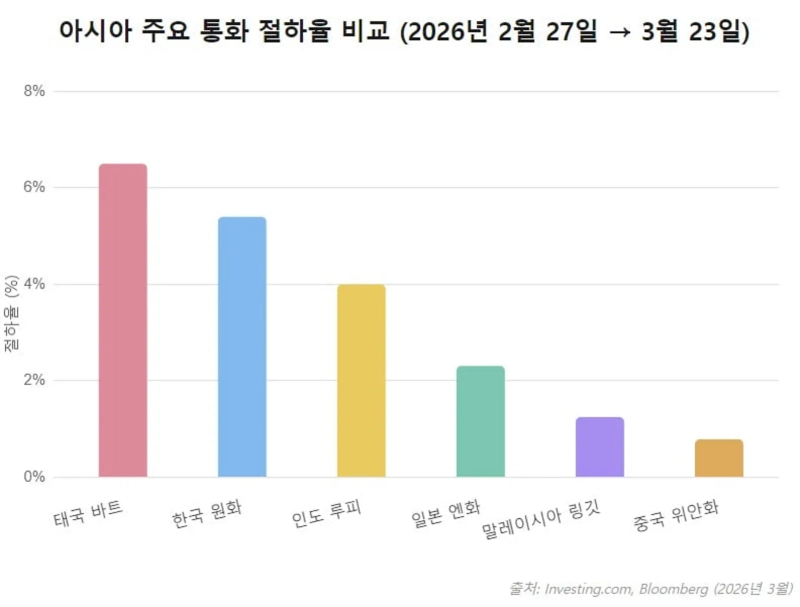
According to Investing.com, the drop in the dollar–ringgit exchange rate (i.e., the ringgit’s depreciation) from the 27th of last month to March 23 was only 1.25%. That stood in contrast to other Asian currencies such as the South Korean won and Thai baht, which plunged by about 5–6% over the same period. Analysts say this is because Malaysia is a net energy exporter, producing about 2 million barrels a day.
Capital inflows tied to advanced technology industries also bolstered the ringgit’s defenses. Global Big Tech companies such as Google, Amazon Web Services (AWS) and Microsoft have committed a combined 90.2 billion ringgit in data-center-related investment in Malaysia.
Goldman Sachs analyst Danny Suwanapruti wrote, “The ringgit will remain Asia’s strongest currency this year,” adding, “Given the blockage of the Strait of Hormuz and rising LNG prices, Malaysia is in the most advantageous position in the region.”
Meanwhile, the Japanese yen—often labeled a “safe haven” in global markets—fell. Based on Investing.com, the USD/JPY rate, which was 156.06 yen per dollar on the 27th of last month, jumped to as high as 159.66 yen intraday on the 23rd. Analysts point to Japan’s dependence on energy imports as the reason for the yen’s slide.
Japan relies on the Middle East for 95% of its crude imports, about 70% of which pass through the Strait of Hormuz. With logistics and insurance disrupted immediately after the outbreak of war, Japan’s refining and manufacturing sectors faced a double hit of procurement panic and surging costs. Japan holds substantial net foreign assets. However, when energy supplies are cut off, it must pay massive import bills in dollars.
China’s yuan ‘holds up’
Other Asian countries also could not escape currency weakness, albeit to varying degrees. India’s currency, for a nation that imports more than 80% of its oil demand, tumbled to 94.19 rupees per dollar, hitting a record low. The oil price surge stoked fears of “twin deficits,” worsening both India’s current account and fiscal balance.
According to data from India Tribune and Trading Economics, foreign portfolio investors (FPI) posted net selling of 88,180 crore rupees in India’s stock and bond markets on a monthly basis this month, underscoring capital outflows.
Thailand’s baht (USD/THB), in an economy heavily dependent on tourism, also fell 6.50% (from Feb. 27 to March 23, per Investing.com), marking the steepest drop among Asian currencies.
Jeff Ng, head of Asia macro strategy at Sumitomo Mitsui Banking Corp., said, “The conflict is likely to intensify over the coming weeks and Brent’s elevated prices will persist in the short term,” adding, “Having to absorb trade deficits translates into strong selling pressure on the currencies of Asian importing countries.”
Energy-poor economies have fallen into a classic macroeconomic dilemma: raising interest rates to defend against imported inflation slows growth, while holding rates steady to support the economy risks a plunge in the domestic currency.
By contrast, China’s yuan (CNY), backed by strong capital controls, showed unusual resilience even as the dollar strengthened. The yuan’s exchange rate against the dollar ended March 23 down a limited 0.79%.
Pan Gongsheng, governor of the People’s Bank of China, pledged to “basically keep the yuan stable and firmly reinforce expectations in the FX market.” Analysts say authorities intervened through the daily fixing to curb speculative selling.
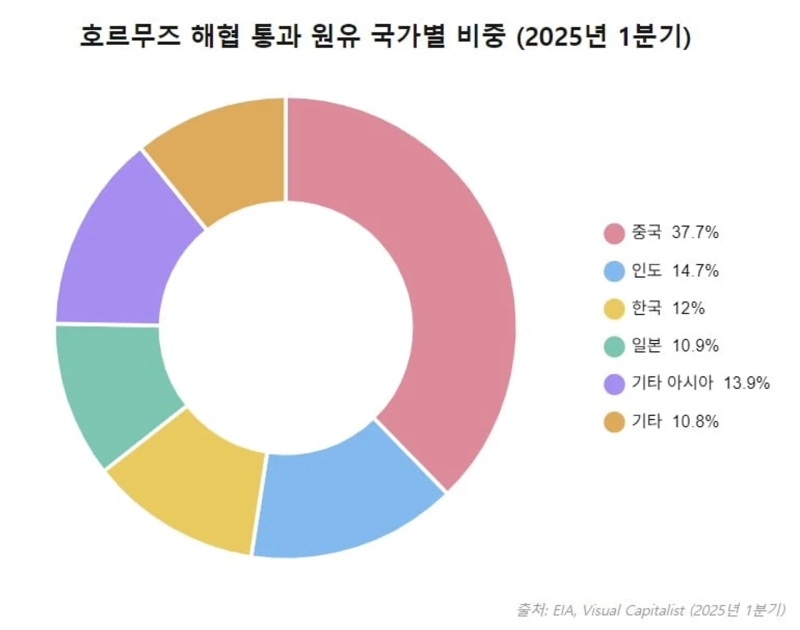
The South Korean won was also hit. According to Investing.com, the won/dollar rate, which was 1,439.80 won on the 27th of last month, surged to as high as 1,517.57 won intraday on the 23rd, marking the highest level (lowest won value) in 17 years since the aftermath of the 2009 global financial crisis. The won posted the second-largest decline among Asian currencies, after the Thai baht.
Reporter Kim Juwan kjwan@hankyung.com

Korea Economic Daily
hankyung@bloomingbit.ioThe Korea Economic Daily Global is a digital media where latest news on Korean companies, industries, and financial markets.