PiCK
Trump: "End the war within weeks"…Bitcoin remains under downside pressure despite ceasefire hopes [Kang Min-seung’s Trade Now]
Summary
- With Bitcoin trading near $70,000, its near-term upside is being capped by macro uncertainty and fears of war-driven inflation.
- On-chain and ETF indicators suggest spot demand and institutional inflows remain limited, and the market is in a deleveraging-led correction phase amid weakening conviction.
- Key variables that could shape the next trend include whether Bitcoin can break above the $72,000 resistance, hold the $67,000 support, and whether total market cap can rise above $2.5 trillion.
Forecast Trend Report by Period


As ceasefire talks between the United States and Iran fail to gain traction, geopolitical tensions persist, and fears of war-driven inflation are adding to the mix—leaving Bitcoin (BTC) with its near-term upside capped.
With macro uncertainty and mixed supply-demand conditions continuing, analysts say a cautious approach is warranted until a breakout above the $72,000 resistance zone is confirmed, rather than treating any short-term rebound as a trend reversal.
As of 18:26 on the 26th, Bitcoin is trading at $70,031 on Binance’s USDT market, down about 1.79% from the previous day (₩105.2 million on Upbit). The kimchi premium, which reflects the price gap between overseas and domestic exchanges, stands at around -0.30%.
Negotiation uncertainty persists despite Trump’s push for an “early ceasefire”…Energy and rate variables grow
Global equities and the crypto market are seeing heightened volatility as attempts at ceasefire negotiations between the United States and Iran intersect with military tensions.
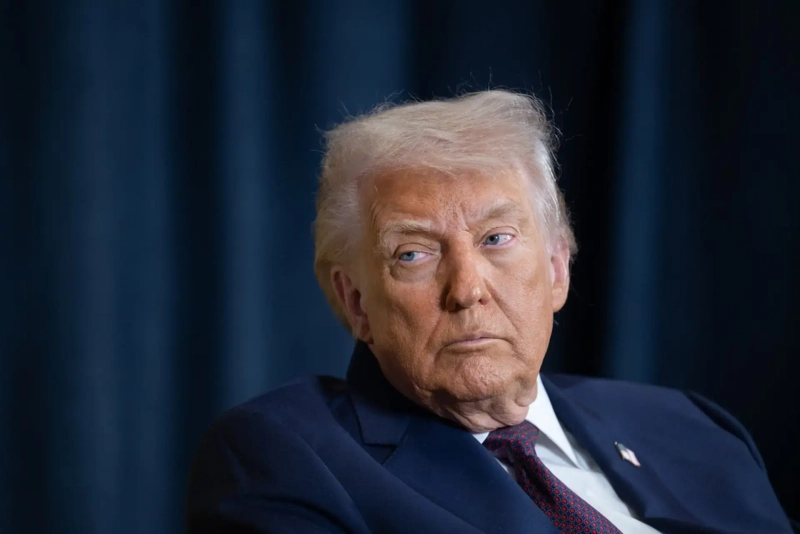
According to The Wall Street Journal (WSJ) on the 25th (local time), President Donald Trump recently instructed aides to “end the war within weeks.” This is interpreted as an effort to wrap up the conflict early ahead of a planned China visit and summit in May.
Still, progress in negotiations remains uncertain. The United States has proposed ceasefire talks, but Iran has refused direct dialogue, and the two sides remain split over the conditions for ending the war. Iran has put forward separate conditions, including compensation for war damage and control over the Strait of Hormuz.
Military tensions have not eased either. The U.S. Department of Defense recently ordered part of its elite 82nd Airborne Division to deploy to the Middle East, and the possibility of additional troop deployments has also been raised. This is seen as part of a strategy combining negotiations with military pressure. However, any broader expansion of ground-force deployments is also amplifying concerns about a prolonged war.
At the same time, Middle East-driven energy supply risks are emerging as a key macro variable. As major Iranian energy facilities came under attack, international oil prices faced near-term upward pressure, while tensions around the Strait of Hormuz continue. S&P Global said that “uncertainty from the war coupled with rising energy prices is increasing the risk of stagflation, where slower growth and rising inflation appear simultaneously.”
On the monetary-policy front, the possibility of a more hawkish stance is resurfacing. Austan Goolsbee, President of the Federal Reserve Bank of Chicago, said in a speech on the 23rd that “if inflation pressures broaden, the possibility of rate hikes cannot be ruled out.” Major global investment banks are also raising their rate forecasts to reflect the possibility of rate hikes by the European Central Bank (ECB).
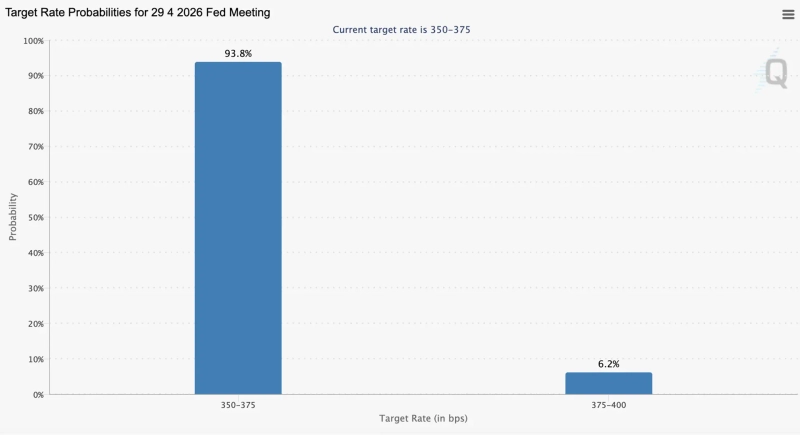
Markets are also watching for potential changes in the expected rate path. According to CME FedWatch, the probability of rates being held steady at the April FOMC meeting was priced at 93.8%, while the probability of a hike was 6.2%. The probability that the year-end policy rate reaches at least 25 bp (1 bp=0.01%) above the current level was also indicated at 31.3%.
Despite ETF inflows, limited upside momentum…On-chain: “Conviction weakening, volatility zone”
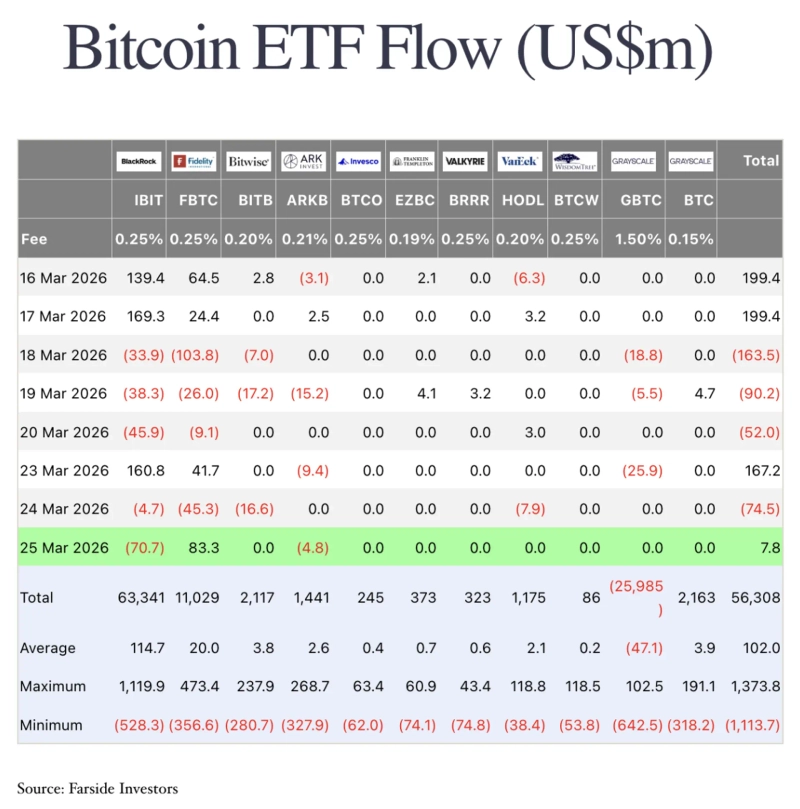
Spot Bitcoin exchange-traded funds (ETFs) saw net inflows of $93.1 million (about ₩140.2 billion) last week, marking a return to inflows, but flows have since turned mixed as inflows and outflows alternate. The slight pickup in inflows is interpreted as a sign of renewed institutional reallocation.
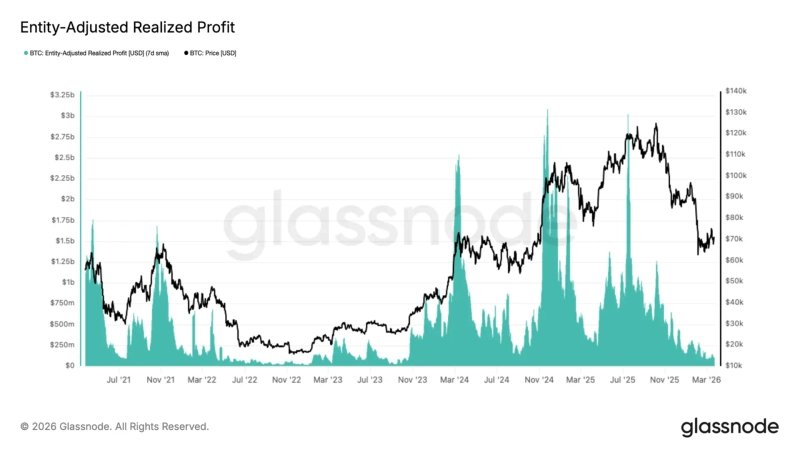
With range-bound trading continuing, Bitcoin’s upside momentum remains unclear. On-chain analytics firm Glassnode said in its weekly research report on the 25th that “even during the recent drawdown, there were no broad capitulation (capitulation·mass selling) signals across the market,” adding that “the current phase looks closer to a controlled deleveraging-driven correction than forced liquidations.”
It also noted that “stress in the futures market persists, and spot volumes have not increased meaningfully despite a recovery,” adding that “with investor conviction not strong, only selective dip-buying is flowing in on a limited basis.”
Despite the recent spike in international oil prices, Bitcoin has not shown a major shift in direction. Binance Research said that “during phases of rising oil prices, Bitcoin tends to see increased short-term volatility, but oil is not a key factor determining price direction.” It added that “in the current market, institutional flows matter more for price formation than geopolitical events themselves,” and that “external shocks such as oil-price moves can be interpreted as timing factors for short-term trades.”
The possibility of heightened near-term volatility has also been raised. Global crypto exchange Bitfinex said in its weekly report on the 25th that “Bitcoin is re-entering the lower end of the air-gap zone between $72,000 and $82,000,” adding that “this zone has relatively limited resistance due to low historical volume accumulation.” However, because accumulation in this area is thin, it can also be a zone of increased price volatility, with the possibility of a rapid shift in direction.
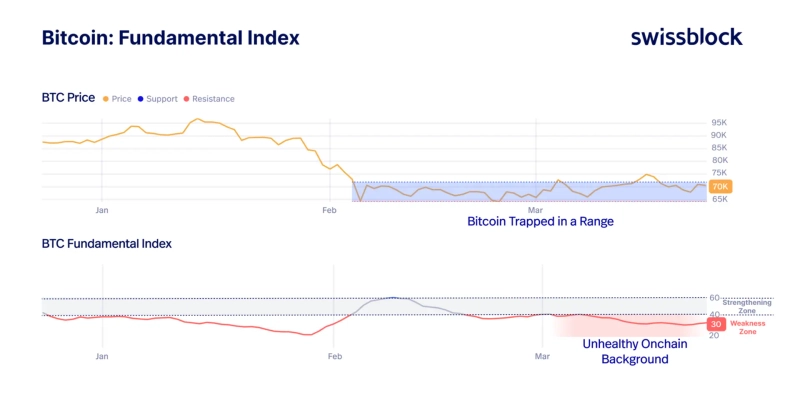
Bitfinex said that “market participants are reacting more sensitively to short-term news flow than to macro variables,” and that “price formation is being driven more by spot demand than leverage.” The interpretation is that while spot volume growth is limited, deleveraging in derivatives has left prices relatively more influenced by spot-demand dynamics.
“Bitcoin battles resistance in the $70,000 range…breakout attempts as upside burden eases”
As Bitcoin continues to fluctuate in the $70,000 range, analysts say a careful approach is needed rather than chasing, until it breaks through the $72,000 resistance zone.
In the near term, whether the $70,000 support holds is seen as critical. Ayush Jindal, an analyst at NewsBTC, said that “Bitcoin is attempting to move higher while maintaining support near $70,200,” adding that “if it breaks above the $71,650 resistance, room could open for additional gains.” He added, “However, if it fails to break through this zone, a pullback could extend to the $70,000 and $69,200 support levels, and if $67,500 breaks, the near-term recovery could weaken.”
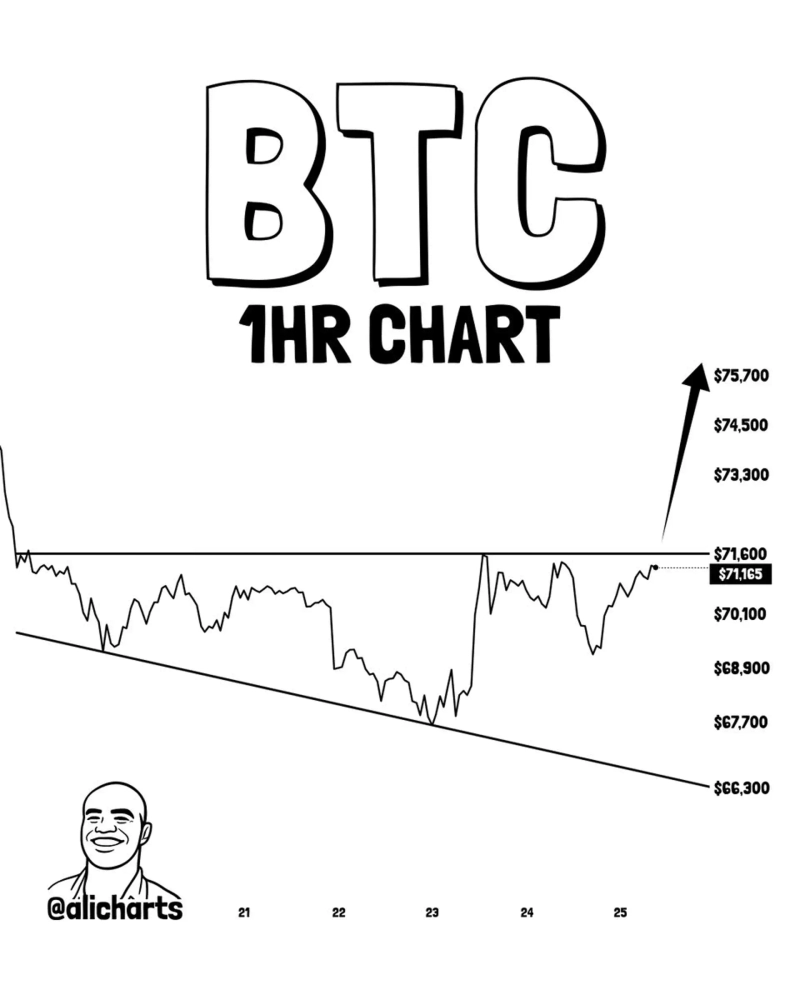
Another view is that a breakout through the $74,000–$75,000 zone is needed for a sustained uptrend. Rakesh Upadhyay, an analyst at Cointelegraph, said that “if it breaks above resistance near $74,508 and holds in that zone, the uptrend could continue,” adding that “in that case, additional upside toward $84,000 could open up.” He cautioned, however, that “if the price falls below $67,000, the attempt to rise could weaken, and downside pressure could expand toward the $62,500–$60,000 zone.”
There is also an assessment that the burden of overhead resistance is gradually easing. Alex Kuptsikevich, chief analyst at FxPro, said that “Bitcoin is attempting to break above $71,500 but has hit resistance multiple times,” adding that “with the 50-day moving average dropping toward the $70,000 area, the resistance burden has eased somewhat.” He added that “if the total crypto market capitalization exceeds $2.5 trillion, it will help gauge the market’s additional upside potential.”
Meanwhile, according to CoinMarketCap, a global crypto market data site, total crypto market capitalization stood at $2.4 trillion, down 1.9% from the previous day.
Kang Min-seung, BloombergBit reporter minriver@bloomingbit.io

Minseung Kang
minriver@bloomingbit.ioBlockchain journalist | Writer of Trade Now & Altcoin Now, must-read content for investors.