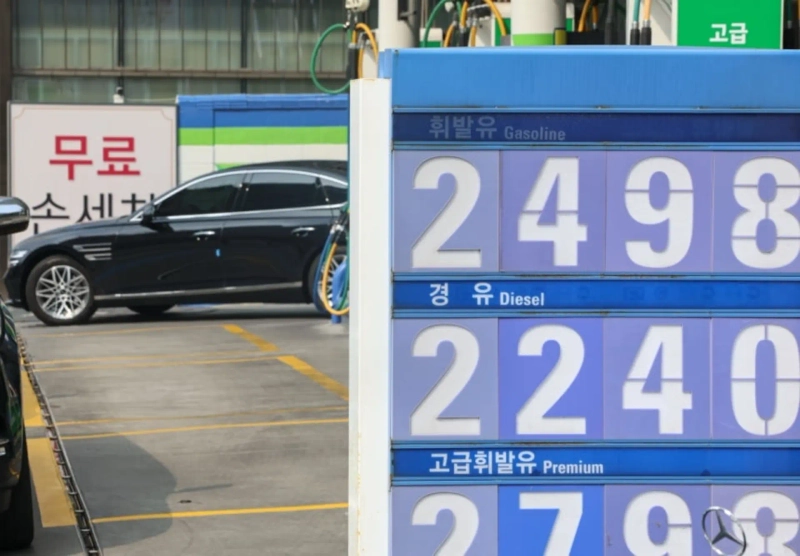
Gasoline hits '2,498 won per liter'…fuel prices soar for a second straight day
Summary
- The government has implemented a second-phase price cap system, but nationwide gasoline and diesel prices have posted double-digit gains for a second straight day.
- In Seoul, the increase was larger, with the average gasoline price at 1,896.6 won per liter and the peak price at 2,498 won.
- With international petroleum product prices and Dubai crude surging, domestic fuel prices continue to rise despite the rollout of the price cap system.
Forecast Trend Report by Period


Nationwide average gasoline: 1,855.7 won
Seoul peak price: 2,498 won
The government has begun implementing the second-phase price cap system (a ceiling on refiners’ supply prices), but fuel prices nationwide posted double-digit gains for a second consecutive day. Despite mobilizing a fuel tax cut and a cap on supply prices, the surge in international prices is being reflected, and retail prices at gas stations appear to be rising even more steeply.
According to Opinet, the Korea National Oil Corporation’s oil price information system, as of 4 p.m. on the 28th the nationwide average gasoline price stood at 1,855.7 won per liter (L), up 16.91 won from the previous day. Diesel rose 15.4 won to 1,849.96 won.
Seoul saw an even larger increase. The average gasoline price in Seoul jumped 31.02 won in a day to 1,896.6 won per liter. The highest price was tallied at 2,498 won. The average diesel price in Seoul also climbed 23.7 won from the previous day to 1,877.22 won per liter. The peak price was 2,279 won.
This second-phase price cap system works by adjusting and applying a ceiling to the price refiners supply to gas stations—namely, the wholesale price. Gas stations set the retail price for consumers by adding a margin on top.
The second-phase cap was recalculated based on the first-phase cap from two weeks earlier. It reflects the rate of increase in Singapore petroleum product prices during the period when the first-phase cap was applied, and then adds taxes and levies.
The problem is that international petroleum product prices have been rising rapidly of late. As these increases are directly feeding into domestic prices, fuel prices continue to climb despite the implementation of the price cap system.
As of the previous day, Dubai crude—Asia’s benchmark in the oil market—rose $9.1 from a day earlier to $122.14 a barrel.
Nationwide gasoline and diesel prices have climbed sharply since the Iran situation. After peaking on the 10th and then trending lower, they turned higher again on the 26th of this month, 16 days later.
Kim Dae-young, Hankyung.com reporter kdy@hankyung.com

Korea Economic Daily
hankyung@bloomingbit.ioThe Korea Economic Daily Global is a digital media where latest news on Korean companies, industries, and financial markets.