Threatening to “send the West back to the Stone Age”... another shock from the “Middle East war” [Hwang Jung-su’s Global Check-in]
Summary
- Yemen’s Houthi rebels reportedly entered the war by carrying out missile attacks on Israel.
- It said expectations are rising that a potential blockade of the Bab el-Mandeb Strait—a route through which about 12% of global seaborne crude shipments pass—could amplify the shock to global markets.
- It reported that the Houthis are also being discussed as potentially threatening to cut undersea cables in the Bab el-Mandeb Strait, raising the possibility of disruptions to global communications.
Forecast Trend Report by Period


Pro-Iran Houthi rebels enter the war
Missile strikes on Israel
Likely move to block the Bab el-Mandeb Strait
Key energy shipping lane through which 12% of the world’s crude oil passes
Possible threat to “cut undersea cables”
On the 28th (local time), with the Middle East war entering its fourth week, a major negative shock hit the global economy. Yemen’s pro-Iran Houthi rebels joined the conflict, launching missile attacks on Israel. Analysts warn that if the Houthis move to block the Bab el-Mandeb Strait—often described as a vital artery of global energy transport rivaling the Strait of Hormuz—the shock to global markets could intensify.
Houthi rebels join the war by launching missiles at Israel
According to The Wall Street Journal (WSJ) and The New York Times (NYT) on the 28th, the Iran-backed Houthi rebels announced that they had “carried out a ballistic missile attack against Israel.” Houthi spokesperson Yahya Saree said in a statement, “Operations will continue until attacks on the resistance fronts in Iran, Lebanon, Iraq, and Palestine stop.”
Israel said it had “detected and intercepted missiles launched from Yemen.” No casualties from the Houthi attack have been reported so far. The NYT described it as “another front opening in the increasingly intensified war in the Middle East.”
Rebellion in Yemen in 2004... a pro-Iran armed group

The Houthi rebels are a Shiite armed group in Yemen. Their official name is Ansar Allah. They maintain close, alliance-level ties with Iran, which presents itself as the leading Shiite power. In 2004, Shiite residents in northern Yemen rose up in rebellion, protesting corruption and inequality in the Yemeni government. One account says the name “Houthi” comes from the name of the leader at the time of the uprising, Hussein Badreddin al-Houthi.
In 2014, the Houthis seized Sana’a, Yemen’s capital, effectively toppling the government. Yemen fell into civil war. The Yemeni government, with support from the international community, has fought back against the Houthis.
The Houthis have maintained a strong presence. They are known to receive weapons and funding from Iran. The Houthis have openly displayed photos of Iran’s leader Ayatollah Ali Khamenei, who was killed in an Israeli airstrike.
Possibility of a blockade of the Bab el-Mandeb Strait, which carries 12% of crude shipments
The reason the Houthis’ entry is expected to shock the global economy is the possibility of a blockade of the Bab el-Mandeb Strait. Meaning “Gate of Tears,” the Bab el-Mandeb Strait is a strategic chokepoint linking the Red Sea and the Gulf of Aden (Indian Ocean), serving as a corridor for Saudi crude to be shipped to Asia and beyond. At its narrowest point it is 32 km wide—narrower than the 39 km-wide Strait of Hormuz.
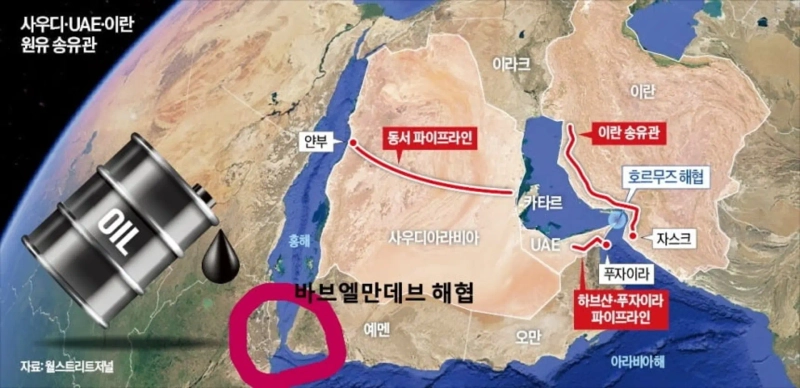
The red circle at the bottom of the figure marks the Bab el-Mandeb Strait. With the Houthis entering the war, crude shipping routes through the Bab el-Mandeb Strait also face the risk of being blocked.
Roughly 10% of global trade, about 12% of seaborne crude shipments, and substantial volumes of liquefied natural gas (LNG) pass through the Bab el-Mandeb Strait. It has mainly been used as a shipping route for Saudi crude. That is why Saudi Arabia, the leading Sunni power, closely watches Houthi moves and at times intervenes militarily.
Well aware of this, the Houthis have repeatedly moved to block the Bab el-Mandeb whenever Middle East conflicts flare. A representative example is when the Houthis moved to blockade the strait during the war between Israel and Hamas, a radical Shiite group, in December 2023. They attacked ships near the Red Sea and attempted seizures, prompting major shipping companies to suspend Red Sea routes.
On the 14th, Abed al-Thawr, a senior Houthi figure, warned, “If we decide to help Iran, a blockade of the Bab el-Mandeb Strait will be one of the top priorities,” adding, “We will stop the U.S., merchant vessels heading for the occupied territories (Israel), and warships including aircraft carriers.”
Previously threatened to “cut undersea fiber-optic cables” used by Big Tech
There is also speculation that the Houthis could issue more reckless threats depending on how the situation develops. During the Israel-Hamas war in January 2024, attention was drawn to the fact that undersea cables—often described as the lifeblood of global communications—are laid from Asia through the Bab el-Mandeb Strait. The Bab el-Mandeb Strait is known to be traversed by 16 major undersea cables backed by U.S. Big Tech companies such as Google, Microsoft, and Amazon.
If the Houthis attack in an effort to disrupt regional communications services, it could trigger widespread chaos, including the inability to conduct internet searches. In January 2024, although the claim was not definitively verified, reports said that Houthi leaders had talked about “cutting Red Sea undersea cables.” At the time, posts spread rapidly across social media worldwide claiming that a Houthi leader said the group could “send the West back to the Stone Age.”
Reporter Hwang Jung-su hjs@hankyung.com

Korea Economic Daily
hankyung@bloomingbit.ioThe Korea Economic Daily Global is a digital media where latest news on Korean companies, industries, and financial markets.