PiCK
[New York Stock Market Briefing] Mixed close amid negotiation uncertainty… Micron -10% on 'Turbo Quant shock'
Summary
- U.S. stocks closed mixed as uncertainty over negotiations between the United States and Iran weighed on major indexes.
- Jerome Powell ruled out the possibility of a policy-rate hike, easing expectations for a Fed rate hike this year.
- On concerns over Google’s Turbo Quant, the Philadelphia Semiconductor Index plunged 4.23% and Micron Technology slid 10%, while Alcoa jumped 8% as aluminum prices rose in the wake of Iran’s attacks.
Forecast Trend Report by Period


U.S. stocks ended mixed as uncertainty over negotiations between the United States and Iran weighed on sentiment.
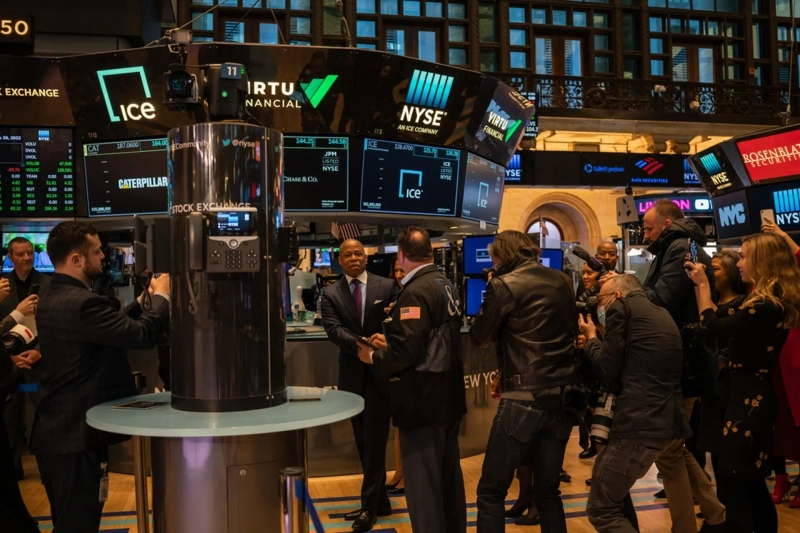
On the 30th (U.S. local time), at the New York Stock Exchange, the Dow Jones Industrial Average rose 49.50 points (0.11%) from the previous session to close at 45,216.14.
The Standard & Poor’s (S&P) 500 fell 25.13 points (0.39%) to 6,343.72, and the Nasdaq Composite slid 153.72 points (0.73%) to finish at 20,794.64.
Markets struggled to find direction as expectations for a ceasefire deal and fears of escalation surfaced at the same time.
U.S. President Donald Trump said earlier in the day that significant progress had been made in talks on a new Iranian regime and a ceasefire.
However, he delivered wavering remarks, saying that if an agreement is not concluded soon for any reason, or if the Strait of Hormuz is not reopened immediately, the U.S. would bomb Iran’s power plants, oil fields and Kharg Island, and could even strike desalination facilities.
The arrival of U.S. ground forces in the Middle East heightened concerns about escalation. CBS reported that several hundred Navy and Army special-operations troops were recently deployed to the region, and are expected to be tasked with missions such as securing Iran’s enriched uranium and landing on Kharg Island.
Federal Reserve Chair Jerome Powell drew a line at raising the policy rate.
In a lecture hosted by Harvard University in Cambridge, Massachusetts, he said, "Energy price shocks tend to occur and fade quickly, whereas monetary policy works with long and variable lags," adding, "By the time policy takes effect, the shock is likely to have already dissipated."
He also said, "In that case, you end up restraining the economy at an inappropriate time," adding that "the Fed generally tends to look through supply shocks of any kind."
The market read Powell’s remarks as signaling that a spike in oil prices should not be taken as a foregone conclusion for higher inflation. As a result, expectations that the Fed would move to raise rates this year eased somewhat.
By sector, the Philadelphia Semiconductor Index, which tracks artificial intelligence (AI) and semiconductor-related shares, plunged 4.23%. All 30 constituents fell, while Micron Technology tumbled 10%. The decline was seen as driven by concerns that Google’s 'Turbo Quant' technology could negatively affect memory chipmakers. TSMC, ASML, AMD and Intel also fell by around 3%.
Aluminum producer Alcoa jumped 8%. Aluminum prices rose after Iran attacked major aluminum production facilities in the Middle East.

Korea Economic Daily
hankyung@bloomingbit.ioThe Korea Economic Daily Global is a digital media where latest news on Korean companies, industries, and financial markets.