On a Day the KOSPI Fell 4%, Global Investment Banks Raised Target Prices for ‘Samsung-Hynix’
Summary
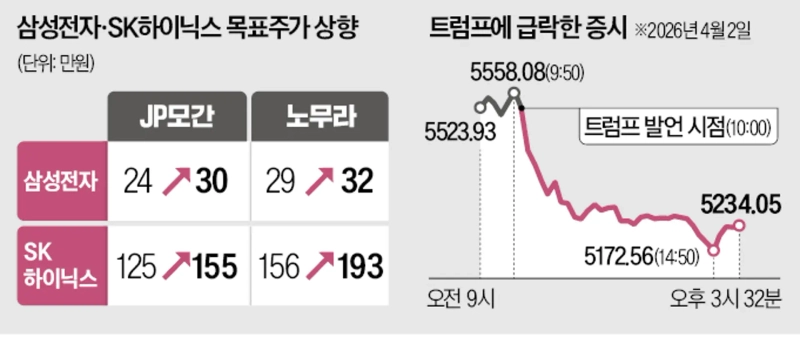
- JPMorgan said it raised Samsung Electronics’ target price from 240,000 won to 300,000 won, and SK Hynix from 1.25 million won to 1.55 million won.
- It added that Nomura Securities and Morgan Stanley also lifted target prices for Samsung Electronics and SK Hynix and recommended buying semiconductor stocks.
- JPMorgan and Morgan Stanley said Korean equities have entered an oversold and rebound phase, adding that investors should take a 1–3 month horizon.
Forecast Trend Report by Period


Global IBs Re-rate Korean Equities
JPMorgan: “Korean stocks correcting on overbought conditions”
Samsung target raised to 300,000 won
SK Hynix also lifted to 1.55 million won
Morgan Stanley reiterates buy on semiconductors
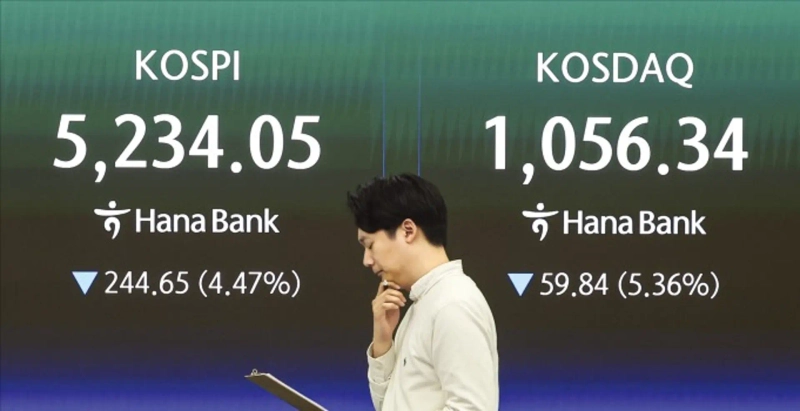
KOSPI and KOSDAQ tumbled in tandem as expectations that the war between the United States and Iran would soon end were dashed. Just a day after both surged more than 8% on intensified hopes of a ceasefire, markets saw a sharp reversal.
Stocks plunge after Trump’s address
On the 2nd, the KOSPI closed at 5,234.05, down 4.47% from the previous day. After gaining 8.44% a day earlier, the index opened up 1.33% before turning sharply lower around 10 a.m. as U.S. President Donald Trump delivered a national address. Instead of the ceasefire declaration the market had anticipated, Trump said he would deliver an “extremely powerful strike,” stoking fears the conflict could drag on. The KOSDAQ ended down 5.36% at 1,056.34. Selling sidecars (temporary halts on program sell orders) were triggered in both the main board and the KOSDAQ markets later in the day.
Samsung Electronics, which had jumped 13.40% the previous day—its biggest gain since a stock split—fell 5.91%, sliding back to the “170,000-won Samsung” level. SK Hynix dropped 7.05%, and Hyundai Motor fell 4.61%. Lee Kyung-min, a researcher at Daishin Securities, said, “The market interpreted President Trump’s remarks as a reconfirmation of a hardline stance toward Iran and a willingness to continue the war,” adding that “risk appetite for risky assets weakened amid uncertainty.”
Global IBs raise price targets for major Korean companies
Even as KOSPI and KOSDAQ have fallen sharply in the wake of the war, global investment banks (IBs) are instead lifting their price targets for major Korean companies such as Samsung Electronics and SK Hynix.
In a report titled “From Overbought to Oversold” released on the 1st (local time), JPMorgan raised its target price for Samsung Electronics to 300,000 won from 240,000 won. JPMorgan said, “Samsung has entered a phase of restoring technological leadership, supported by OpenAI-related orders in the HBM (high-bandwidth memory) and foundry segments.”
For SK Hynix, the bank projected that “the upcycle will continue through 2028 as beneficiaries of the DRAM and NAND markets,” lifting its target to 1.55 million won from 1.25 million won.
Late last month, Nomura Securities also raised its target for Samsung Electronics to 320,000 won from 290,000 won, and for SK Hynix to 1.93 million won from 1.56 million won. Morgan Stanley said “the outlook for DRAM, NAND and HDD (hard disk drive) is positive,” recommending buying semiconductor stocks.
Regarding the KOSPI’s 19.1% slide since March, JPMorgan pointed to the roughly 50% surge in the index during the first two months of the year. In other words, the market had remained in an “overbought” rally, then took a severe war-driven correction and flipped abruptly into “oversold” territory.
Morgan Stanley said, “The Korean market has passed through a major storm in the form of Middle East risk and has entered a rebound phase,” adding, “Industrials with tailwinds from higher oil prices and momentum around energy security will lead the market’s recovery.”
Lee Kyung-soo, a researcher at Hana Securities, said, “In the month since the outbreak of the war, there have been six days when the KOSPI fell more than 4%,” adding, “Given that rebounds tended to be large when sharp drops occurred frequently in the past, investors need to take a 1–3 month view.”
Kim Yong-beom, senior secretary for policy at the Blue House, also noted the stock market’s resilience in a Facebook post that day. “Korea’s economic fundamentals are solid,” he wrote, adding that “indexes distorted by external factors are highly likely to converge toward fundamentals.” He added, “If stock-market-driven distortions in supply and demand normalize, the exchange rate also has ample room to revert to its previous band.” In the Seoul FX market, the won-dollar exchange rate (as of 3:30 p.m.) ended daytime trading at 1,519.7 won per dollar, up 18.4 won from the previous day. After dropping nearly 30 won a day earlier, it retraced more than half of that move.
Kang Jin-gyu/Lee Seon-ah, reporters josep@hankyung.com

Korea Economic Daily
hankyung@bloomingbit.ioThe Korea Economic Daily Global is a digital media where latest news on Korean companies, industries, and financial markets.